Showing posts with label austerity measures. Show all posts

August 24, 2012

Germany and France Turn Screw on Greece over Austerity Plans

THE GUARDIAN: Greek PM Antonis Samaras to be told to stick to hardline reforms to stay in eurozone as Berlin rejects plea for more time

Germany and France have ratcheted up the pressure on the Greek government by insisting that Athens stick to its hardline austerity plans in order to remain a member of the eurozone.

Before meetings with the German chancellor, Angela Merkel, in Berlin on Friday and the French president, François Hollande, in Paris on Saturday, the Greek prime minister, Antonis Samaras, was given little hope that the two biggest EU economies were prepared to soften their approach.

Hollande, speaking at a meeting with Merkel in Berlin on Thursday night, said he wanted Greece to remain in the single currency but that the recession-stricken country had to carry out the reforms it had promised.

Wolfgang Schäuble, Germany's finance minister, flatly rejected Samaras's plea that Greece be given two extra years to put its finances back on track.

A decision on whether Athens should be allowed more time will be taken next month by the "troika" – the European Central Bank, the EU and the International Monetary Fund – but Schäuble said it was only six months ago that a second package of help had been provided.

"You cannot just say after half a year, all of that is not enough, because then you will never win the confidence of financial markets," he said on Germany's SWR radio. » | Larry Elliott, economics editor | Thursday, August 23, 2012

July 23, 2012

Spanish Protest Taxes and Cuts in Public Sector Wages

Taking their anger to the street, this demonstration in Madrid by Spanish government workers comes a day after tens of thousands protested across the country. The message to Prime Minister Mariano Rajoy is 'You're cutting too far and too fast'. Plans to introduce new taxes and cut public sector wages are part of a drive to slash the budget deficit. Al Jazeera's Nadim Baba reports

July 11, 2012

Spain Piles On Austerity Measures

THE WALL STREET JOURNAL: MADRID—Spanish Prime Minister Mariano Rajoy announced new austerity measures Wednesday that should help Madrid cut its budget deficit by €65 billion ($80 billion) through to 2015, and warned the euro-zone's fourth-largest economy may not grow at all next year.

In an impassioned address to parliament, Mr. Rajoy called on all Spaniards to back the measures, which include a value-added tax hike to 21% from 18% and cuts to jobless benefits and public sector wages, saying Spain's economic situation is "extraordinarily serious."

The measures were swiftly welcomed by the European Commission, the executive branch of the European Union. But analysts said the moves would hurt Spain's recovery from recession and may not save the country from needing a full-fledged financial bailout on top of a plan to support its struggling banks with up to €100 billion in EU loans.

As Mr. Rajoy spoke during a six-hour parliament debate on austerity, hundreds of coal miners and their supporters rallied in Spain's capital against government plans to end subsidies for their sector. Some protesters threw rocks and firecrackers at police, the latest sign of growing social unrest in a country mired in an unprecedented, five-year-long crisis. » | Davíd Roman and Nicholas Winning, with contributions from Ilan Brat and Dan Strumpf | Wednesday, July 11, 2012

June 17, 2012

Italians Vent Anger at Austerity Measures

Thousands of demonstrators in Rome have taken to the streets of the Italian capital to protest against the country's latest austerity measures. Many Italians fear that the government's spending cuts will harm worker rights and pensions. The protest came as Mario Monti, the prime minister, said the country was flirting with economic disaster. Al Jazeera's Claudio Lavanga reports from Rome.

June 11, 2012

Greek Anger as Spain Is Handed [€]100bn Bailout with No Need for Austerity Measures... and World Markets Bounce Back

MAIL ONLINE: Greek party Syriza: 'Deal shows Europe abandoning policy of austerity' / Agreement in stark contrast to deal agreed with Greeks two years ago / Spain only told to restructure its troubled banking sector / Will not be subjected to inspections by troika or strict supervision / FTSE-100 up 1.52%; CAC 40 up 2.17%; DAX up 2.18%

Angry Greeks are demanding better terms on their country's bailout after Spain was handed what they see as a 'no-strings attached' €100billion cash boost.

Far-left party Syriza, which could win the re-run of the Greek elections on Sunday, said the Spanish deal 'showed Europe was abandoning its policy of austerity'.

The agreement, they said, was in stark contrast to the deal hammered out with the Greeks two years ago.

That saw the nation hit with strict rules including tight supervision and submitting to regular inspections by the troika of the European Commission, the European Central Bank and the International Monetary Fund.

Spain has only been told to restructure its trouble financial sector - currently lumbered with billions of euros worth of bad loans by the bursting of the Spanish property bubble.

Party leader Alexis Tsipras, Greece's possible next Prime Minister, told Avgi newspaper: 'Developments in Spain have confirmed the position we have supported from the start.

'Namely, that the crisis is a Europe-wide problem and that the way it has been dealt with so far is socially destructive and completely ineffective.

'Two years ago the crisis was related to the supposed laziness and unproductiveness of the Greeks.

'After two years of failure of the bailout memorandum, there is a dramatic increase in the voices calling for a policy change so as not to crash the whole European economy.'

Greek politicians have also said that the Spanish deal will give them room to renegotiate their deal to include less austerity measures. Read on and comment » | Daily Mail Reporter | Monday, June 11, 2012

May 17, 2012

Poor at Risk as US State Mulls Austerity

Jerry Brown, Califronia's governor, has called on state assembly members to adopt austerity measures and urged citizens to approve tax increases in a speech outlining a revised budget. Brown proposed on Monday $8.3bn in spending cuts for education, health care and welfare programmes in a plan aimed at combating the state's severe budget deficit amounting to $15.7b. But critics say the plan will hurt the poor the most. Al Jazeera's Rob Reynolds reports from Los Angeles.

April 05, 2012

Austerity Suicide: Greek Pensioner Shoots Himself in Athens

THE DAILY TELEGRAPH: A cash-strapped Greek pensioner who said he feared having to “scrounge for food” shot himself dead in Athens’ main square in the latest in a series of suicides and attempted suicides triggered by European austerity measures.

The death of the 77-year-old retired pharmacist in the Greek capital's Constitution Square caused an outpouring of anger and grief and came after similar incidents in Italy.

The pensioner, named locally as Dimitris Christoulas, shot himself with a handgun a few hundred yards from the Greek parliament, which has been the focus of numerous violent protests against tough austerity measures in recent months.

Witnesses said he put a gun to his head and pulled the trigger after yelling: “I have debts, I can’t stand this anymore.”

A passer-by told Greek television the man said: “I don’t want to leave my debts to my children.”

A suicide note found in his coat pocket blamed politicians and the country’s acute financial crisis for driving him to take his life, police said.

The government had “annihilated any hope for my survival and I could not get any justice. I cannot find any other form of struggle except a dignified end before I have to start scrounging for food from rubbish bins,” the note said. » | Paul Anast, Athens and Nick Squires | Wednesday, April 04, 2012

March 31, 2012

Spain's Unemployed Speak Out on Budget Cuts

Al Jazeera's Barnaby Phillips speaks to two of the country's approximately five million unemployed about what they think of the latest round of cuts.


Related video »
Spain Unveils Deep Budget Cuts

Spain's government has announced $36 billion of tax rises and spending cuts as it tries to avoid a bailout.

March 22, 2012

Portuguese to Strike over Austerity Measures

Portugal is preparing for a general strike, as trade unions try to rally opposition to the government's austerity measures. The Portuguese economy is mired deep in recession, as many economists predict it will follow Greece and have to ask European partners for a second emergency bailout. A group of activists have made a protest video, in which they say the government's austerity measures are threatening the social gains of the past 35 years. Al Jazeera's Barnaby Phillips reports from Lisbon.

February 10, 2012

Greece Austerity Deal Hits People Hard

Greece's political leaders have finally reached an agreement on further austerity cuts in order to get a second bailout package worth $170bn from EU and IMF to avoid a looming bankruptcy. EU finance ministers have been meeting in Brussels to discuss the details of the deal, while in Athens thousands of people have been gathering outside parliament against the deal. The deal includes cuts to pensions worth hundreds of millions of dollars, reduction of private-sector wages and termination of 150,000 public sector jobs by 2015. Greek unions have planned a 48-hour strike which is due to begin on Friday. Al Jazeera's John Psaropoulos reports from Athens.


January 30, 2012

The Austerity Debacle

THE NEW YORK TIMES: Last week the National Institute of Economic and Social Research, a British think tank, released a startling chart comparing the current slump with past recessions and recoveries. It turns out that by one important measure — changes in real G.D.P. since the recession began — Britain is doing worse this time than it did during the Great Depression. Four years into the Depression, British G.D.P. had regained its previous peak; four years after the Great Recession began, Britain is nowhere close to regaining its lost ground.

Nor is Britain unique. Italy is also doing worse than it did in the 1930s — and with Spain clearly headed for a double-dip recession, that makes three of Europe’s big five economies members of the worse-than club. Yes, there are some caveats and complications. But this nonetheless represents a stunning failure of policy.

And it’s a failure, in particular, of the austerity doctrine that has dominated elite policy discussion both in Europe and, to a large extent, in the United States for the past two years.

O.K., about those caveats: On one side, British unemployment was much higher in the 1930s than it is now, because the British economy was depressed — mainly thanks to an ill-advised return to the gold standard — even before the Depression struck. On the other side, Britain had a notably mild Depression compared with the United States.

Even so, surpassing the track record of the 1930s shouldn’t be a tough challenge. Haven’t we learned a lot about economic management over the last 80 years? Yes, we have — but in Britain and elsewhere, the policy elite decided to throw that hard-won knowledge out the window, and rely on ideologically convenient wishful thinking instead. » | Paul Krugman | Sunday, January 29, 2012

January 17, 2012

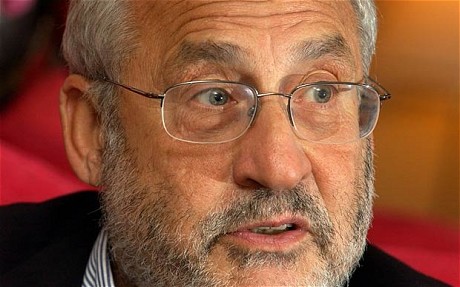
Stiglitz Says European Austerity Plans Are a 'Suicide Pact'

THE DAILY TELEGRAPH: European governments have signed a "suicide pact" by imposing fiscal austerity plans that will collapse their economies, Joseph Stiglitz, the liberal economist, has warned.

Imposing austerity measures as countries slow towards recession is a fundamentally flawed response, said Mr Stiglitz, who won the Nobel prize in 2001 for his work on how markets work inefficiently.

"The answer, even though they see over and over again that austerity leads to collapse of the economy, the answer over and over [from politicians] is more austerity," said Mr Stiglitz to the Asian Financial Forum, a gathering of over 2,000 finance professionals, businessmen and government officials in Hong Kong.

"It reminds me of medieval medicine," he said. "It is like blood-letting, where you took blood out of a patient because the theory was that there were bad humours.

"And very often, when you took the blood out, the patient got sicker. The response then was more blood-letting until the patient very nearly died. What is happening in Europe is a mutual suicide pact," he said.

Keynesian economics, which require governments to help sustain demand, suggests that austerity measures should be imposed when an economy is booming, not waning.

Mr Stiglitz pointed out that 700,000 public sector jobs had been cut in the United States in the past four years, removing demand from the system as unemployment spikes. The UK is set to lose a similar number by 2017. Read on and comment » | Malcolm Moore, in Hong Kong | Tuesday, January 17, 2012

June 28, 2011

Greek Police Fire Tear Gas on Protesters

THE DAILY TELEGRAPH: Greek police fired tear gas at demonstrators in central Athens at the start of a 48-hour strike to protest austerity measures demanded by international lenders as the price for more financial aid.


As Greece teeters on the edge of bankruptcy, parliament is due to vote this week on a package of spending cuts, tax increases and privatisations agreed as part of a massive bail-out aimed at averting the euro zone's first default.

Following weeks of protests and rolling strikes, ADEDY, the public sector union representing half a million civil servants, and GSEE, which represents 2 million private sector workers, are stepping up pressure on deputies before the votes.

As thousands rallied in Syntagma square near the parliament, hundreds of hooded youths threw stones and bottles at police who responded with tear gas as the initially peaceful mood turned violent. A street umbrella was set fire outside a record-and-book store sending black smoke spiralling into the air above Syntagma Square near the parliament.

The protesters had marched through the capital chanting slogans, banging drums and carrying banners attacking the bail-out deal which many Greeks feel imposes harsh and unjust penalties on ordinary pensioners and workers while sparing the wealthy.

Transport and public services were hit, schools were shut and many shops and businesses were closed, while the streets of central Athens were virtually deserted. » | Tuesday, June 28, 2011

Verbunden »

June 23, 2011

People & Power: The Indignant

Demonstrations, marches, rallies. For months now hundreds of thousands of Europeans have been expressing their anger at government imposed austerity measures. So what is driving them? And what do they hope to achieve?

May 11, 2011

Greek Anger Over Austerity Measures

Auditors from the International Monetary Fund and the European Union have arrived in Greece to assess the country's economic situation after last year's bailout.

Greece owes $155bn and paying all that money back has meant tough austerity measures and public protests.

Al Jazeera's Paul Brennan reports from the capital, Athens.


May 03, 2011

Unions Warn of 'Massive' Protests over Government Cuts

THE DAILY TELEGRAPH: Trade union leaders have warned of industrial turmoil on a "massive scale" as workers protest at government cuts.

A series of annual conferences are due to be held over coming weeks, with activists expected to vent their anger at the Coalition's austerity measures.

Dave Prentis, the general secretary of Unison, the public service trade union, said: "After the double bank holiday, feel-good factor wears off, the reality of austerity Britain will kick back in.

"Unless this Government changes direction, it is heading for industrial turmoil on a massive scale.

"The Government must understand that Unison will fight tooth and nail to protect and defend public services, and will ballot one million of its members to strike to protect their pensions.

"This will not be a token skirmish, but a prolonged and sustained war, because this Government has declared war on a huge proportion of the population." » | Rosa Prince, Political Correspondent | Monday, May 02, 2011

April 12, 2011

Witness - Greece: Protesting the Protesters

This unusual take on the Greek protests centres on a small group of 'anti-activists' who think the austerity measures undertaken by the government are in fact a good thing for the crisis-ridden Greek economy. We follow Fotis and his friends in their Liberal Party as they mount their own campaign, while around them the masses gather on the streets for the huge protests that regularly rock the capital.