Showing posts with label Chinese Yuan. Show all posts

March 17, 2026

Iran Challenges US Dollar, Demanding Oil Be Sold in Chinese Yuan, as It Targets US Corporations

Mar 17, 2026 | In response to the US-Israeli war, Iran shut down the Strait of Hormuz, the most important oil chokepoint on Earth, causing energy prices to skyrocket.

However, Tehran is allowing Chinese tankers through, and says other ships can pass if they agree to sell oil in China's currency, the renminbi (aka yuan).

Iran is also targeting offices of major American corporations, and wants to force them out of the Middle East (West Asia), while trying to expel US military bases.

Ben Norton explains how this war affects the petrodollar system, and the dominance of the dollar as the global reserve currency.


INVESTOPEDIA: Yuan vs. Renminbi: What’s the Difference? »

March 03, 2011

Ausweitung der Yuan-Menge: China attackiert den Dollar

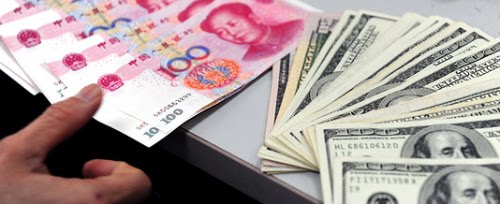
Dollar- und Yuan-Noten: Drohende Dollar-Dämmerung. Bild: Spiegel Online

SPIEGEL ONLINE: Die chinesische Notenbank überrascht mit einer spektakulären Ankündigung: Die angehende Supermacht will ihren kompletten Außenhandel künftig in Yuan abwickeln, nicht mehr in Dollar. Peking rüttelt an Amerikas Anspruch, die Leitwährung zu stellen - mit gravierenden Folgen für die USA.

Berlin - Es ist unscheinbare Ankündigung, doch sie hat das Potential, das Machtgefüge auf dem Weltwährungsmarkt nachhaltig zu verändern: China stärkt die internationale Rolle des Yuan. Alle Exporteure und Importeure sollen noch in diesem Jahr die Geschäfte mit ihren ausländischen Partnern in Yuan abrechnen können, teilte die Zentralbank am Mittwoch in Peking mit.

Damit werde auf die wachsende Bedeutung des Yuan als weltweite Reservewährung reagiert. "Die Marktnachfrage nach einer grenzüberschreitenden Verwendung des Yuan steigt", erklärte die Zentralbank. Testweise wurde bereits im vergangenen Jahr 67.000 Unternehmen in 20 Provinzen erlaubt, ihre Auslandsgeschäfte in Yuan abzuwickeln. Das Handelsvolumen belief sich auf umgerechnet rund 56 Milliarden Euro.

Jetzt soll die Yuan-Menge ausgeweitet werden, es sollen deutlich mehr Geschäfte in der chinesischen Währung abgewickelt werden - und weniger in der amerikanischen. Chinesische Unternehmen handeln zurzeit oft in Dollar, sie sind dadurch abhängig von den Entscheidungen der US-Notenbank Fed, zahlen bei einem steigenden Ölpreis drauf und müssen höhere Transaktionsgebühren als nötig berappen. Das soll sich jetzt ändern.

Langfristig will die Volksrepublik sogar noch weiter gehen. Sie will den streng reglementierten Yuan schrittweise in eine frei konvertierbare Weltwährung aufbauen. >>> ssu/AFP/Reuters | Mittwoch, 02. M¨rz 2011

Diskutieren Sie über diesen Artikel >>>

January 12, 2011

New Move to Make Yuan a Global Currency

A Chinese clerk counts yuan next to U.S. dollars. Photograph: The Wall Street Journal

THE WALL STREET JOURNAL: China has launched trading in its currency in the U.S. for the first time, an explicit endorsement by Beijing of the fast-growing market in the yuan and a significant step in the country's plan to foster global trading in its currency.

The state-controlled Bank of China Ltd. is allowing customers to trade the yuan, also known as the renminbi, in the U.S., expanding the nascent offshore market for the currency which began last year in Hong Kong.

The decision is the latest move by China to allow the yuan, whose value is still tightly controlled by the government, to become an international currency that can be used for trade and investment.

"We're preparing for the day when renminbi becomes fully convertible," Li Xiaojing, general manager of Bank of China's New York branch, told The Wall Street Journal. He said the bank's goal is to become "the renminbi clearing center in America." >>> Lingling Wei | Wednesday, January 12, 2011

June 21, 2010

Chinese Central Bank Set to Allow Yuan to Rise

Photobucket
A bank clerk stacks up renminbi banknotes. Photo: The Times

THE TIMES: China signalled on Saturday it was ready to allow its currency to resume its rise, ending a 23-month-long peg to the US dollar and stifling critics who claim the country’s exports have benefited from the state-engineered weakness of the renminbi.

In a carefully worded statement, deliberately issued on a weekend evening when global markets were closed, the People’s Bank of China indicated that it was ready to allow its currency to resume its natural rise.

It said: “The global economy is gradually recovering. The recovery and upturn of the Chinese economy has become more solid with enhanced economic stability.”

The typically opaque statement, released just days before the G20 summit in Canada, continued: “It is desirable to proceed further with reform of renminbi exchange rate regime and increase the renminbi exchange rate flexibility.”

Among the most remarkable aspects of the statement was its lack of detail. China is anxious to avoid being seen as bowing to pressure from the United States, especially as members of Congress have heightened their criticism of what they say is Beijing’s manipulation of its currency. >>> Jane Macartney, Beijing | Saturday, June 19, 2010

May 31, 2010

Beijing in a Sweat as China's Economy Overheats

THE SUNDAY TELEGRAPH: China is struggling to contain the threat of an overheating economy in the face of rising house prices, inflationary wage increases and a continuing surge in money supply, the head of the country’s second-largest bank has warned.

Guo Shuqing, chairman of China Construction Bank, said that the latest figures for China’s M1 money supply – a key predictor of inflation – had raised concerns that the country’s vast stimulus and bank-lending was running too hot.

“I saw the figures for last month and M1 is still very high, increasing 31pc from last year, which is one per cent higher than last month,” he said in an interview with The Daily Telegraph.

“We are seeing a lot of money coming to China which is creating a current and capital account surpluses.”

China’s regulators have introduced a raft of measures in recent weeks in an attempt to cool down the economy, forcing banks to raise the capital adequacy ratios and hitting second home buyers with regulation designed to drive speculators out of the property market.

However, Mr Guo warned that the effectiveness of measures to cool house prices, which have risen by up to 40pc this year in some major cities, could be blunted by the massive reserves of cash still being held by private developers. “Sales are falling but prices are not,” he said. “Developers have a lot of cash, so they’re not too concerned at the moment.”

“Property prices are definitely seeing something of a bubble, but it differs from city to city. You can see prices going very high on the coastline, but in the inland areas and western areas, even in provincial capitals, it’s still not so high.” >>> Peter Foster and Adrian Michaels in Beijing | Sunday, May 30, 2010

May 26, 2009

China’s Yuan: The Next Reserve Currency?

SPIEGELONLINE INTERNATIONAL: Skeptics have dismissed Beijing's talk of de-emphasizing the US dollar, but China is making moves that could soon lead to a convertible yuan.

Are the Chinese finally getting serious about loosening their ties to the dollar -- and even replacing the greenback with the yuan as the global economy's reserve currency? The evidence is mounting that they are.

For the last two months, China's leadership has been complaining about the country's dangerous dependence on the dollar.. Beijing holds $2 trillion (€1.43 trillion) in dollar assets, accumulated through years of exports to America and massive purchases of Treasuries by the Chinese government. If Washington can't rein in its mounting budget deficit, both Treasuries and the greenback could weaken considerably -- and the Chinese could be big losers as a result.

The Chinese began generating attention on the issue in March, when Chinese Premier Wen Jiabao said he was worried that the country's dollar assets could slide. Ten days later Chinese central bank chief Zhou Xiaochuan suggested replacing the dollar as the international reserve currency. One idea, Zhou said, was to replace the dollar with a basket of currencies supervised by the International Monetary Fund. >>> © SPIEGEL ONLINE 2009 | Tuesday, May 26, 2009

LeVine is a correspondent in BusinessWeek's Washington bureau.