Aber Washington ist keine gewöhnliche Stadt, sondern durchgeplant bis ins Detail: Sichtachsen, Monumente und Freiflächen erzählen die politische Geschichte der USA. Genau deshalb sind Trumps Bauprojekte so umstritten – sie stören dieses Gleichgewicht. Wir zeigen anhand mehrerer Beispiele, wie Trump Washington gerade verändert und warum es dabei um mehr geht als persönlichen Geschmack.
Showing posts with label Washington. Show all posts
Showing posts with label Washington. Show all posts
July 03, 2026
USA: Donald Trump baut Washington um
ul 2, 2026 | Donald Trump will die Hauptstadt Washington umbauen. Er hat bereits das Oval Office nach seinem Geschmack umgestaltet – mit Gold, Ornamenten und Porträts. Jetzt lässt er direkt gegenüber einen Ballsaal für 600 Millionen Dollar bauen, plant einen 76 Meter hohen Triumphbogen am Potomac River und schreibt per Dekret Klassizismus als Pflicht-Baustil für Bundesgebäude vor. Und das alles in dem Jahr, in dem die USA ihren 250. Geburtstag feiern.
Aber Washington ist keine gewöhnliche Stadt, sondern durchgeplant bis ins Detail: Sichtachsen, Monumente und Freiflächen erzählen die politische Geschichte der USA. Genau deshalb sind Trumps Bauprojekte so umstritten – sie stören dieses Gleichgewicht. Wir zeigen anhand mehrerer Beispiele, wie Trump Washington gerade verändert und warum es dabei um mehr geht als persönlichen Geschmack.
Aber Washington ist keine gewöhnliche Stadt, sondern durchgeplant bis ins Detail: Sichtachsen, Monumente und Freiflächen erzählen die politische Geschichte der USA. Genau deshalb sind Trumps Bauprojekte so umstritten – sie stören dieses Gleichgewicht. Wir zeigen anhand mehrerer Beispiele, wie Trump Washington gerade verändert und warum es dabei um mehr geht als persönlichen Geschmack.
June 07, 2012
REUTERS.COM: Fitch Ratings reiterated on Thursday it would cut its sovereign credit rating for the United States next year if Washington cannot come to grips with its deficits and create a "credible" fiscal consolidation plan.
It also said it would immediately cut the credit ratings on Cyprus, Ireland, Italy, Spain and Portugal if Greece were to exit the euro zone. Additionally, all euro zone nations would have their ratings put on its negative ratings watch list, setting a six-month time frame for a potential downgrade.
Europe's ongoing sovereign credit crisis undermines already below-trend growth seen in the United States, the world's biggest economy.
"The United States is the only country (of four major AAA-rated countries) which does not have a credible fiscal consolidation plan," and its debt-to-GDP ratio, or how much debt it has relative to the size of the economy, is expected to increase over the medium term, Ed Parker, sovereign ratings analyst, told a Fitch conference in New York.
Lower credit ratings typically lead to higher borrowing costs, putting more strain on government balance sheets already straining to cut spending without sending their economies into a tailspin. » | Jed Horowitz | NEW YORK | Thursday, June 07, 2012
REUTERS DEUTSCHLAND: Ratingagentur Fitch senkt Spaniens Bonitätsnote » | Donnerstag, 07. Juni 2012
July 28, 2009
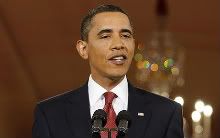
THE TELEGRAPH: US President Barack Obama said the US and China will "shape the course of the 21st century" as he opened high-level talks in Washington.
To the satisfaction of the Chinese at talks designed to usher in a new era of friendship, "not confrontation", Mr Obama said that the ties between the two powers were "as important as any bilateral relationship in the world".
"That reality must underpin our partnership. That is the responsibility we bear," he said at the first meeting of the Strategic and Economic Dialogue in Washington.
In recognition of the importance of the two-day summit it has been described by analysts in the US as the "G2", after the G8 and G20 gatherings.
Mr Obama said he was under "no illusions that the United States and China will agree on every issue", but insisted closer co-operation on a range of challenges from lifting the global economy to nuclear proliferation and climate change was vital for the whole world.
In what appeared to be a co-ordinated new slogan, both Mr Obama and Hu Jintao, the Chinese president, who sent a message to the meeting, said they sought a "positive, constructive, and comprehensive relationship".
The talks are a revamped version of a meeting launched by George W Bush that focused solely on economic issues.
The new dialogue, to be held every year in alternate capitals, involves the US state department and Chinese foreign ministry and firmly underlines China's growing global footprint.
Beijing sent 150 officials to Washington for dozens of meetings with their US counterparts, bringing much of the capital to a virtual standstill.
The Chinese are still sensitive about their inferior status and pushed hard for Mr Obama to open the meeting, according to sources close to the administration, because "they are still looking for validation".
But the hosts were happy to pay tribute to China's ascendance and were optimistic about its ability to act as a responsible member of the global community.
Mr Obama and Hillary Clinton, the US secretary of state, made only brief reference to China's poor human rights record, which used to loom much larger in discussions. >>> Alex Spillius in Washington | Monday, July 27, 2009
May 26, 2009
SPIEGELONLINE INTERNATIONAL: Skeptics have dismissed Beijing's talk of de-emphasizing the US dollar, but China is making moves that could soon lead to a convertible yuan.
Are the Chinese finally getting serious about loosening their ties to the dollar -- and even replacing the greenback with the yuan as the global economy's reserve currency? The evidence is mounting that they are.
For the last two months, China's leadership has been complaining about the country's dangerous dependence on the dollar.. Beijing holds $2 trillion (€1.43 trillion) in dollar assets, accumulated through years of exports to America and massive purchases of Treasuries by the Chinese government. If Washington can't rein in its mounting budget deficit, both Treasuries and the greenback could weaken considerably -- and the Chinese could be big losers as a result.
The Chinese began generating attention on the issue in March, when Chinese Premier Wen Jiabao said he was worried that the country's dollar assets could slide. Ten days later Chinese central bank chief Zhou Xiaochuan suggested replacing the dollar as the international reserve currency. One idea, Zhou said, was to replace the dollar with a basket of currencies supervised by the International Monetary Fund. >>> © SPIEGEL ONLINE 2009 | Tuesday, May 26, 2009
LeVine is a correspondent in BusinessWeek's Washington bureau.
April 15, 2009
THE GUARDIAN: For the last 50 years, Cuba has struggled under a crippling US trade embargo. But this week President Obama eased sanctions on the island. Rory Carroll reports from Havana on what this will mean for ordinary Cubans

They file into terminal 2 of José Martí international airport like any other tourists, wheeling and hauling luggage, checking mobile phones for reception, fumbling with passports. Navy blue passports, stamped with the image of a bald eagle with outstretched wings. American passports. History has yet to call time on half a century of enmity between the United States and Cuba, but these arrivals in jeans and sneakers are not awaiting a formal truce. A once forbidden island, they sense, is on the verge of opening up, and they are here to see it.
The trickle started a few weeks ago. Gum-chewing backpackers, middle-aged professionals, retirees, all bold enough to defy the US prohibition on spending money in Cuba, a de facto travel ban. Cubans half- jokingly call their new American visitors "los valientes", the brave ones, for carving a beachhead. Lenin, in a wry mood, might have called them a revolutionary vanguard. A more poetic soul would compare them to the first swallows of spring, harbingers of thaw.
The glacier in which the cold war remnant that is Cuba has been trapped may soon melt. Barack Obama this week lifted a broad set of sanctions that were designed to isolate the island. Cuban Americans, currently restricted on the amount of money then can send home and to one visit every three years, will be allowed to go as often as they wish and to send more money to relatives. Obama has also lifted restrictions on US telecommunications companies applying for licences to operate there, and on scheduled commercial flights to the island. Air travel is currently limited to charter flights from Miami, New York and Los Angeles for Cuban Americans with relatives on the island, and those with a special reason to visit, such as journalists.
The changes soften US policy but leave in place the economic embargo that John Kennedy imposed in 1962 - a ban on trade and investment designed to choke Fidel Castro's nascent revolutionary government. Over the decades the embargo was tightened and loosened, but the objective remained the same: topple Castro. It failed to do so. Cuba's economy staggered on and Castro strengthened his grip, but the embargo was maintained. >>> Rory Carroll | Wednesday, April 15, 2009
Guardian Audio: The Guardian's Latin America correspondent Rory Carroll explains why Barack Obama has been able to sidestep Florida's powerful Cuban exiles in breaking down barriers between the two nations >>>
September 22, 2008
SPIEGELONLINE INTERNATIONAL: Response to Washington's multibillion-dollar Wall Street bailout has involved a lot of skeptical grumbling in Germany and the UK. German Chancellor Angela Merkel says the Bush administration has mishandled Wall Street, and that its refusal to adopt stricter rules led to the current crisis.
The United States government is campaigning around the world for support for its multibillion-dollar Wall Street rescue package. The reaction has been skeptical at best -- and in Europe the plan has been met with bareknuckled criticism.
German Chancellor Angela Merkel has accused the US government of serious failures which she believes contributed to the current credit crisis. In particular she blamed Washington for resisting stricter regulation.
On Monday she also said the crisis could hurt the German economy. "The whole thing is going to set the pace for the economy in the coming months and perhaps years," Merkel said at a meeting of her party, the conservative Christian Democrats. Merkel Says Washington Helped Drag Europe into the Credit Crisis >>> dsl -- with wire reports | September 22, 2008
STUTTGARTER ZEITUNG ONLINE:
Deutschland beteiligt sich nicht an Hilfspaket: Berlin/Washington - Die Bundesregierung will sich nicht an dem gigantischen US-Rettungspaket für den Bankensektor beteiligen. Regierungssprecher Ulrich Wilhelm sagte, die aktuelle Krise habe ihre Ursache im US-Hypothekenmarkt und im Verbriefungsgeschäft. Man werde daher kein eigenes Programm zur Stabilisierung der Finanzmärkte auflegen und sich auch nicht an dem US-Paket beteiligen. Der republikanische Präsidentschaftskandidat John McCain sprach am Montag von der "schlimmsten Krise seit dem Zweiten Weltkrieg." >>> AP | 22. September 2008
TRIBUNE DE GENÈVE:
La Suisse contaminée par la crise financière : BANQUES | Rendement des caisses de pension, perte de confiance dans UBS ou cartes de crédit: nos habitudes vont changer. Les banques suisses, dont UBS, pourraient perdre quelque 650 millions à cause de Lehman Brothers. >>> Par Élisabeth Eckert, Pierre-Yves Frei et Philippe Rodrick| © TdG | 17.09.2008
TIMESONLINE:
Wall Street Falls Again as $700bn Bailout Is Delayed by Political Squabbling: Just after the collective sigh of relief was drawn following last week’s financial turmoil, a startling late plunge in the US stock market last night started a fresh wave of fears for banks, savers, pension holders and employees.
It had appeared that a $700 billion (£378 billion) bailout of the banking system announced by the US Government on Friday had restored some stability.
But the stock market euphoria generated by the plan disappeared yesterday as political squabbling over the terms of the rescue threatened to delay the Bill. A sudden surge in oil prices also unsettled the markets. >>> By Miles Costello and Leo Lewis in Tokyo | September 23, 2008
The Dawning of a New Dark Age – Paperback (US) Barnes & Noble >>>
The Dawning of a New Dark Age – Hardcover (US) Barnes & Noble >>>
September 21, 2008
THE SUNDAY TIMES: THE US Treasury’s $700 billion (£380 billion) plan to bail out the banks could undermine the dollar, economists warn.
The plan, details of which were unveiled yesterday, will seek congressional approval to raise the total amount the US government can borrow from $10.6 trillion to $11.3 trillion.
It also gives Hank Paulson, the US Treasury secretary, immunity from legal challenge under the plan. The US Treasury will buy mortgage-related securities “from any financial institution having its headquarters in the United States”, draft legislation said. Securities issued before September 17 will be eligible for inclusion.
Word of the proposals created a mood of euphoria in financial markets on Friday. But analysts warned of the risks.
Tim Bond of Barclays Capital, while conceding that the rescue was necessary to avoid the risk of depression, said: “The volume of fresh government borrowing and the fast expansion of the Fed’s balance sheet are both negatives for the dollar, carrying a potential risk of increased inflation.”
Other economists also think that the dollar could be undermined. Kenneth Rogoff, former chief economist at the International Monetary Fund and now a professor at Harvard, said: “It is hard to believe that the dollar will continue to stand its ground as the crisis continues to deepen.” Fears of Dollar Being Hit by Washington’s $700bn Bailout Plan >>> By David Smith, Economics Editor | September 21, 2008
The Dawning of a New Dark Age – Paperback (US) Barnes & Noble >>>
The Dawning of a New Dark Age – Hardcover (US) Barnes & Noble >>>
January 29, 2008
NEW YORK TIMES: WASHINGTON — The House voted overwhelmingly Tuesday afternoon to approve a $146 billion fiscal stimulus package, hoping to quickly seal a fast-paced deal with the Bush administration. But Senate Democrats forged ahead with their own, more expensive plan despite a rising chorus of warnings from the White House and Speaker Nancy Pelosi that they risk delaying much-needed help for the economy and could plunge the nation too far in debt.
The House vote was 385 to 35, with 169 Republicans joining 216 Democrats voting “yes.” Voting against the package were 10 Democrats and 25 Republicans. House Passes $146 Billion Economic Aid Package >>> By David M. Herszenhorn
Mark Alexander (Paperback)

Mark Alexander (Hardback)
Subscribe to:
Posts (Atom)