Showing posts with label Great Depression. Show all posts

February 06, 2026

The Great Depression of 1929: When the Dream Collapsed I SLICE History | Full Documentary

Nov 2, 2025 | 1929: The biggest economic crisis of the 20th century brought an abrupt end to the euphoria of the Roaring Twenties. Driven from their land, the farmers of the Great Plains were forced to abandon everything they had. They became migrants in their own country and were treated as such by the vast Californian estates. They became the symbol of an America confronted by its own reality.

Built on the work of the iconic photographers of the Great Depression - Dorothea Lange, Walker Evans, and Arthur Rothstein - this full archive documentary analyzes the consequences of the economic collapse in the United States and provides a unique take on the failure of the American model.

Documentary: An American Depression (2019)
Directed by Sylvain Desmille
Production: Les Batelières Productions pour LCP & Toute l’Histoire


July 06, 2020

Brace Yourself for Trump's Great Recession


Former Secretary of Labor Robert Reich warns of the looming Great Depression brought on by Trump and the GOP's refusal to act to mitigate the damage wrought by this pandemic.

Trump and businesses demanded America "reopen" to revive the economy. But we’ve reopened too soon, before COVID-19 is under control. So we're needing to close or partly close again, which will prolong the economic downturn and wreak even more havoc on millions of Americans’ livelihoods. The wave of evictions and foreclosures in the next 2 months will be unlike anything America has experienced since the Great Depression. And the expiration of expanded unemployment benefits at the end of July will leave unemployed Americans with a 60% income reduction and no stimulus check to fall back on. Meanwhile, state and local governments are forced to gut vital public services like low-income housing and health care — even as over 16.2 million households have lost employer-provided health insurance.

So what’s Trump’s and Mitch McConnell’s response to this looming catastrophe?

Do nothing.

This is lunacy. The priority must be getting control over this pandemic and helping Americans survive it physically and financially. Extra unemployment benefits must be extended. The HEROES Act must be signed into law. Moratoriums on evictions and foreclosures must be extended. If it’s necessary to go back to sheltering in place to contain this pandemic, we must be willing to do so. This shouldn't be controversial. It's the bare minimum of what our government must do to prevent an even worse economic and human catastrophe.

Anything less is indefensible.


April 08, 2020

Coronavirus Putting World On Track for New Great Depression, Says WTO


THE GUARDIAN: International trade body predicts commerce could shrink up to 32% and warns against 30s-style protectionism

International trade has dried up as a result of the Covid-19 pandemic and could be on course for a collapse as severe as that of the 1930s Great Depression, the World Trade Organization has said.

The Geneva-based WTO, responsible for policing the global trading system, said even the most optimistic scenario for 2020 was that trade would shrink by 13%, a bigger drop than in the 2008-09 recession caused by the banking crisis.

But it warned there was the risk of a much gloomier outcome under which trade would shrivel by 32%, on a par with the reduction seen between 1929 and 1932.

The collapse in global trade during the 1930s was in part due to the protectionist measures imposed by developed countries, and the head of the WTO, Roberto Azevêdo, warned that putting up barriers in response to Covid-19 would make matters worse. » | Larry Elliott | Wednesday, April 8, 2020

July 22, 2012

Debt Crisis: Greek Economy Is In a 'Great Depression' Says Samaras

THE SUNDAY TELEGRAPH: Greece is in a "Great Depression" similar to the American one in the 1930s, the country's Prime Minister Antonis Samaras told former US President Bill Clinton on Sunday.

Mr Samaras's comments come two days before a team of Greece's debt inspectors arrive in Athens to push for further austerity measures if the debt-laden country wants to qualify for further rescue payments and avoid a chaotic default.

Athens wants to soften the terms of a €130bn euro bailout agreed last March with the European Union and the International Monetary Fund, to soften their impact on an economy going through its worst post-war recession.

Greek GDP is expected by the end of this to have shrunk by about a fifth in five consecutive years of recession since 2008, hammered by tax hikes, spending cuts and wage reductions required by two EU/IMF bailouts. Unemployment climbed to a record 22.6pc in the first quarter.

"You had the Great Depression in the United States," Samaras told Clinton, who was visiting Greece as part of a delegation of Greek-American businessmen. "This is exactly what we're going through in Greece - it's our version of the Great Depression." » | Source: Reuters | Sunday, July 22, 2012

December 16, 2011

Are We Really Heading for a Second Great Depression?

GUARDIAN – ECONOMICS BLOG: IMF chief Christine Lagarde is right to be worried about potential economic doomsday scenarios – but the Europe of 2011 is very different from that of the 1930s

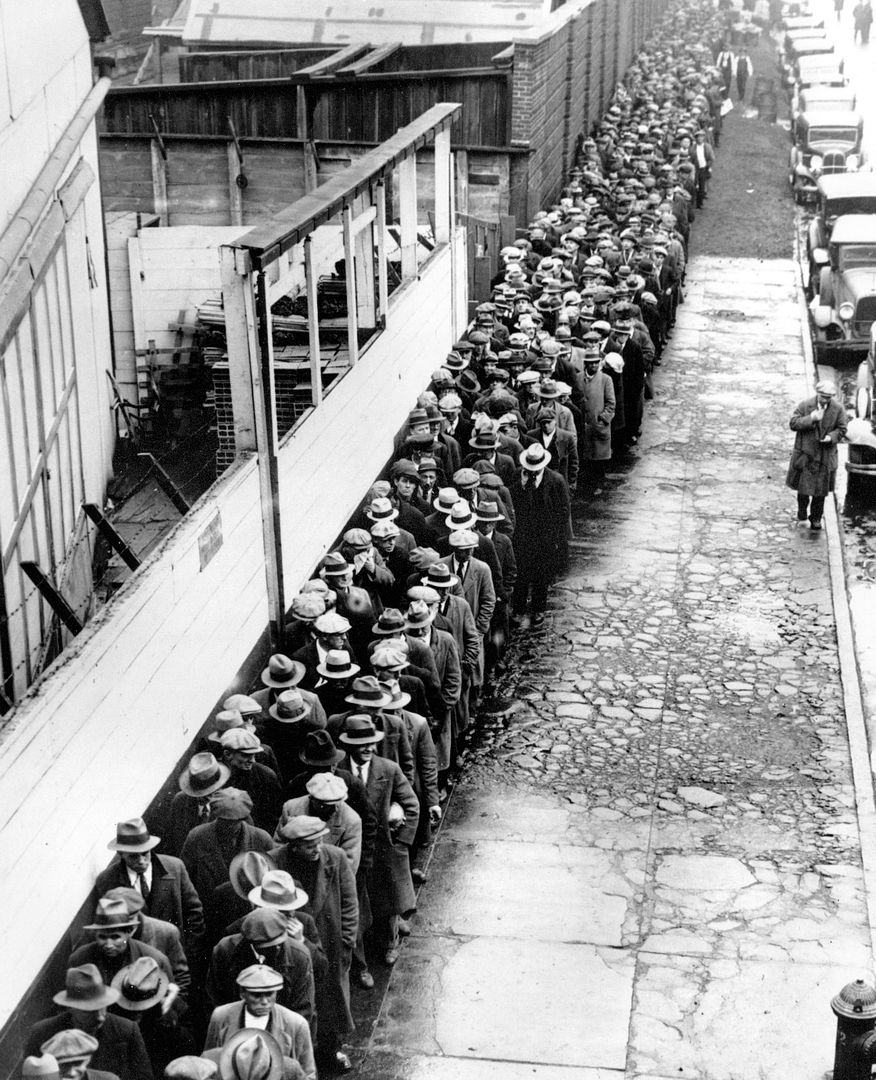
Soup kitchens. Dole queues. Jarrow marches. Bank failures. Trade wars. Falling prices. Desperate poverty. Dust bowls. Fascism. The long descent into war.

That was the 1930s, and it was the world conjured up by Christine Lagarde, the managing director of the International Monetary Fund on Thursday night.

A failure of the international community to co-operate to sort out Europe's sovereign debt crisis risked, she said, "retraction, rising protectionism and isolation. This is exactly the description of what happened in the 1930s and what followed is not something we are looking forward to."

Clearly not. But is Lagarde right? Are we really heading inexorably into a second Great Depression? Or is the head of the IMF, unwisely perhaps, making us all feel more depressed than we need to be?

There are certainly reasons to be concerned about the state of the world.

To the extent that a depression can be defined as a prolonged period of sub-trend growth, then what we have experienced since 2008 has been a depression.

Many countries – including Britain – have struggled to recover from the collapse of asset-price bubbles – and now face the prospect of double-dip recessions. Read on and comment » | Larry Elliott, economics editor | Friday, December 16, 2011

July 12, 2010

Photobucket
During the Great Depression preceding the passage of the Social Security Act, "soup kitchens" provided the only meals some unemployed Americans had. This particular soup kitchen was sponsored by the Chicago gangster Al Capone. Photograh: Social Security Online

UK Recession Even Deeper Than First Thought

THE GUARDIAN: Six successive quarters of negative economic growth from spring 2008 until autumn 2009 were the toughest for the economy since the Great Depression of the 1930s

The deepest recession in Britain's post-war history was even more severe than previously feared, the government said today.

Fresh information collected by the Office for National Statistics showed that the peak to trough decline in output was 6.4% of gross domestic product rather than the original 6.2% estimate.

The new figures confirmed that the six successive quarters of negative growth from spring 2008 until autumn 2009 were the toughest for the economy since the Great Depression of the 1930s, harsher even than the slump of the early 1980s. Continue reading and comment >>> Larry Elliott, economics editor | Monday, July 12, 2010

May 21, 2010

City Fears of 'Great Depression Mark II'

THE TELEGRAPH: Leading City experts have started raising the prospect of "Great Depression II" amid worries that the European economic crisis could trigger a deeper bout of chaos.

Markets on both sides of the Atlantic dipped to fresh lows as fears surrounding the fate of the euro project transmuted into worries about the wider global economic system.

Bill Gross of bond fund Pimco said that hedge funds were starting to liquidate their positions in a bid to preserve their capital – a worrying "mini relapse" towards 2008 territory.

Andrew Roberts, head of European rates strategy at RBS, said "Great Depression II" could now be approaching, adding: "It now has potential to speed toward its conclusion; a European $1trn package which does little and political panic tells you we are about to reach the end of the road. The world should be discussing deflation, not inflation." Read on and comment >>> Edmund Conway, Economics Editor | Friday, May 21, 2010

April 29, 2010

1929 – The Great Wall Street Crash & Depression

Part 1:


Part 2:


Part 3:


Part 4:


Part 5:


Part 6:

March 16, 2009

Britain Showing Signs of Heading Towards 1930s-style Depression, Says Bank

THE TELEGRAPH: Britain is showing signs of sliding towards a 1930s-style depression, the Bank of England says today for the first time.

The country is displaying early symptoms of being trapped in a so-called “debt deflation trap” where families find themselves pushed further and further into the red every month, according to a Bank report published today.

The stark warning will cause serious concerns, since it was this combination of falling prices and soaring debt burdens that plagued the US in the 1930s.

The Bank is using its Quarterly Bulletin to highlight the threat posed to the economy by deflation – where prices fall each year rather than rise.

Although inflation is currently in positive territory, it is expected to become negative in the coming months.

The Bank is worried that this may combine with high levels of indebtedness to squeeze families further.

It says that families with high debts could fall prey to the debt deflation trap. This means that the cost of their debts, which are fixed, would rise compared to average prices throughout the economy. While inflation erodes debts, deflation makes them relatively higher.

The Bank’s paper suggests that Britain is particularly at risk because there is a high proportion of families with significant levels of debt, and many of them are on fixed mortgage rate, which means they will not benefit from rate cuts.

Britons’ total personal debt – the amount owed on mortgages, loans and credit cards – is, at £1.46 trillion, more than the value of what the country produces in a year.

Total personal debt has risen by 165 per cent since 1997 and each household now owes an average of about £60,000.

The Conservatives claim this is the highest personal debt level in the world. >>> By Edmund Conway, Economics Editor | Monday, March 16, 2009

The Dawning of a New Dark Age (Paperback & Hardback) – Free delivery >>>

January 10, 2009

Surprise Rise in US Jobless Raises Spectre of Great Depression

TIMES ONLINE: Fears that the world is sliding into the worst global recession since the Great Depression multiplied yesterday as figures showed the steepest jump in American unemployment since the Second World War and a slump in manufacturing across Europe.

Economists on both sides of the Atlantic were startled by the severity of the latest indications of global economic slump, which further stoked pressure for radical action to stave off economic calamity.

A further surge in US joblessness led the litany of bleak developments yesterday. Official figures confirmed that more Americans lost their jobs last year than in any year since 1945, and that unemployment is soaring at the fastest pace seen since then.

A total of 524,000 Americans were made redundant by US employers last month alone, the latest official payroll figures showed. The mounting toll of job losses drove the unemployment rate in the world's largest economy up to a 15-year peak of 7.2 per cent, sharply higher than November's 6.8 per cent, amid predictions that it will leap to 9.5 per cent or more by the second half of next year.

“The jobs situation is ugly and it is going to get uglier,” Richard Yamarone, chief economist at Argus Research in New York, said. “There's no reason to expect hiring any time in the next three to six months. We're not going to get any hiring until the Government steps in and acts. Talk doesn't work.” >>> Gary Duncan, Economics Editor | Saturday, January 10, 2009

WELT ONLINE: Experten erwarten längsten Abschwung seit 1945

Die Rezession schlägt in den USA dramatisch auf den Arbeitsmarkt durch: Allein im Dezember gingen 524.000 Jobs verloren. Die Rezession in Amerika wird nach Ansicht von Experten länger dauern als alle anderen seit 1945. Frühestens im kommenden Jahr wird sich die US-Wirtschaft wieder erholen.

Die Rezession in den USA wird Experten zufolge voraussichtlich länger dauern als alle anderen seit dem Zweiten Weltkrieg. Zwar werde es wohl noch in diesem Jahr zu einer leichten Erholung der Wirtschaft kommen, normalere Wachstumsraten seien jedoch erst wieder für 2010 zu erwarten, erklärten die Experten des Blue-Chip-Barometers. Die Mehrheit der Befragten aus führenden Unternehmen und Forschung glaubt demnach, dass die Rezession offiziell im dritten Quartal 2009 enden wird. Die Arbeitslosigkeit wird nach Ansicht der Hälfte der Umfrageteilnehmer jedoch erst 2010 ihren Höhepunkt erreichen. >>> Reuters/dpa/ras | Samstag, 10. Januar 2009

The Dawning of a New Dark Age – Paperback (US) Barnes & Noble >>>
The Dawning of a New Dark Age – Hardcover (US) Barnes & Noble >>>

October 01, 2008

On the Brink of Another Great Depression?

THE TELEGRAPH: Corporate America has just lost a chunk of its value the size of the Indian economy

In one fell swoop, the House of Representatives has applied a sledgehammer to the American economy. The staggering plunge in the value of publicly quoted stocks in the US last night - a $1.2 trillion fall - shows more clearly than anything else just how much it had been holding out for a financial bail-out.

Even so, the longer you stare at a screen of the Dow Jones or FTSE 100, the more abstract it seems. So this is what it means:

It means millions more Americans, and hundreds of thousands more Britons, will lose their jobs; it means the recession will be deeper and more protracted than previously feared; it means borrowing costs will increase on both sides of the Atlantic. Companies will cut back on investment. Pension funds will be depleted.

The Western world, in short, will become significantly less wealthy.

There is still time for US policymakers to rescue the deal, but not much. Financial markets are no longer just chaotic, but are close to complete collapse. A number of banks, already on the edge, will be pushed that bit closer to the precipice as a result.

As the past few weeks have shown, companies can go bust very, very quickly. When they collapse they are very difficult, if not impossible, to put back together again.

The free market can be very creative but it can also be immensely destructive. This is one of those points where the scale of destruction is potentially so great that it could set the economy back years.

This is why so many people – and not just the politicians putting the deal together – are warning that if the deal fails entirely we could be facing a second Great Depression.

The big mistake policymakers made in the 1930s was to allow too many banks to fail. This caused such a financial earthquake that it led to a decade of hardship. Financial Crisis: The Western World Will Become Significantly Less Wealthy >>> By Edmund Conway, Economics Editor | September 30, 2008

THE TELEGRAPH:
US Economy: Even Hank Paulson's Bail-out Plan Cannot Detox Global Banking: Can the rescue package really halt our slide into a new Depression, asks Ambrose Evans-Pritchard.

Even if Congress backs the Paulson bail-out, the $700 billion blast cannot save the US, Britain or the world from the deepest economic slump since the Thirties. If Congress balks, God help us. The credit system is suffering a heart attack. Inter-bank lending is paralysed. Funds are accepting zero interest on US Treasury notes for the first time since Pearl Harbour, because no bank account is safe.

Wherever you look – dollar, euro, sterling Libor (the rate at which banks lend to each other), or spreads on credit derivatives – the stress has reached breaking point. If borrowers cannot roll over the three-month loans that are the lifeblood of business, they will default en masse.

“Money markets are imploding. If no action is taken very soon, there is a significant risk that the global economy will collapse,” says BNP Paribas. Almost every trader says much the same thing. So does US treasury secretary Hank Paulson, who as Toby Harnden reports, literally dropped on bended knee to beg help from Democrats on Capitol Hill.

Republican refuseniks – defying their president – have a grim responsibility if they now tip America over the edge, setting off the “adverse feedback loop” that so terrifies the US Federal Reserve. Like players in a Greek tragedy, they seem determined to repeat the “liquidation” policy that led to the Great Depression – and to Democrat ascendancy for years.
>>>
By Ambrose Evans-Pritchard | September 27, 2008

The Dawning of a New Dark Age – Paperback (US) Barnes & Noble >>>
The Dawning of a New Dark Age – Hardcover (US) Barnes & Noble >>>

April 09, 2008

IMF: ‘Largest Financial Shock Since Great Depression’

THE GUARDIAN: America's mortgage crisis has spiralled into "the largest financial shock since the Great Depression" and there is now a one-in-four chance of a full-blown global recession over the next 12 months, the International Monetary Fund warned today.

The US is already sliding into what the IMF predicts will be a "mild recession" but there is mounting pessimism about the ability of the rest of the world to escape unscathed, the IMF said in its twice-yearly World Economic Outlook. Britain is particularly vulnerable, it warned, as it slashed its growth targets for both the US and the UK.

The report made it clear that there will be no early resolution to the global financial crisis.

"The financial shock that erupted in August 2007, as the US sub-prime mortgage market was derailed by the reversal of the housing boom, has spread quickly and unpredictably to inflict extensive damage on markets and institutions at the heart of the financial system," it said. IMF Says US Crisis Is 'Largest Financial Shock Since Great Depression' >>> By Heather Stewart in Washington

The Dawning of a New Dark Age (Paperback)
The Dawning of a New Dark Age (Hardback)