THE GUARDIAN: Kristalina Georgieva outlines mounting risks to economic stability before fund’s annual meetings next week
The head of the International Monetary Fund has issued a stark warning about the mounting risks facing the global economy, saying: “Buckle up: uncertainty is the new normal.”
As finance ministers and central bankers prepare to meet in Washington for the IMF’s annual meetings next week, its managing director, Kristalina Georgieva said the world economy had shown surprising resilience in the face of Donald Trump’s trade war.
The US is now expected to avoid recession, despite the imposition of historic tariffs on many of its trading partners, and the global economy is forecast to slow “only slightly this year and next”, she said.
But Georgieva pointed to growing signs of strain, including the record gold price – which topped $4,000 an ounce on Wednesday, signalling anxiety among investors – and exceptionally high valuations for US stocks. » | Heather Stewart | Wednesday, October 8, 2025
Showing posts with label IMF. Show all posts
Showing posts with label IMF. Show all posts
October 08, 2025
October 10, 2023
IMF Says UK Faces Five More Years of High Interest Rates
BBC: The UK faces another five years of high interest rates to stem rising prices, an influential global group has warned.
The International Monetary Fund expects the UK to have the highest inflation and slowest growth next year of any G7 economy including the US, France, Germany, Canada, Italy and Japan.
However, the Treasury said recent revisions to UK growth had not been factored in to the IMF's report.
The outlook was drawn up before this weekend's developments in Israel. » | Lucy Hooker & Faisal Islam, BBC News | Tuesday, October 10, 2023
The International Monetary Fund expects the UK to have the highest inflation and slowest growth next year of any G7 economy including the US, France, Germany, Canada, Italy and Japan.
However, the Treasury said recent revisions to UK growth had not been factored in to the IMF's report.
The outlook was drawn up before this weekend's developments in Israel. » | Lucy Hooker & Faisal Islam, BBC News | Tuesday, October 10, 2023
October 15, 2022
April 09, 2019
IMF Says No-deal Brexit Risks Two-year Recession for UK
Ahead of Theresa May’s plea to EU leaders for a further delay to Britain’s departure, the IMF used a downbeat half-yearly assessment of the global economy to predict that the UK economy could be 3.5% smaller than expected by 2021 if trade barriers were swiftly erected.
The World Economic Outlook – completed in March before the latest developments in Brexit – predicted UK growth of 1.2% in 2019 on the assumption that a Brexit deal is done.
Growth in 2020 has also been revised down – by 0.1 points to 1.4% – since the fund’s last WEO in October, but the IMF said its projections were surrounded by uncertainty. » | Larry Elliott in Washington | Tuesday, April 9, 2019
October 15, 2017
Bubble Trouble: What Lies beneath at the IMF? - Counting the Cost
The IMF has spent the last decade trying to pick up the pieces after failing to predict the last financial crisis. This week, the IMF said nearly 75 percent of the world is now experiencing an upswing.
It's predicting that the world's economy will expand by 3.6 percent in 2017 and by 3.7 percent in 2018. That's slightly higher than the 3.5 percent and the 3.6 percent growth what it was predicting back in July.
But the IMF also issued a warning: It said record low borrowing costs designed to help the economic recovery are pushing up debt levels in the world's largest economies. It singled out China as one of the worst offenders.
Shihab Rattansi reports from the annual World Bank, IMF meetings; and David Coker, a lecturer at the Westminster Business School, discusses the cracks in the global economy.
November 04, 2016
Egypt Floats Currency, Paving Way for IMF Loan
November 29, 2015
IMF to Make Chinese Yuan Reserve Currency in Historic Move

The International Monetary Fund is to give the yuan a historic vote of confidence on Monday when it includes the Chinese currency in its elite club of major currencies.
The yuan, also known as the renminbi, is widely expected to be added to the IMF’s group of international reserve currencies after an IMF meeting held by its managing director Christine Lagarde.
It comes after lengthy efforts by Chinese officials to legitimise the yuan, which critics say has been kept artificially cheap to artificially boost exports in the world’s second-largest economy.
China has lobbied hard for the currency to be included in the list, which at present is made up of just the dollar, the euro, the pound and the Japanese yen. The list has not been altered since 2000, when the euro replace[d] the franc and deutschmark. Read on and comment » | James Titcomb | Sunday, November 29, 2015
July 31, 2015
Greece Crisis Escalates as IMF Witholds Support for a New Bail-out Deal

Talks over an €86bn bail-out for Greece have been thrown into turmoil after just four days as the International Monetary Fund said it would have no involvement in the country until it receives explicit assurances over debt sustainability.
An IMF official said the fund would withhold financial support unless it has guarantees Greece can carry out a "comprehensive" set of reforms and will be the beneficiary of debt relief from its European creditors.
The comments came after the IMF's executive board was told that the institution could no longer continue pumping more money into the debtor nation, according to a leaked document seen by the Financial Times.
The Washington-based Fund has been torn over its involvement in Greece - its largest ever recipient country. The world's "lender of last resort' said it would continue talks with its creditor partners and the Leftist government of Athens, but made it clear the onus of keeping Greece in the eurozone now fell on Europe's reluctant member states.
"There is a need for difficult decisions on both sides... difficult decisions in Greece regarding reforms, and difficult decisions among Greece's European partners about debt relief," said the official.
"One should not be under the illusion that one side of it can fix the problem." » | Mehreen Khan | Thursday, July 30, 2015
April 02, 2015
Greece Draws Up Drachma Plans, Prepares to Miss IMF Payment
Greece is drawing up drastic plans to nationalise the country's banking system and introduce a parallel currency to pay bills unless the eurozone takes steps to defuse the simmering crisis and soften its demands.
Sources close to the ruling Syriza party said the government is determined to keep public services running and pay pensions as funds run critically low. It may be forced to take the unprecedented step of missing a payment to the International Monetary Fund next week.
Greece no longer has enough money to pay the IMF €458m on April 9 and also to cover payments for salaries and social security on April 14, unless the eurozone agrees to disburse the next tranche of its interim bail-out deal in time.
“We are a Left-wing government. If we have to choose between a default to the IMF or a default to our own people, it is a no-brainer,” said a senior official. » | Ambrose Evans-Pritchard | Thursday, April 02, 2015
August 13, 2013
Talk to Al Jazeera: Michael Sarris: 'Abandoned' by Europe
June 06, 2013
SPIEGEL ONLINE INTERNATIONAL: The International Monetary Fund conceded on Wednesday that it lowered its own standards on the Greek bailout, underestimating the effects of austerity and making overly optimistic projections for Greece's economy.
The International Monetary Fund acknowledges that it made "notable failures" on the first rescue package for Greece, setting overly optimistic expectations for the country's economy and underestimating the effects of the austerity measures it imposed. As such, the fund said in an unusually frank report released on Wednesday, it lowered its own standards on debt sustainability, setting lending levels too high for Greece while not pushing hard enough on Greek debt restructuring. » | chw -- with wires | Thursday, June 06, 2013
July 19, 2012

THE DAILY TELEGRAPH: Britain’s recovery has stalled and the Government must be prepared to relax austerity to pump life into the ailing economy, the International Monetary Fund has warned.
The IMF said that post-crisis repair to the ravaged economy would take longer than expected, meaning extra effort to boost growth could take priority over deficit reduction should the outlook worsen.
It said the 2013 Budget would be an ideal time for the Government to consider further action, should policies already in place fail to make an impact.
"If growth does not take off and unemployment fails to recede even after substantial further monetary stimulus and strong credit easing measures have been given time to work, the policy response should include a further slowing of fiscal consolidation," said Ajai Chopra, the IMF’s deputy director of the European department.
"[The Budget] would be the natural time to look at the state of the economy and policy responses," he said. » | Angela Monaghan, Economics Correspondent | Thursday, July 19, 2012
My comment:
Austerity, austerity, austerity is not the answer to a severe recession, depression. What the Chancellor is doing with all this austerity is slamming the breaks on really hard when in actual fact the pump needs to be primed.
Whilst it is always prudent for a country to get its finances in order, the time for doing this is when the going is good. It is when the going is good that we save for that proverbial 'rainy day'. A family doesn't save money when the rainy day has come; rather, it saves for the rainy day when circumstances allow. So it should be for government. The coffers should be being filled when the economy is booming. What this government is doing is turning this wisdom on its head. The result will be misery for the people. Witness what is going on in Greece – austerity as we have, but in extremis.
All this austerity should therefore be tempered by a solid growth strategy. Only when the economy starts to grow again, only when there is at least a modicum of recovery can we hope to shorten the dole queues, can we hope to relieve people's misery, can we hope to encourage people to spend again. For it is only when people spend that demand increases; and only when demand increases will the economy start moving again. – © Mark
This comment also appears here.
July 16, 2012

The International Monetary Fund has downgraded its forecast for UK growth next year by more than any other developed nation and warned that the world economy is weakening.
The Washington-based organisation predicted on Monday that growth in the UK will be just 1.4% in 2013, compared with a previous forecast of 2%. This year the situation will be even worse and a previous forecast for 0.8% growth for the year has all but evaporated.
The IMF said in its latest World Economic Outlook that GDP across the UK – which is currently in recession – will increase by just 0.2% in 2012, beating Italy and Spain, but behind France and Germany.
Christine Lagarde, the former French finance minister who heads the IMF, has warned European leaders they must press ahead with further measures to deal with the euro crisis or growth forecasts could prove optimistic. » | Phillip Inman, economics correspondent | Monday, July 16, 2012
June 09, 2012
eKATHIMERINI: Lagarde, Juncker express solidarity to Greek people
The serious possibility of the crisis expanding to Spain and of a possible Greek exit from the eurozone depending in the outcome of the June 17 election, that Moody’s warned would see a downgrade for the bloc’s countries with the top credit rating, have generated huge worries among European officials.
In this context the French head of the International Monetary Fund, Christine Lagarde, stressed in Saturday’s edition of German newspaper Suddeutsche Zeitung the lack of a long-term vision in Europe.
The IMF managing director also spoke in favor of a European banking watchdog, of common guarantees for bank deposits, and of a so-called “debt repayment accord” as proposed by German experts, while expressing her confidence that Greece will overcome the crisis.
Lagarde reiterated that what she said last month in an interview to The Guardian newspaper was misunderstood: “I said that I feel great respect for the sacrifices the Greek people are making to overcome the crisis. I also said that I am sorry that my observations [about Niger] were misunderstood and hurt some people’s feelings. That was not my intention.
“In the last few years we support Athens very warmly and we are aware of the difficulties Greece has been going through. We continue to believe that the country will get over the crisis and have a better future, when all parties involved take the appropriate measures as they are supposed to. I assure you that the IMF, just like myself, are fully supporting Greece.” » | ekathimerini.com | Saturday, June 09, 2012
December 16, 2011

Soup kitchens. Dole queues. Jarrow marches. Bank failures. Trade wars. Falling prices. Desperate poverty. Dust bowls. Fascism. The long descent into war.
That was the 1930s, and it was the world conjured up by Christine Lagarde, the managing director of the International Monetary Fund on Thursday night.
A failure of the international community to co-operate to sort out Europe's sovereign debt crisis risked, she said, "retraction, rising protectionism and isolation. This is exactly the description of what happened in the 1930s and what followed is not something we are looking forward to."
Clearly not. But is Lagarde right? Are we really heading inexorably into a second Great Depression? Or is the head of the IMF, unwisely perhaps, making us all feel more depressed than we need to be?
There are certainly reasons to be concerned about the state of the world.
To the extent that a depression can be defined as a prolonged period of sub-trend growth, then what we have experienced since 2008 has been a depression.
Many countries – including Britain – have struggled to recover from the collapse of asset-price bubbles – and now face the prospect of double-dip recessions. Read on and comment » | Larry Elliott, economics editor | Friday, December 16, 2011
December 15, 2011

The world risks sliding into a 1930s-style slump unless countries settle their differences and work together to tackle Europe's deepening debt crisis, the head of the International Monetary Fund has warned.
On a day that saw an escalation in the tit-for-tat trade battle betweenChina and the United States and a deepening of the diplomatic rift between Britain and France, Christine Lagarde issued her strongest warning yet about the health of the global economy and said if the international community failed to co-operate the risk was of "retraction, rising protectionism, isolation".
She added: "This is exactly the description of what happened in the '30s and what followed is not something we are looking forward to."
The IMF managing director's call came amid growing concern that 2012 will see Europe slide into a double-dip recession, with knock-on effects for the rest of the global economy. "The world economic outlook at the moment is not particularly rosy. It is quite gloomy," she said. » | Larry Elliott, Heather Stewart and Nicholas Watt | Thursday, December 15, 2011
To call what happened in the 1930s a “slump” is a bit of a stretch and a misnomer, to say the least. The 1930s was characterized by a 'full-on' depression. The terms “slump” and “double-dip” are far too mild to describe the dire economic situation experienced during that period in history. The IMF and these politicians need to get their facts straight. – © Mark
June 09, 2011

"There's a lot of information coming from different sources which is implying that there's agreement between G8 countries about support for Madame Lagarde, and if countries which together have more than 60pc of the vote have agreed to support one candidate, then it's more or less a done deal," Mr Marchenko, who heads the National Bank of Kazakhstan, said in an interview with The Daily Telegraph.
Mr Marchenko, an economist educated at the US's Georgetown University, said that G8 countries may have agreed to back the French finance minister, even before the sudden resignation of Dominique Strauss-Kahn, who was expected to leave in July to campaign in the French presidential elections.
"Whether this deal was reached several months ago, or whether it was reached in May in Deauville in France, it's pretty clear the deal has been reached," he said, speaking from his offices in Almaty, Kazakhstan's commercial capital. » | Richard Orange, Almaty, Kazakhstan | Thursday, June 09, 2011
May 19, 2011
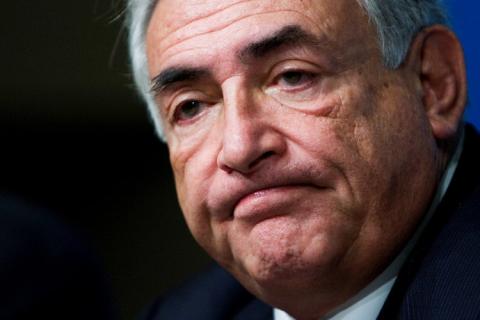
THE DAILY TELEGRAPH: Dominique Strauss-Kahn has resigned as head of the International Monetary Fund, four days after being charged with the sexual attack of a Manhattan hotel chambermaid.
In a statement released by the Fund in the early hours of Thursday morning, Mr Strauss-Kahn said he needed to "devote all my strength, all my time, and all my energy to proving my innocence".
The 62-year-old Frenchman has been under intense pressure since being arrested in the First Class cabin of on an Air France jet on the tarmac of John F. Kennedy airport on Saturday afternoon.
He is being held at Rikers Island prison after being formally charged with seven crimes related to the alleged assault of a 32-year-old Guinean maid in his suite at the Sofitel earlier that day, including attempted rape and an illegal sexual act. » | Jon Swaine, New York | Thursday, May 19, 2011
April 19, 2011
 THE DAILY TELEGRAPH: David Cameron will block Gordon Brown's attempts to head up the International Monetary Fund after criticising his handling of the financial crisis.
In a direct attack on the former Prime Minister, Mr Cameron said his predecessor was not the "most appropriate person" to lead the IMF because he would not admit the UK had a "debt problem".
Mr Brown is reportedly hoping to take on the £270,000-a-year role but he must first be nominated by the Government.
“If you have someone who didn’t think we had a debt problem (running the IMF) they may not be the best person to decide whether other countries have that problem," he said on BBC Radio 4's Today programme.
He added that the role needed to be filled by “someone who understands the dangers of excessive spending.”
And in a clear signal that Britain would block Mr Brown if stood for the job, Mr Cameron suggested the position should be filled by a candidate from “China, India or south east Asia.” » | Andrew Porter and James Kirkup | Tuesday, April 19, 2011
Subscribe to:
Posts (Atom)