Showing posts with label world economy. Show all posts
Showing posts with label world economy. Show all posts
May 01, 2026
Will the Iran War Cause a Global Depression? (w/ Prof. Richard Wolff) | The Chris Hedges Report
April 25, 2026
Michael Hudson: Iran War Ignites Global Financial Armageddon
March 19, 2026
The End of the Petrodollar? How Iran War Is Reshaping the Global Economy: Author Laleh Khalili
Democracy Now! can be supported here.
March 12, 2026
THE NEW YORK TIMES: Countries already walloped by a breakdown of the international trading order, war in Ukraine and chaotic U.S. policymaking are facing potentially lasting economic damage.
Bombs are exploding in Iran and the Middle East, but the fallout is rattling households and businesses in neighborhoods all over the globe.
In Kansas, home buyers saw 30-year mortgage rates edge above 6 percent this week. In Western India, families mourning the death of a loved one discovered that gas-fired crematories had been temporarily closed.
In Hanoi, Vietnam, gas station owners posted “sold out” signs. In Kenya, tea growers and traders worried their exports to Iran would rot on the dock. And across the United States, Canada, Europe, Britain and Mexico, farmers blanched at the surge in fertilizer costs.
The widening war in Iran has delivered a stunning punch to a worldwide economy that has already been walloped by a breakdown of the international trading order, war in Ukraine and President Trump’s chaotic policymaking.
“This really is the big one,” David Goldwyn, a former U.S. diplomat and U.S. Energy Department official, said of the shutdown of the Strait of Hormuz, the world’s most important choke point for oil. It is the emergency scenario everyone feared, he said.
Cargo deliveries have been stranded, shipping charges have increased and insurance premiums have skyrocketed. Yes, the price of gas at the pump is affected. But so is the price of food, medicine, airplane tickets, electricity, cooking oil, semiconductors and more.
A drawn-out war between the United States and Iran could have “catastrophic consequences” for the world’s oil market and the global economy, Amin Nasser, chief executive of Saudi Aramco, the world’s largest oil and gas company, warned this week.
Yet even if the war, which began on Feb. 28 when the United States and Israel struck Iran, wraps up relatively quickly, this latest upheaval is sending consumers, workers and employers on another unnerving and unpredictable ride. » | Patricia Cohen | Patricia Cohen is the global economics correspondent in London.| Thursday, March 12, 2026
One can but wonder what all the members of Trump’s fan club have to say for themselves now! The king of dealmaking is not looking so clever now, is he? His magic touch looks pretty elusive to me. — © Mark Alexander
Bombs are exploding in Iran and the Middle East, but the fallout is rattling households and businesses in neighborhoods all over the globe.
In Kansas, home buyers saw 30-year mortgage rates edge above 6 percent this week. In Western India, families mourning the death of a loved one discovered that gas-fired crematories had been temporarily closed.
In Hanoi, Vietnam, gas station owners posted “sold out” signs. In Kenya, tea growers and traders worried their exports to Iran would rot on the dock. And across the United States, Canada, Europe, Britain and Mexico, farmers blanched at the surge in fertilizer costs.
The widening war in Iran has delivered a stunning punch to a worldwide economy that has already been walloped by a breakdown of the international trading order, war in Ukraine and President Trump’s chaotic policymaking.
“This really is the big one,” David Goldwyn, a former U.S. diplomat and U.S. Energy Department official, said of the shutdown of the Strait of Hormuz, the world’s most important choke point for oil. It is the emergency scenario everyone feared, he said.
Cargo deliveries have been stranded, shipping charges have increased and insurance premiums have skyrocketed. Yes, the price of gas at the pump is affected. But so is the price of food, medicine, airplane tickets, electricity, cooking oil, semiconductors and more.
A drawn-out war between the United States and Iran could have “catastrophic consequences” for the world’s oil market and the global economy, Amin Nasser, chief executive of Saudi Aramco, the world’s largest oil and gas company, warned this week.
Yet even if the war, which began on Feb. 28 when the United States and Israel struck Iran, wraps up relatively quickly, this latest upheaval is sending consumers, workers and employers on another unnerving and unpredictable ride. » | Patricia Cohen | Patricia Cohen is the global economics correspondent in London.| Thursday, March 12, 2026
One can but wonder what all the members of Trump’s fan club have to say for themselves now! The king of dealmaking is not looking so clever now, is he? His magic touch looks pretty elusive to me. — © Mark Alexander
March 09, 2026
Peter Schiff: Iran War Creates Chaos in the World Economy
October 15, 2022
September 26, 2022
The Dollar Is Strong. That Is Good for the U.S. but Bad for the World.
THE NEW YORK TIMES: The Federal Reserve may have no choice but to wage a relentless inflation fight, but countries rich and poor are feeling the pain of plunging currencies.
The Federal Reserve’s determination to crush inflation at home by raising interest rates is inflicting profound pain in other countries — pushing up prices, ballooning the size of debt payments and increasing the risk of a deep recession.
Those interest rate increases are pumping up the value of the dollar — the go-to currency for much of the world’s trade and transactions — and causing economic turmoil in both rich and poor nations. In Britain and across much of the European continent, the dollar’s acceleration is helping feed stinging inflation.
On Monday, the British pound touched a record low against the dollar as investors balked at a government tax cut and spending plan. And China, which tightly controls its currency, fixed the renminbi at its lowest level in two years while taking steps to manage its decline.
In Nigeria and Somalia, where the risk of starvation already lurks, the strong dollar is pushing up the price of imported food, fuel and medicine. The strong dollar is nudging debt-ridden Argentina, Egypt and Kenya closer to default and threatening to discourage foreign investment in emerging markets like India and South Korea.
“For the rest of the world, it’s a no-win situation,” said Eswar Prasad, an economics professor at Cornell and author of several books on currencies. At the same time, he said, the Fed has no choice but to act aggressively to control inflation: “Any delay in action could make things potentially even worse.” » | Patricia Cohen, Reporting from London | Monday, September 26, 2022
The Federal Reserve’s determination to crush inflation at home by raising interest rates is inflicting profound pain in other countries — pushing up prices, ballooning the size of debt payments and increasing the risk of a deep recession.
Those interest rate increases are pumping up the value of the dollar — the go-to currency for much of the world’s trade and transactions — and causing economic turmoil in both rich and poor nations. In Britain and across much of the European continent, the dollar’s acceleration is helping feed stinging inflation.
On Monday, the British pound touched a record low against the dollar as investors balked at a government tax cut and spending plan. And China, which tightly controls its currency, fixed the renminbi at its lowest level in two years while taking steps to manage its decline.
In Nigeria and Somalia, where the risk of starvation already lurks, the strong dollar is pushing up the price of imported food, fuel and medicine. The strong dollar is nudging debt-ridden Argentina, Egypt and Kenya closer to default and threatening to discourage foreign investment in emerging markets like India and South Korea.
“For the rest of the world, it’s a no-win situation,” said Eswar Prasad, an economics professor at Cornell and author of several books on currencies. At the same time, he said, the Fed has no choice but to act aggressively to control inflation: “Any delay in action could make things potentially even worse.” » | Patricia Cohen, Reporting from London | Monday, September 26, 2022
June 03, 2022
Elon Musk Has 'a Super Bad Feeling' about the Economy - or Rather Tesla? | DW News
Jun 3, 2022 • Elon Musk, the CEO of Tesla, wrote in an email to executives of the electric carmaker announcing a 10% reduction in staff and a worldwide pause on hiring, Reuters reported on Friday. The reported email comes on the heels of Musk facing backlash over a message to staff demanding they return to the office. It also comes amid a tumultuous and gloomy global economic outlook amid Russia's ongoing war in Ukraine.
What did Musk reportedly say?
In the email carried the subject line "pause all hiring worldwide" and was sent late on Thursday. Musk wrote that he has a "super bad feeling" about the economy, but did not elaborate. Neither Tesla nor Musk immediately commented on the Reuters report. Tesla shares were down 3.4% in premarket trading following the report. Earlier in the week, Musk made headlines for another email to staff announcing a 40-hour in office requirement for all employees. "If you don't show up, we will assume you have resigned," he wrote in that email.
What did Musk reportedly say?
In the email carried the subject line "pause all hiring worldwide" and was sent late on Thursday. Musk wrote that he has a "super bad feeling" about the economy, but did not elaborate. Neither Tesla nor Musk immediately commented on the Reuters report. Tesla shares were down 3.4% in premarket trading following the report. Earlier in the week, Musk made headlines for another email to staff announcing a 40-hour in office requirement for all employees. "If you don't show up, we will assume you have resigned," he wrote in that email.
April 03, 2020
August 23, 2019
April 01, 2019
Opinion: Should We Worry About the Slowing Economy?
Last year looked like the time when President Trump had delivered on his promises to strengthen the economy. His tax cuts appeared to juice growth above 3 percent, a pace the United States had not topped since 2005. But on Thursday the Commerce Department revised 2018 growth downward to below 3 percent, even as forecasts for 2019 were also trending lower, toward 2 percent. It all has triggered another wave of disappointed commentary about doggedly “slow” growth in the United States.
But it is not just an American story, and it’s not just Mr. Trump who won’t deliver on promises of 3, 4 or even 5 percent growth. Across the world, economists have had to downgrade growth forecasts in most years since the global financial crisis of 2008. » | Ruchir Sharma | Mr. Sharma is a contributing opinion writer. | Monday, April 1, 2019
March 28, 2019
Turkey May Be the Spark That Sets Fire to the World Economy
The battle waged by Turkey’s Recep Tayyip Erdoğan against currency speculators is a classic pyrrhic victory. The show of resolve by the self-styled strongman on Wednesday stopped investors from dumping the lira but at enormous cost in both the short and long term. That Turkey will be damaged is beyond question. All that’s in doubt is how severe that damage will be and whether the fallout will be felt elsewhere. Looking at the fragile state of the global economy, there’s every chance it will be. » | Larry Elliott | Wednesday, March 27, 2019
August 13, 2017
How the Rich Get Richer – Money in the World Economy | DW Documentary
For years, the world’s central banks have been pursuing a policy of cheap money. The first and foremost is the ECB (European Central Bank), which buys bad stocks and bonds to save banks, tries to fuel economic growth and props up states that are in debt. But what relieves state budgets to the tune of hundreds of billions annoys savers: interest rates are close to zero.
The fiscal policies of the central banks are causing an uncontrolled global deluge of money. Experts are warning of new bubbles. In real estate, for example: it’s not just in German cities that prices are shooting up. In London, a one-bed apartment can easily cost more than a million Euro. More and more money is moving away from the real economy and into the speculative field. Highly complex financial bets are taking place in the global casino - gambling without checks and balances. The winners are set from the start: in Germany and around the world, the rich just get richer. Professor Max Otte says: "This flood of money has caused a dangerous redistribution. Those who have, get more." But with low interest rates, any money in savings accounts just melts away. Those with debts can be happy. But big companies that want to swallow up others are also happy: they can borrow cheap money for their acquisitions. Coupled with the liberalization of the financial markets, money deals have become detached from the real economy. But it’s not just the banks that need a constant source of new, cheap money today. So do states. They need it to keep a grip on their mountains of debt. It’s a kind of snowball system. What happens to our money? Is a new crisis looming? The film 'The Money Deluge' casts a new and surprising light on our money in these times of zero interest rates.
July 05, 2017
How the Rich Get Richer – Money in the World Economy | DW Documentary
For years, the world’s central banks have been pursuing a policy of cheap money. The first and foremost is the ECB (European Central Bank), which buys bad stocks and bonds to save banks, tries to fuel economic growth and props up states that are in debt. But what relieves state budgets to the tune of hundreds of billions annoys savers: interest rates are close to zero.
The fiscal policies of the central banks are causing an uncontrolled global deluge of money. Experts are warning of new bubbles. In real estate, for example: it’s not just in German cities that prices are shooting up. In London, a one-bed apartment can easily cost more than a million Euro. More and more money is moving away from the real economy and into the speculative field. Highly complex financial bets are taking place in the global casino - gambling without checks and balances. The winners are set from the start: in Germany and around the world, the rich just get richer. Professor Max Otte says: "This flood of money has caused a dangerous redistribution. Those who have, get more." But with low interest rates, any money in savings accounts just melts away. Those with debts can be happy. But big companies that want to swallow up others are also happy: they can borrow cheap money for their acquisitions. Coupled with the liberalization of the financial markets, money deals have become detached from the real economy. But it’s not just the banks that need a constant source of new, cheap money today. So do states. They need it to keep a grip on their mountains of debt. It’s a kind of snowball system. What happens to our money? Is a new crisis looming? The film 'The Money Deluge' casts a new and surprising light on our money in these times of zero interest rates.
November 17, 2014
Cameron: World Facing Second Economic Crash
David Cameron has said that “red warning lights are flashing on the dashboard of the global economy” and a second global crash could be looming.
In a bleak assessment as the G20 summit draws to a close, the Prime Minister said there were early signs similar to those seen before the global recession six years ago.
There is a “dangerous backdrop of instability and uncertainty” with diplomatic, humanitarian and economic problems across the world, he warned, which potentially endanger Britain’s recovery.
Mark Carney, the Governor of the Bank of England, said hedge funds, private equity firms and other parts of the unregulated “shadow banking” world will face increased scrutiny over the possible risks that they pose to financial stability. » | Telegraph Reporter | Sunday, November 16, 2014
THE GUARDIAN: David Cameron: Red lights are flashing on the global economy: The G20 meeting in Brisbane made it clearer than ever to me that we in Britain must stick to our long-term economic plan » | David Cameron | Monday, November 17, 2014
October 18, 2011
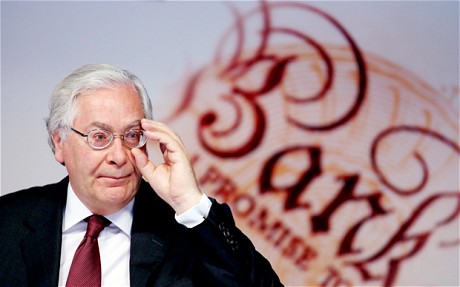
Despite record low interest rates, printing new money and other emergency measures, governments had not yet addressed the underlying problem of overspending that was at the root of the financial crisis, Sir Mervyn King warned. The consequences threatened to “inflict pain on everyone”, he said.
In a sobering assessment of the world economy, Sir Mervyn warned that even if world leaders managed to agree on emergency moves to support the banking system and debt-stricken economies such as Greece, they would still not have averted the threat to global stability.
Unless overspending by Western economies was curbed it would bring about an ever-larger debt crisis that would mean much lower long-term growth rates, he said.
Worse, he suggested, some of the measures being deployed to counter the short-term situation could actually exacerbate fundamental economic problems, worsening the debt crisis and leaving taxpayers footing an even larger bill.
Sir Mervyn delivered his gloomy verdict as official figures showed that inflation surged to 5.2 per cent last month, squeezing living standards and eroding the value of savings and pensions. Inflation was “at or close to” its peak and would soon start to fall back towards the Bank’s two per cent target, he said. » | James Kirkup | Tuesday, October 18, 2011
September 30, 2011
THE DAILY TELEGRAPH: There is a growing risk that the global economy will move from the 'Great Recession' into the 'Great Stagnation', according to economists at Goldman Sachs.
Stagnations typically mean long periods of sluggish growth of about 0.5pc, low inflation, rising and sticky unemployment, stagnant house prices, and lower returns on shares, they said.
There is a 40pc chance of the current situation developing into a period of stagnation among developed economies, Goldman calculated.
"Trends in Europe and the US are so far still following growth paths that would be typical of stagnations," they said in a note.
"Given those risks, whether these countries manage to avoid a ‘Great Stagnation’ by a pick-up in the recovery is likely to depend on policy being able to restore confidence and putting in place reforms that can decisively jolt growth". » | Angela Monaghan, Economics Correspondent | Friday, September 30, 2011
'Great Stagnation'? What a load of cobblers! 'Great Depression,' more like! And just who are the people who played a large part in this mess? And just what do they mean when they talk about a period of low inflation? Inflation is already running pretty high, despite the economy in a deep recession, sliding toward depression.
Best to ignore the Mickey Mouse economists at Goldman Sachs. They're all waiting for their fat bonuses. However bad the depression will be, they'll see to it that they and theirs are well-provided for. – © Mark
This comment also appears here
August 08, 2011
May 06, 2011
TELEGRAPH – BLOGS – JEREMY WARNER: It’s all a bit worrying. Evidence of a sharp slowdown in both the European and world economies continues to mount. Earlier confidence that the global economy was strong enough to absorb moves by China and other emerging markets to tighten policy in the face of rising inflation are being increasingly questioned. Today alone, there’s been a whole clutch of indicators suggesting trouble on the way. Here’s a list of the top ten. » | Jeremy Warner | Thursday, May 05, 2011
December 14, 2008
THE SUNDAY TIMES: American Account
“DON’T project beyond the range of the known observations” is a rule followed by careful economists. In plain English this means, for example, that we know how American consumers behave when petrol prices move between $1 and $4 a gallon, “the range of the known observations”. But we haven’t much of an idea what consumers would do if prices rose to $5 — no experience, no data to inform our forecasts. Which is why we have to be very careful when predicting the effect of the various policies that are being adopted to fight the credit crisis and recession. We simply have no experience of this combination of events.
So we have reason to worry about the galaxy of stars that Barack Obama has assembled to help him right the American economy. They are so bright, so self-confident, so accustomed to being the smartest guy or girl in the room, that doubt is not one of the emotions with which they are familiar, as was true of the bright young “quants” (mathematical economists) who designed the models used to manage the risks taken on by Lehman Brothers and AIG. Something about hubris and nemesis comes to mind. >>> Irwin Stelzer | Sunday, December 14, 2008
The Dawning of a New Dark Age – Paperback (US) Barnes & Noble >>>
The Dawning of a New Dark Age – Hardcover (US) Barnes & Noble >>>
Subscribe to:
Posts (Atom)