March 05, 2010

Azerbaijan President's Son, 12, 'Buys £30m Worth of Luxury Dubai Property'

THE TELEGRAPH: The 12-year-old son of the Azerbaijan president has gone on a multi-million pound property spending spree, buying up a series of luxury Dubai waterfront mansions.

Heydar Aliyev, the son of Ilham Aliyev, the oil-rich country’s president, allegedly spent almost £30 million (US$44 million) on nine waterfront mansions in the southern Gulf emirate earlier this year, reports said.

The boy, who was 11 at the time, made the purchase in the Palm Jumeirah development over two weeks, the Washington Post reported on Friday.

Heydar’s name and his date of birth appeared on Dubai Land Department records, which were obtained by the paper.

The details listed on the property records were the same as those of the son of the former Soviet Republic’s president, whose annual salary is about £150,000 ($228,000).

The purchases are about the equivalent to 10,000 years' worth of salary for the average citizen of the country. >>> Andrew Hough | Friday, March 05, 2010
Germans Tell Greeks to Rise Earlier and Work Harder to Avoid Financial Crisis

THE TELEGRAPH: A German tabloid has advised Greeks to adopt a more Germanic work ethic – by rising earlier and working harder – in order to solve the country's financial crisis.

On Thursday, two German politicians told their Greek counterparts that the country should sell off its assets – art, historic buildings and islands – before accepting international aid.

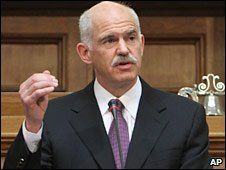
George Papandreou, the Greek prime minister, was dispatched abroad, to seek the help of European leaders including Angela Merkel, the German chancellor, in addressing the country's mounting debt.

But Germany's Bild tabloid had another suggestion, calling on Greek citizens to adopt a more Germanic work ethic in an open letter to Mr Papandreou. Dear Mr Prime Minister, >>> | Friday, March 05, 2010
Barroso Tells Greece: "Full Compliance Paramount"

Schuldenkrise: Empörte Griechen wollen Inseln nicht verkaufen

WELT ONLINE: Damit Griechenland aus den Schulden rauskommt, haben Politiker von CDU und FDP den Verkauf von unbewohnten griechischen Inseln gefordert. Die Empörung ist groß, denn die Griechen denken an die deutsche Besatzung während des Zweiten Weltkrieges zurück. Angela Merkel soll sich jetzt für die Idee entschuldigen.


Politiker von CDU und FDP haben Griechenland aufgefordert, zur Bewältigung der Schuldenkrise unbewohnte Inseln zu verkaufen – und damit für Empörung gesorgt. Der Vorsitzende der CDU- Mittelstandsvereinigung, Josef Schlarmann, sagte der „Bild“-Zeitung, Griechenland besitze Gebäude, Firmen und unbewohnte Inseln, die zur Schuldentilgung eingesetzt werden könnten.

„Ein Bankrotteur muss alles, was er hat, zu Geld machen, um seine Gläubiger zu bedienen.“ Der FDP-Finanzexperte Frank Schäffler sagte:
„Der griechische Staat muss sich radikal von Beteiligungen an Firmen trennen und auch Grundbesitz, zum Beispiel unbewohnte Inseln, verkaufen.“
Der Linken-Vorsitzende Lothar Bisky forderte von Kanzlerin Angela Merkel (CDU) eine Entschuldigung für den Vorstoß. „Die Herren von Union und FDP haben wohl vergessen, wer zuletzt den Versuch gemacht hat, griechische Inseln zu erobern. So ein Vorschlag aus Deutschland ruft bei vielen Menschen in Griechenland entsetzliche Erinnerungen auf“, kritisierte Bisky.

Deutschland hatte Griechenland im Zweiten Weltkrieg besetzt. Deutsche Soldaten verübten damals Massaker unter der Zivilbevölkerung. Bisky forderte nun, Merkel solle sich öffentlich bei Griechenlands Regierungschef Giorgos Papandreou entschuldigen. Merkel trifft Papandreou am Freitag in Berlin. >>> dpa/afp/jm | Donnerstag, 04. März 2010
Ja zu milliardenschwerem Sparprogramm: Abstimmung im griechischen Parlament – Schwere Krawalle in Athen

NZZ ONLINE: Unmittelbar vor einem Krisentreffen in Berlin mit dem griechischen Regierungschef Papandreou hat das Parlament in Athen das milliardenschwere Sparpaket gebilligt. Bei einer Protestkundgebung vor dem Parlamentsgebäude kam es zu schweren Zusammenstössen.

Nach den Krawallen vor dem Parlament sprachen Beobachter vom heftigsten Ausbruch der Gewalt in Griechenland seit den Jugendunruhen von 2008. Damit gerät die griechische Regierung nicht nur finanziell, sondern auch innenpolitisch unter wachsenden Druck. Massiver Druck der EU >>> ddp | Freitag, 05. März 2010

Treffen mit Papandreou: Merkel droht den Griechenland-Spekulanten

WELT ONLINE: Bundeskanzlerin Angela Merkel (CDU) will Spekulanten das Handwerk legen, die mit den Problemen Griechenlands Geld verdienen. Nach einem Treffen mit dem griechischen Premier Giorgos Papandreou lobt Merkel dessen Sparprogramm. Als erste Hilfe für den verschuldeten Staat gibt es eine neue Kommission.

Bundeskanzlerin Angela Merkel (CDU) hat das Milliarden-Sparprogramm der griechischen Regierung als außerordentlich wichtigen Schritt begrüßt. Zugleich kündigte sie schärfere Maßnahmen gegen Spekulanten an den Märkten an.

Man habe mit Freude zur Kenntnis genommen worden, dass die griechische Regierung und das Parlament in Athen weiterführende Maßnahmen beschlossen hätten, sagte Merkel nach einem Gespräch mit dem griechischen Premierminister Giorgos Papandreou in Berlin. Dies sei ein wichtiger Schritt.

Merkel sprach sich für Maßnahmen gegen Spekulanten aus, die von der Krise in Griechenland profitieren. „Wir müssen es schaffen, den Spekulanten das Handwerk zu legen“, sagte die Bundeskanzlerin. Dies sei ein schwieriger Prozess. „Die Politik hat aber das Primat.“ >>> dpa/Reuters/oht | Freitag, 05. März 2010
ECO:nomics: The Economics of Electric Cars

The US Economy: Jobless Rate at 9.7%

The Future of Oil

March 04, 2010

Dette de la Grèce: et si elle vendait ses îles?

Quelle folie! – Mark

TRIBUNE DE GENÈVE: PROPOSITION | Des députés allemands ont appelé la Grèce à vendre des îles pour aider à financer sa dette.

Photo: Tribune de Genève

Le quotidien populaire allemand Bild révèle cette information jeudi, qu'il résume l’idée en ces termes: "On vous donne du fric, vous nous donnez Corfou".

"L’Etat grec doit renoncer à sa participation dans des sociétés, et vendre des propriétés foncières, comme par exemple des îles inhabitées", a affirmé au journal le député libéral Frank Schäffler, du parti FDP au pouvoir. >>> AFP | Jeudi 04 Mars 2010

Greece Should Sell Islands to Keep Bankruptcy at Bay, Say German MPs

What a stupid idea! Really dumb! – Mark

THE GUARDIAN: Fire sale of Greek islands, Acropolis and Parthenon suggested / Greek public reacts with outrage and boycotts German goods

Josef Schlarmann told Bild newspaper that Greece should consider selling its uninhabited islands for debt redemption. Photograph: The Guardian

Greece must consider a fire sale of land, historic buildings and art works to cut its debts, two rightwing German politicians said today in a newspaper interview that is bound to exacerbate tensions between Athens and Berlin.

Alongside austerity measures such as cuts to public sector pay and a freeze on state pensions, why not sell a few uninhabited islands or ancient artefacts, asked Josef Schlarmann, a senior member of Angela Merkel's Christian Democrats, and Frank Schaeffler, a finance policy expert in the Free Democrats.

The Acropolis and the Parthenon could also fall under the hammer, along with temptingly idyllic Aegean islands still under state ownership, in a rush to keep bankruptcy at bay.

"Those in insolvency have to sell everything they have to pay their creditors," Schlarmann told Bild newspaper. "Greece owns buildings, companies and uninhabited islands, which could all be used for debt redemption." >>> Phillip Inman and Helena Smith | Thursday, March 04, 2010

Verkauft doch eure Inseln, ihr Pleite-Griechen ... UND DIE AKROPOLIS GLEICH MIT!

Welch eine Dummheit! – Mark

BILD.de: Jetzt machen die Griechen ernst, um ihr Land vor dem Bankrott zu retten, ohne auf EU-Hilfe angewiesen zu sein!

Gestern beschloss die Regierung in Athen: Die Mehrwertsteuer rauf (von 19 auf 21%), Alkohol, Luxusgüter und Tabak teurer, die Bezüge von Staatsdienern, Rentnern, Studenten gekürzt.

4,8 Mrd. Euro soll das Sparprogramm bringen – aber bei Staatsschulden von mehr als 300 Mrd. Euro ist das nicht mal ein Tropfen auf den heißen Stein ...

Was kann die Griechen dann noch retten?

Auch wenn es vielleicht verrückt klingt: Wenn wir den Griechen doch noch mit Milliarden Euro aushelfen müssen, sollten sie dafür auch etwas hergeben – z. B. ein paar ihrer wunderschönen Inseln. Motto: Ihr kriegt Kohle. Wir kriegen Korfu.

Tatsächlich ist es der größte Schatz der Griechen: 3054 Inseln, nur 87 davon bewohnt.

Und einen Markt gibt es! Derzeit bietet z. B. das Hamburger Maklerbüro Vladi Private Islands eine unbewohnte griechische Insel an – Verhandlungsbasis: 45 Mio. Euro.

Ob die Kanzlerin morgen mit ihrem Amtskollegen Papandreou bei dessen Berlin-Besuch die Insel-Frage anschneidet ...?

Der Koalitionspartner rät dazu. FDP-Finanzexperte Frank Schäffler zu BILD: „Die Kanzlerin darf keinen Rechtsbruch begehen, darf Griechenland keine Hilfen versprechen. Der griechische Staat muss sich radikal von Beteiligungen an Firmen trennen und auch Grundbesitz, z. B. unbewohnte Inseln, verkaufen.“

CDU-Mittelstandschef Josef Schlarmann: „Ein Bankrotteur muss alles, was er hat, zu Geld machen – um seine Gläubiger zu bedienen. Griechenland besitzt Gebäude, Firmen und unbewohnte Inseln, die für die Schuldentilgung eingesetzt werden können.“ >>> jan/pro/rok | Donnerstag, 04. März 2010
Income Tax

Tax is for the little people >>> | Wednesday, March 03, 2010

March 03, 2010

Crise : Et si l'Europe coulait la Grèce ?

L’EXPANSION.fr: Hausse des impôts, baisses des salaires, gel des retraites... L'heure est à l'austérité budgétaire en Grèce. Bruxelles ne lui a pas laissé d'autre choix. Au risque d'asphyxier l'économie encore en crise de la péninsule.

Sous la pression de Bruxelles, le gouvernement grec a annoncé ce mercredi de nouvelles mesures d'austérité permettant d'économiser 4,8 milliards d'euros. Athènes avait déjà présenté début février un plan de redressement budgétaire équivalent (environ 4,7 milliards d'euros) pour 2010. Mais pour l'UE, ce n'était pas encore assez pour atteindre l'objectif de réduire le déficit public du pays de quatre points, et passer de 12,7% en 2009 à 8,7% du PIB en 2010.

Il est vrai que la crise financière traversée par la péninsule hellénique pourrait coûter 0,2 point de croissance à la zone euro cette année. Plus grave encore, elle menace d'éclatement l'Euroland, la monnaie unique européenne étant l'objet d'attaques spéculatives des marchés financiers. Reste que le plus lourd tribut à cette crise grecque sera payé par la Grèce elle-même.

Contrairement à la plupart des grandes économies européennes, la péninsule hellénique n'est pas sortie de la récession en 2009. Et elle devrait le rester en 2010 : après une baisse de 1,2% l'an passé, son PIB devrait reculer de 0,3% cette année selon les prévisions de la Commission européenne publiées à l'automne. Voire de beaucoup plus.

Une austérité contre-productive

Les mesures d'austérité prévues par le gouvernement grec - hausse de la TVA, gel des retraites, coupes dans les salaires des fonctionnaires, suppression d'exonérations d'impôts pour les sociétés, hausses des taxes sur le tabac, l'essence, les cigarettes, etc. - vont en effet avoir un effet dépressif fort sur la demande intérieure. >>> Emilie Lévêque | Mercredi 03 Mars 2010
La guerre économique! Economic Warfare! Wirtschafts-Krieg! Affaire Libyenne : La Libye décide un embargo économique «total» sur la Suisse

Mouammar Kadhafi. Photo: Le Temps

LE TEMPS: La Libye a décidé d’imposer un embargo économique «total» sur la Suisse dans la foulée de la crise diplomatique entre les deux pays, a déclaré mercredi à l’AFP le porte-parole du gouvernement libyen, Mohamed Baayou

«La Libye a décidé d’imposer un embargo total sur tous les échanges économiques et commerciaux avec la Suisse», a indiqué M. Baayou.

Elle a décidé par ailleurs d’»adopter d’autres alternatives en ce qui concerne les médicaments et les équipements médicaux et industriels» suisses importés par Tripoli, a-t-il précisé. >>> AFP | Mercredi 03 Mars 2010
Hélas pour Recep Tayyip Erdogan, la Turquie n'est pas... le Brésil

LE MONDE: Recep Tayyip Erdogan va avoir besoin de talent autant que de chance. Le premier ministre turc affiche un assez bon bilan économique : il a stabilisé la dette de l'Etat et favorisé un appréciable taux de croissance avant que la récession ne s'installe du fait de la crise mondiale. Cependant, son parti, l'AKP, au pouvoir depuis 2002, est confronté à des problèmes internes sans vraie perspective d'aide extérieure.

La situation économique n'est pas désastreuse. La crise est certes profonde et les taux d'inflation et de chômage préoccupants, mais le déficit budgétaire de la Turquie est maîtrisé. Dès qu'une vraie reprise s'amorcera pour l'économie internationale, le pays devrait renouer avec la croissance.

Popularité entamée

Reste que la crise grecque a bouché les perspectives déjà sombres d'une adhésion de la Turquie à l'Union européenne (UE). Celle-ci, qui s'inquiète de devoir renflouer ses Etats membres, ne voudra pas intégrer un pays pauvre, très peuplé et enclin aux déficits budgétaires lourds. Souhaitée aussi bien par Ankara, qui y voit une aide au développement, que par l'opposition laïque, car elle constituerait un rempart contre les tendances islamistes du gouvernement, l'adhésion n'est pourtant pas au programme. La récession, naturellement, a entamé la popularité du gouvernement. >>> Martin Hutchinson | Traduction de Julie Marcot | Mercredi 03 Mars 2010
Greece on the Brink: Anatomy of a Debt Crisis

Europe's Original Sin: National Leaders Ignored Greece's Soaring Debt for Years

THE WALL STREET JOURNAL: Europeans are blaming financial transactions arranged by Wall Street for bringing Greece to the brink of needing a bailout. But a close look at the country's finances over the nearly 10 years since it adopted the euro shows not only that Greece was the principal author of its debt problems, but also that fellow European governments repeatedly turned a blind eye to its flouting of rules.

Though the European Commission and the U.S. Federal Reserve are examining a controversial 2001 swap arranged with Goldman Sachs Group Inc., Greece's own budget moves, in clear breach of European Union rules, dwarfed the effect of such deals.

Predicaments of the sort Greece is facing—years of overspending, leaving bond investors worried the country can't pay back its debts—weren't supposed to happen in the euro zone. Early on, countries made a pact aimed at preventing a free-spending state from undermining the common currency. The pact required countries adopting the euro to limit annual budget deficits to 3% of gross domestic product, and total government debt to 60% of GDP.

But an examination of budget reports to the EU shows Greece hasn't met the deficit rule in any year except 2006. It has never been within 30 percentage points of the debt ceiling. >>> Charles Forelle and Stephen Fiddler | Wednesday, March 03, 2010
Greece's budget crisis is like wartime situation - PM

BBC: Greek Prime Minister George Papandreou has likened the country's budget crisis to a "wartime situation".

He said Greece was at risk of bankruptcy if it did not take radical extra measures to cut its debts.

The comments come as Mr Papandreou is due to announce further big budget cuts following the pressure from the EU.

The government in Athens has pledged to reduce its deficit from 12.7% - more than four times eurozone rules - to 8.7% during 2010.

It also also seeking to reduce its 300bn euros ($419bn; £259bn) debt.

'Blow to wallets'

"We find ourselves in a wartime situation, faced with the negative scenarios affecting our country," Mr Papandreou told the parliamentary group of his Socialist Party (Pasok).

He said that Greece had to avoid "a nightmare of bankruptcy" in which the state would not be able to pay salaries or pensions.

Mr Papandreou has used some dramatic phrases to describe Greece's fiscal problems over the past few months, but this was his most alarmist to date, the BBC's Malcolm Brabant in Athens says.

The prime minister was effectively telling Greeks to prepare themselves for another blow to their wallets, our correspondent adds. >>> | Tuesday, March 02, 2010

March 02, 2010

Grèce : Athènes va annoncer de nouvelles économies

LE TEMPS: Le gouvernement de George Papandréou viserait 4,8 milliards d’économies supplémentaires, pour rassurer les marchés obligataires, Bruxelles et surtout l’Allemagne, encore réticente à lui accorder son aide

Face aux pressions de l’Union européenne et des investisseurs, le gouvernement grec s’apprête à annoncer quelque 4,8 milliards d’euros de réduction budgétaire en plus des engagements d’austérité qu’il a déjà pris.

Les nouvelles mesures d’économie influeraient notamment des taxes plus élevées sur le tabac, l’alcool, une augmentation de la TVA, et de nouvelles coupes dans les primes variables des fonctionnaires, a indiqué mardi une source gouvernementale. >>> Le Temps | Mardi 02 Mars 2010
HSBC Hands Top Banker £9 million Bonus

TIMES ONLINE: One of the biggest bonuses seen this year for any London-based banker was revealed today as HSBC announced it had given Stuart Gulliver, its head of investment banking, a £9.8 million package.

Mr Gulliver was awarded a £9 million bonus on top of his £800,000 base pay for his "exceptional performance" in trebling the profits of his division to $10.5 billion, HSBC said.

The payment came as Michael Geoghegan, HSBC chief executive, confirmed that he will give his £4 million bonus to charity.

HSBC disappointed investors after full-year profits fell by 24 per cent to $7.1 billion (£4.7 billion) following a big write down of the value of its own bonds. Its shares lost more than 5 per cent, down 37.1p, to 682.46p. >>> Patrick Hosking and Catherine Boyle | Monday, March 01, 2010

March 01, 2010

Pound Slumps to Nine-month Low Over Fears of a Hung Parliament

MAIL ONLINE: The pound slumped to a nine-month low against the dollar today as fears over a hung Parliament sparked a sterling sell-off.

The currency fell sharply to as low as 1.478 against the dollar, as well as dropping below 1.10 against the euro.

Pressure on the pound comes as the Conservative lead against Labour in the polls narrows - threatening an indecisive General Election result at the same time markets want firm action to sort out the UK's dire public finances.

Mark O'Sullivan, director of dealing at foreign exchange firm Currencies Direct, said: 'Until the political situation in the UK becomes clearer, sterling will remain very, very vulnerable.'

The sudden drop from 1.52 to below 1.48 is the pound's biggest one-day fall since January last year, according to Chris Turner, head of FX Strategy at ING Commercial Banking.

He warned: 'While UK policymakers may have quietly welcomed the pound's recent weakness, they will not appreciate the kind of fast markets that can see a "sell UK" mentality developing.'

Sterling has lost nearly 10 cents against the dollar in little more than a week - hitting holidaymakers in the pocket, increasing pressure on petrol pump prices and adding to import costs for businesses. Read on and comment >>> | Monday, March 01, 2010
Sorgen um Griechenland: Der geheime deutsche Rettungsplan

BASLER ZEITUNG: Offiziell bestreiten die Deutschen noch immer, dass sie für die Griechen Geld springen lassen werden. Doch vieles spricht dafür, dass sie bereits an einem Trick arbeiten, um trotzdem einzugreifen.

Basteln sie im Hintergrund bereits an einer Rettungsaktion? Deutsche Bank-Chef Joe Ackermann (links), Bundeskanzlerin Angela Merkel (rechts). Bild: Basler Zeitung

Wegen der Griechenlandkrise kommen die europäischen Staaten Deutschland und Frankreich zunehmend unter Druck. An den internationalen Kapitalmärkten wird von ihnen rasch ein stützendes Eingreifen erwartet. Doch in Deutschland wäre ein solcher Schritt äusserst unpopulär, laut Umfragen lehnt das eine deutliche Mehrheit der Bevölkerung ab. Ausserdem gälte es als verheerendes Signal, wenn ein Land wie Griechenland, das sich um die Regeln der Währungsunion bisher derart foutiert hat, durch Steuergelder der anderen gerettet werden würde.

Deshalb betont besonders die deutsche Regierung nach wie vor, dass von ihr keine Hilfe erfolgen werde. Die Franzosen wiederum sagen, ohne Beteiligung der Deutschen würden auch sie nichts bezahlen. Auch die Griechen dementieren weiterhin, Hilfe zu beantragen. Die offizielle Sprachregelung ist noch immer, dass die Griechen erst einmal glaubhaft damit beginnen sollten, das eigene Haus in Ordnung zu bringen. Erst am 16. März soll die nächste Prüfung der Lage vorgenommen werden. >>> Von Markus Diem Meier | Montag, 01. März 2010