Showing posts with label Renmimbi. Show all posts
Showing posts with label Renmimbi. Show all posts
June 13, 2017
Unheralded Chinese Bonds Offer | Short View
January 14, 2016
'China to Spark Global Financial Ice Age with Depression Sending Markets Crashing by 75%'
The sinking value of the Chinese currency is already crippling British industry as it can’t compete with China’s cheap exports.
Other Western nations are also feeling the strain.
And with even more to come experts have predicted an 'ice age' for the world’s economies – including Britain’s.
Global deflation is going to wipe around 75 per cent in value off the American S&P stock market, as western firms will be unable to compete with cheap Chinese exports, according to analyst Albert Edwards from french bank Societe Generale.
He gave the stark warning in an investment note to clients.
And he blamed the upcoming 'carnage' on American central bank (the Fed) and its British and European counterparts for inflating prices in the first place.
American Quantitative Easing (QE) - injecting extra money into the financial system - has push up global asset prices, teeing up a disastrous fall, Mr Edward believes.
He said: "Investors are coming to terms with what a Chinese renminbi devaluation means for Western markets.
"It means global deflation and recession. » | Lana Clements | Thursday, January 14, 2016
November 29, 2015
IMF to Make Chinese Yuan Reserve Currency in Historic Move

The International Monetary Fund is to give the yuan a historic vote of confidence on Monday when it includes the Chinese currency in its elite club of major currencies.
The yuan, also known as the renminbi, is widely expected to be added to the IMF’s group of international reserve currencies after an IMF meeting held by its managing director Christine Lagarde.
It comes after lengthy efforts by Chinese officials to legitimise the yuan, which critics say has been kept artificially cheap to artificially boost exports in the world’s second-largest economy.
China has lobbied hard for the currency to be included in the list, which at present is made up of just the dollar, the euro, the pound and the Japanese yen. The list has not been altered since 2000, when the euro replace[d] the franc and deutschmark. Read on and comment » | James Titcomb | Sunday, November 29, 2015
August 12, 2015
China Stuns Financial Markets by Devaluing Yuan for Second Day Running
China stunned the world’s financial markets on Wednesday by devaluing the yuan for the second consecutive day, triggering fears the world’s second largest economy is in worse shape than investors believed.
The move sent fresh shockwaves through global markets, pushing shares sharply lower and sending commodity prices further into reverse as traders feared the move could ignite a currency war that would destabilise the world economy.
There were widespread losses in Asia, and in Europe stock markets suffered falls of about 1%, with the FTSE 100 tumbling almost 2% at one stage. » | Martin Farrer and Fergus Ryan in Beijing | Wednesday, August 12, 2015
January 12, 2011
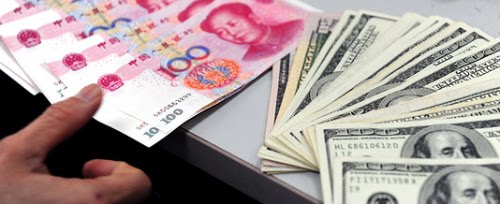
THE WALL STREET JOURNAL: China has launched trading in its currency in the U.S. for the first time, an explicit endorsement by Beijing of the fast-growing market in the yuan and a significant step in the country's plan to foster global trading in its currency.
The state-controlled Bank of China Ltd. is allowing customers to trade the yuan, also known as the renminbi, in the U.S., expanding the nascent offshore market for the currency which began last year in Hong Kong.
The decision is the latest move by China to allow the yuan, whose value is still tightly controlled by the government, to become an international currency that can be used for trade and investment.
"We're preparing for the day when renminbi becomes fully convertible," Li Xiaojing, general manager of Bank of China's New York branch, told The Wall Street Journal. He said the bank's goal is to become "the renminbi clearing center in America." >>> Lingling Wei | Wednesday, January 12, 2011
Subscribe to:
Posts (Atom)