March 06, 2008

The Risky Business of Islamic Finance

INVESTOR’S BUSINESS DAILY: Islamofascism: Shariah banking has come into vogue in the West, as even cash-strapped U.S. banks try to attract free-flowing Arab petrodollars. But it poses major risks. Wall Street beware.

With oil prices hovering around $100 a barrel, more than $1 trillion in petrodollars are now available annually for global investment. And major U.S. financial institutions, hit hard by the credit crunch, are hungrily eyeing them.

Citibank and Goldman Sachs, for example, are creating investment vehicles that cater to Muslim investors in order to grab some of the billions in management fees in the offing. These products include Shariah-compliant bonds, mutual funds, mortgages, insurance, hedge funds and soon REITs.

Dow Jones Corp. has even created its own index for Islamic-correct investments: the Dow Jones Islamic Index.

While the $800 billion global Shariah market is relatively small, it's growing at a 15% clip, thanks to the oil boom and a resurgence in Islamic fundamentalism, according to the Center for Security Policy. And it's expected to more than double over the next 10 years.

What's the fuss? Money is money, right? Not in this case.
Shariah-compliant finance involves investments and other transactions that have been structured to conform with the orthodox teachings of Islamic law.

That means they can't charge or earn interest — the cornerstone of our credit-driven economy. Nor can they take any stake in haram, or forbidden, industries, including meat and beverage producers (if they process any pork or alcohol); entertainment; gaming; and interest-based financing.

Wall Street is jumping into this hot new market oblivious to the risks not just to the bottom line, but to national security. It knows little about Shariah law and is turning to consultants to create "ethical" products to sell.

Lost in the hype over these Muslim-friendly funds is that they must "purify" their returns by transferring at least 3% into Islamic charities, many of which funnel funds to terrorists. So the Street may unwittingly be helping the evildoers launder blood money.

Shariah law obligates that a sizable portion of zakat, or giving — one of the pillars of Islam — go to support jihad. So many of the purification donations generated from Shariah finance could wind up in the hands of our enemy.

Wall Street also knows little about who's advising these funds. Each has to hire Muslim scholars to bless the investments.
One such scholar is Yusuf Qaradawi, a member of the radical Muslim Brotherhood, which works for the establishment of a global caliphate, and an open supporter of suicide bombings.

Another is Muhammad Usmani, a radical Pakistani cleric who ran a madrassa that trained thousands of Taliban, according to the Washington-based Center for Security Policy.

Usmani sits on the Shariah supervisory board of the Dow Jones Islamic Index Fund, which is run by the North American Islamic Trust — a Saudi-tied alleged front for the Muslim Brotherhood that holds title to some of the most radical mosques in America. The Justice Department last year named the Islamic Trust an unindicted co-conspirator in a major terror-financing case.

It is this radical group, which may be using investment proceeds to finance new mosques in America, to which Dow Jones has lent its name — something the company, under the new management of Fox News founder Rupert Murdoch, may want to revisit. The Risky Business of Islamic Finance >>>

Mark Alexander (Paperback)
Mark Alexander (Hardback)
March 05, 2008

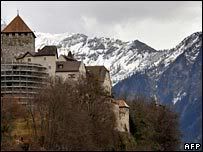
Is Time Running Out for Tax Havens such as Fürstentum Liechtenstein

Photobucket
Photo of Liechtenstein courtesy of the BBC

"Liechtenstein has existed for hundreds of years and weathered many storms" - Prince Max von und zu Liechtenstein

BBC: The bankers in their grey suits and silk shirts looked a bit bemused.

The annual press conference of LGT, the Liechtenstein bank at the centre of the tax evasion controversy, is usually a dull and dry affair.

But it wasn't this year. The room was packed.

And every question was about the scandal in which German intelligence purchased a data disc stolen from the bank, filled with details of Germans who allegedly tried to evade paying tax back home.

Fourteen other countries, including Britain, are conducting inquiries into their own citizens on the disc for tax evasion.

The head of the LGT, His Serene Highness Prince Max von und zu Liechtenstein, is a member of the principality's ruling family.

Speaking afterwards, when I pressed him on the £100m Britain expects to get back from UK taxpayers who used LGT to evade paying tax, he told me Liechtenstein was being treated unfairly - and that Britain, too, was a keen player on offshore finance markets.

"There is tax competition going on on a global basis. The British have positioned themselves very well in a number of areas - not only in their [dependent] territories, but also in the UK," he said.

The British government says it is keen to clamp down on people using other havens to hide their money.

But other critics also say Britain is being inconsistent, with tax havens such as Bermuda or the Cayman Islands operating from British dependent territories.

"Because of the number of places that the UK allows to operate as tax havens, our role in providing the secrecy spaces that these locations provide, which harbour crime, is greater than Liechtenstein's," says Richard Murphy, a campaigner on tax issues.

"We're the biggest tax haven operator in the world. They've been seen as useful. They've brought money into London, Switzerland and other financial centres, and for that reason, London has tolerated them." Is Time Running Out for Tax Havens? >>> By Ray Furlong, Vaduz

Mark Alexander (Paperback)
Mark Alexander (Hardback)

Zapatero’s Poll Lead Falters as Good Times Fade in Spain

TIMES ONLINE: New figures showing rising unemployment, sinking house prices and a stalling economy have rocked the Spanish Government in the final days of a bitterly fought general election.

Hours after being proclaimed the victor of the second televised debate José Luis RodrÍguez Zapatero, the Socialist Prime Minister, struggled to explain why more than 50,000 Spaniards lost their jobs last month.

Unemployment now tops 2.3 million, or 8.6 per cent, as struggling construction firms make workers redundant and the property bubble deflates.

The two main political parties this week began a final assault to capture undecided voters before Sunday’s poll. The Prime Minister and Mariano Rajoy, his conservative opponent, have clashed in two ill-tempered television debates over the slowing economy, rising immigration and the fight against terrorism.

The opposition leader repeatedly called the Prime Minister a liar and accused him of insulting the victims of Eta by holding peace talks with the Basque separatist group last year.

Polls showed that the Prime Minister was thought to have won both debates but neither candidate was able to land a knockout blow. Analysts said that the duels, which attracted record television audiences, had galvanised voters but failed to give either candidate a commanding lead. Jose Luis Rodriguez Zapatero's poll lead falters as good times fade in Spain >>> By Thomas Catan in Madrid

Mark Alexander (Paperback)
Mark Alexander (Hardback)
March 04, 2008

Dhimmifinanciers: Home Ownership the Shari’ah Way

How Western companies are falling over themselves to become Dhimmifinanciers:

Mark Alexander (Paperback)
Mark Alexander (Hardback)
Oil Prices Near $104 a Barrel as US Dollar Falls to Historic Low Against the Euro

INTERNATIONAL HERALD TRIBUNE: NEW YORK: The price of oil rose Monday to nearly $104 a barrel after the dollar fell to a historic low against the euro, setting a record and exceeding the inflation-adjusted high reached in the early 1980s during the second oil shock.

Oil futures touched $103.95 on the New York Mercantile Exchange, topping the record set in April 1980 of $39.50 a barrel, a level that would translate to $103.76 a barrel at current values.

Oil prices are surging as investors seek refuge in commodities to offset a slowing U.S. economy and declines in the dollar.
Financial institutions, like pension funds and hedge funds, are also investing heavily in oil and other commodities as a hedge against a rise in inflation, analysts said.

That trend is expected to continue, especially after Ben Bernanke, the chairman of the Federal Reserve, signaled last week that he was ready to cut interest rates further to bolster growth despite rising consumer prices.

"When investors lose confidence in the central bank, they tend to look for hard assets," Philip Verleger, an independent economist and oil expert, said. "The Fed's capitulation on inflation is driving investors to commodities. The problem is there are no sellers. This means futures prices will keep rising." Oil prices near $104 a barrel as dollar falls to historic low against euro >>> By Jad Mouawad | March 3, 2008

Mark Alexander (Paperback)
Mark Alexander (Hardback)
Islamic Finance and the Square Mile

Photobucket
Image courtesy of Google Images

TIMES ONLINE: How does Sharia fit into the heated debate about the relationship between the British legal system and religious codes?

Here’s a thought. If all the sub-prime deals in the US had been governed by Sharia there would have been no massive defaults and the credit crunch would never have loomed over our shopping expeditions.

Instead, Islamic law’s requirements for prudent lending, the sharing of risk and a ban on the earning of interest would have insulated the borrowers and the world economy at large from the debacle of the past six months. And for that even the Archbishop of Canterbury’s harshest critics might have been a mite grateful.

So how does Islamic finance — now increasingly practised by law firms in London and New York — fit into the heated debate about the relationship between the British legal system and religious codes?

The Prime Minister in particular needs to have an answer to that. Last week he was quoted as saying that: “British laws must be based on British values and religious law should be subservient to British criminal and civil law.” How come then that Gordon Brown, when Chancellor, wanted “to make Britain the gateway to Islamic finance and trade”? And, to support that, government introduced changes to the taxation regime to accommodate Sharia-compliant transactions.

To appreciate the full impact of Sharia on City law and business you have only to go to Clifford Chance where Islamic finance is an important activity. The firm was named Euromoney Islamic finance firm of the year in 2007 and it has scores of lawyers both in the Middle East and in London practising Sharia. Habib Motani explains: “Doing deals that are Sharia compliant is a standard part of what we do. It’s part of the mainstream.”

But does this mean that there is now a rival jurisdiction operating in London? Has Sharia sneaked into the Square Mile by the back door while the good Archbishop waits befuddled at the front? Well, in the spirit of Canterbury unclarity, the answer is Yes (and a little bit No). What is clear is that transactions hatched in London by UK lawyers are being reviewed by Sharia scholars in the Middle and Far East who judge whether or not they comply with Islamic law. If they do not, they do not go ahead. So in practice the jurisdiction of Sharia is now well established in Britain. Islamic finance and the Square Mile >>> By Edward Fennell

TIMES ONLINE:
London risks losing its lead in Islamic finance: Reports that the Government has gone cold on plans to issue its own sukuk, or Sharia bond, is a blow for the City By Michael Herman

Mark Alexander (Paperback)
Mark Alexander (Hardback)
Europe vs the Super-Rich

THE INDEPENDENT: The European Union will declare war today on Liechtenstein, Monaco, Andorra and Switzerland. Weary of losing billions of tax euros, the EU's 27-strong high command of economics and finance ministers, Ecofin, is meeting in Brussels to agree a strategy aimed at bringing the continent's tax havens under control.

Their weapon of choice will be a strengthened version of the EU's 2005 savings tax directive, which has proved pathetically easy for armies of accountants, lawyers and specialist tax planners to outflank.

Urged on by Peer Steinbruck, the German Finance Minister, the new directive will seek to close the loopholes. Mr Steinbruck says tax evasion costs Germany about €30bn (£23bn) a year in lost revenue; the UK loses a similar sum; the EU may lose €100bn (£77bn) in all.

The stakes are high. But tax experts remain sceptical about the prospects for this new offensive. Mike Warburton, senior tax partner at Grant Thornton accountants, commented yesterday that, while he and his firm condemned tax evasion, which is illegal, "tax avoidance is the second oldest profession in the world, and just as difficult to control. The tax havens will survive. There are stacks of money out there. If they close down the ones in Europe, the money will move to Dubai and Singapore". Europe vs the super-rich >>> By Sean O'Grady, Economics Editor
| Tuesday, 4 March 2008

Mark Alexander (Paperback)
Mark Alexander (Hardback)

March 03, 2008

Dollar Declines Spark Equity Sell-Off

FINANCIAL TIMES: US equity markets were lower on Monday, adding to pressure on European indices as fears about a potential recession in the world’s biggest economy intensified.

The dollar fell to fresh lows against the euro after Warren Buffett, the billionaire investor, warned that the US economy was in a recession and data showed manufacturing activity contracted last month.

The chief investment officer of Berkshire Hathaway and one of the most influential investors in the US also said he was withdrawing his offer to guarantee $800bn of municipal bonds backed by MBIA, Ambac Financial and FGIC.

The Institute for Supply Management February manufacturing report fell to 48.3 from 50.7 in January, although the fall was slightly better than a consensus forecast of 48. A reading of 50 marks the inflection point between growth and contraction.

“The ISM data was not nearly as soft as the Chicago and Philly Fed indices suggested, and is certainly better than the market’s worst fears,” Alan Ruskin of RBS Global Banking & Markets, said.

The benchmark S&P 500 index fell 0.4 per cent to 1,325.99, off earlier lows, while the Dow Jones industrial average slipped 0.5 per cent to 12,210.10. The Nasdaq composite shed 0.7 per cent to 1,732.84.

“It seems that equities are finally becoming aware that all other asset classes are in risk aversion mode,” analysts at BNP Paribas said.

“They are also recognizing that the prospects for profit growth in the near term could be constrained, given the procession of economic data highlighting the fragile state of the US economy.” Dollar declines spark equity sell-off >>> By Chris Bryant and Stacy-Marie Ishmael in New York, Michael Hunter in London, and Lindsay Whipp in Tokyo | March 3 2008

BBC:
Stock Markets Fall on US Worries

TIMES ONLINE:
Warren Buffett Declares America in Recession By Dearbail Jordan and Agencies

NZZ Online:
Aktienmärkte auf Talfahrt: US-Börsen im Minus – Banken unter Druck

Mark Alexander (Paperback)
Mark Alexander (Hardback)

March 02, 2008

UC Berkeley Plans Saudi University Deal

ARABIAN BUSINESS.COM: California university UC Berkeley is in "secret talks" with Saudi Arabia’s King Abdullah University of Science and Technology (KAUST), over a possible collaboration, US press reported on Saturday.


Under the planned partnership agreement, the two universities would collaborate on research, with Berkeley helping the Saudi school to hire professors, reported the San Jose Mercury News.

The move has raised concerns among some Berkeley staff that the $10 billion university will discriminate against women, and limit academic freedom, the newspaper said. UC Berkeley plans Saudi university deal >>> By Lynne Roberts

Cross-posted at A New Dark Age Is Dawning

Mark Alexander (Paperback)
Mark Alexander (Hardback)

March 01, 2008

Now the Insurance Companies Are Jumping on the ‘Shari’ah-Compliant’ Bandwagon

TIMES ONLINE: Conventional insurance products are in conflict with Islamic beliefs for three reasons. Insurance involves an element of uncertainty, gambling and the charging of interest, which are prohibited by the Koran.

In Sudan in the 1970s, a concept called Takaful insurance was created to circumvent these problems. The policies of British Islamic Insurance Holdings (BIIH) will include a contract specifying the nature of the risk and the period covered that is clear to the participants. Every participant pays their contribution into the Takaful fund and the pool is invested in Sharia-compliant, non-interest-bearing investments to maximise the fund value.

Administration of the scheme, management of the contributions and other associated services are usually undertaken by an agent, appointed by the participants.

The agent is paid a fee that can be deducted from each contribution before it is placed in the fund, whose running costs and any insurance claims arising are met by it.

The agent is paid a fee that can be deducted from each contribution before it is placed in the fund, whose running costs and any insurance claims arising are met by it. Conventional insurance in conflict with Islam >>> By Angela Jameson: Analysis

TIMES ONLINE:
Capita announces first UK insurance firm to operate on Muslim principles By Angela Jameson

Mark Alexander (Paperback)
Mark Alexander (Hardback)

February 29, 2008

Bernanke: US Slowdown Will Eclipse Dotcom Bust

THE TELEGRAPH: Federal Reserve chairman Ben Bernanke said that the impact of the current housing-led slowdown in America has the potential to be far deeper than the collapse of the dotcom boom at the start of the decade.

In his second day of semi-annual assessment of the economy on Capitol Hill, Mr Bernanke explained that the decline in home prices is causing a broader set of problems than the end of the technology bubble.

Comparing the 2001 slowdown to the economy's current woes, he said: "In fact the effects of the stock market declines were primarily on investments. In this case, consumers are taking the brunt of the effects."

Mr Bernanke also believes the Fed is in a more difficult position to respond now that it was in 2001.

However, he does not anticipate a period of stagflation - where stagnant economic growth and inflation coincide - saying that economy's current problems are "nowhere near" the set of issues that led to the stagflatory environment of the 1970's. Bernanke says US slowdown will eclipse dotcom bust >>> By James Quinn, Wall Street Correspondent

Mark Alexander (Paperback)
Mark Alexander (Hardback)
What’s Really Driving the Price of Oil?

SPIEGELONLINE INTERNATIONAL: The price of crude oil has doubled, from $50 to $100, within months. The increase cannot be attributed to the fundamental data, which have hardly changed. And the looming recession ought to drive the price down. So why is oil getting more expensive?

Cushing is the kind of place where you'd expect to see a cowboy ride around the corner and tie his horse to a rail in front of the Buckhorn Bar. This sleepy town of 8,000 on the Oklahoma prairie comes complete with a main street that could double for a set in a Western. Its biggest attractions include a defunct train station and a run-down movie theater, where the price of admission is $1.50.

Robert Felts, a friendly old man who works for the Cushing Industrial Authority, likes to show visitors the historic oil pump in the middle of town. He tells the story of how, in 1912, a giant oil field was discovered nearby that placed Cushing on the map and showered it with more than two decades of prosperity. Up to 50 million barrels of oil bubbled out of the ground each year in those days. "Our refineries could hardly keep up," says Felts. To solve the problem, the oil barons of the day had large storage tanks installed in the surrounding prairieland.

There isn't much to talk about besides oil in this small Oklahoma town. But reports on the situation in Cushing get global markets moving at 10:30 every Wednesday morning. That's when US government officials publish a figure that reflects the amount of oil stored in the hundreds of tanks which now stretch for miles along the horizon.

Located at a key intersection in the North American pipeline system, Cushing is home to the largest oil storage facility in the United States. Oil traded on the New York Mercantile Exchange literally changes owners here in Cushing. If the tanks are full, prices sink. But if levels in these tanks fall, prices rise. A rule of thumb for traders: Supply and demand control the market.

Normally, at any rate. But in recent months the conventional wisdom has flip-flopped. Within a year the price of a barrel of crude has doubled, from $50 to last week's high of $100. Nothing seems impossible now. Some analysts see prices rising to between $120 and $150, which would have dramatic consequences for the world economy.

Similarly spectacular price developments have only occurred four times in the last few decades: in 1973, when the Organization of Petroleum Exporting Countries (OPEC) imposed an embargo for the first time; in 1979, as a consequence of the Iranian revolution; a year later, when Iraq invaded Iran; and in 1990, when Iraq invaded Kuwait.
Which leads to one the most provocative questions being asked about the world economy today: Why are oil prices soaring again? What's Really Driving the Price of Oil? >>> By Beat Balzli and Frank Hornig

Mark Alexander (Paperback)
Mark Alexander (Hardback)
Reactions to the Euro’s Record High

SPIEGELONLINE INTERNATIONAL: The euro has reached a record high of $1.50. How much higher can it go and does the high-flying euro threaten jobs? SPIEGEL ONLINE talks to economists Thomas Straubhaar, Christian Dreger and Peter Bofinger about the enormous risks -- and few benefits -- of the high euro.

SPIEGEL ONLINE: Mr. Bofinger, the euro keeps climbing and climbing. How much higher can it go?

Bofinger: There's no end in sight at the moment. Experience has shown that the dollar is under pressure when euro interest rates are higher than dollar interest rates. That's why I was in fact surprised that it took the euro so long to crack the $1.50 threshold.

SPIEGEL ONLINE: What are the risks for Germany?

Bofinger: German exports have stagnated in real terms since August. The rising euro exchange rate, together with a significantly weaker world economy, carries substantial risks for an export-oriented economy like Germany's.

SPIEGEL ONLINE: When prices rise, returns on exports decline. BMW is currently using this argument to justify laying off 8,100 workers.

Bofinger: That isn't far-fetched at all. When the euro's value increases from $1.30 to $1.50, there isn't much left over in the way of profits. It comes as no surprise that German industry is about to face a new wave of cost cuts.

SPIEGEL ONLINE: Are there also positive effects?

Bofinger: Yes. The appreciation of the euro softens the rise in the price of oil. This also cushions the effect of prices rising too fast in the euro zone. ’There’s No End in Sight’ >>>

Mark Alexander (Paperback)
Mark Alexander (Hardback)

February 28, 2008

An Emerging New Mode of ‘Finanzkapital’

IQTISAD AL ISLAMY (ISLAMIC ECONOMIC) – Abstract: Islamic banking is making a debut in the world of 'Finanzkapital'. Despite being new in the world of finance and still hesitant to make bold claims, it is emerging slowly but steadily. The men who took upon themselves the task of piloting the Islamic mode of 'Finanzkapital' belong to the new generation of Muslims. Not only are they endowed with a strong Islamic faith but are also equipped with the necessary technical wherewithal to rise to this occasion. The one who first started the ball rolling in this direction was Dr. Ahmed El-Naggar, an Egyptian economist. Among others who joined him later, were the late King Faisal and his son Prince Muhammad. Tunku Abdul Rahman too played the pioneering role in the establishment of the Islamic Development Bank in Jeddah.

Although the superstructure of Islamic banking is still in the making and there are quite a large number of fundamental issues waiting to be resolved, the spirit to make this premier pas a success seems undaunted. While some Muslim countries have already set up Islamic banks, there are others where at least a part of the banking business has been Islamized. Pakistan is among those countries which have set up special counters for interest-free banking.

As Islamic economics is not only confined to mere 'finance', quite a large number of steps are also being taken to orientate the economic contours of these countries compatible with the basic tenets of Islam. Zakat and Ushr have already been introduced in Pakistan. In addition, serious efforts are under way to find new ways and means towards raising funds through taxation etc. for purpose of meeting both the budgetary and developmental outlays.

The World of Islam, today, finds itself in an enviable position. Not only is it now largely liberated from the colonial yoke, but is also endowed with the fabulous oil wealth. With a view to enable the Muslim countries to break their centuries-old economic stagnation, the present exercise into Islamic banking is destined to open up a new epoch of resurgent development and distributive justice. If this effort got crowned with success, not only will it benefit the Muslims, but will also usher in a new era of efficient and broad-based growth and development in the whole world. Islamic Bank: An Emerging New Mode of ‘Finanzkapital’ in the World >>> By M. A. Hussein Mullick

Mark Alexander (Paperback)
Mark Alexander (Hardback)
Bernanke Dreams On!

Photobucket
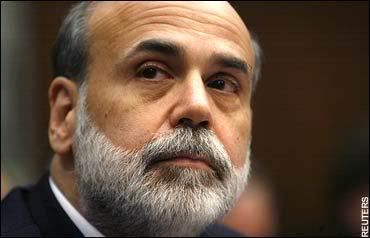
Photo of Ben Bernanke courtesy of The Telegraph

THE TELEGRAPH: Federal Reserve chairman Ben Bernanke hinted at the prospect of further interest rate cuts as he admitted that the US economy is facing attack on a number of flanks.

Mr Bernanke, head of America's central bank, said the Fed would do whatever it needed to do to prevent the American economy from being hurt yet further by the combined effects of the declining housing market and the illiquid credit markets.

In a speech followed by answers to questions from members of the House of Representatives Financial Services Committee, Mr Bernanke said keeping downside risks to growth in check were more important than keeping a lid on inflation.

He said the Fed "will be carefully evaluating incoming information and will act as needed to support growth and to provide adequate insurance against downside risks". US fed chief Bernanke hints at more rate cuts >>> By James Quinn, Wall Street Correspondent

Mark Alexander (Paperback)
Mark Alexander (Hardback)
Australian Dollar Rises to Highest Level Since 1984

Photobucket
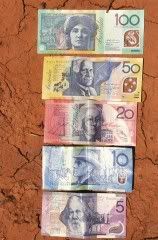
Images of Australian dollars courtesy of Google Images

BLOOMBERG: The Australian dollar rose to its highest in almost 24 years on speculation the nation's interest- rate advantage over the U.S. will widen.

The currency, know[n] as the Aussie, extended its six-day gain as Federal Reserve Chairman Ben S. Bernanke signaled the U.S. central bank is prepared to lower its 3 percent interest rate to shore up a faltering economy. Australia's dollar was buoyed as investors bought the nation's higher-yielding assets in anticipation of the central bank raising its 7 percent benchmark rate again next week to slow inflation.

“It's clearly a one-way street higher for the Aussie," said Clifford Bennett, chief economist in Sydney at Sonray Capital Markets Ltd. Bernanke's comments are "the latest catalyst points overlaying what is still a very strong investment argument for the Australian dollar, consisting of high yields likely to go higher."

The Australian dollar touched 94.34 U.S. cents, the most since March 1984, before trading at 94.11 cents at 9:19 a.m. in Sydney, from 93.81 cents in late Asian trading yesterday. The currency also climbed to its highest since August 1997 against the pound, reaching 47.59 pence. Australian Dollar Rises to Highest Since 1984 on Rate Advantage >>> By Chris Young | February 28

Mark Alexander (Paperback)
Mark Alexander (Hardback)

February 27, 2008

Dollar Hits New Low as Fed Signals Rate Cut

THE FINANCIAL TIMES: The Federal Reserve is ready to cut interest rates again next month, Ben Bernanke signalled on Wednesday in comments that sent the dollar to a record low against the euro.

The dollar fell below $1.51 after the Fed chairman told Congress the US central bank remained firmly focused on the risks to growth in spite of a run of bad price data. The Fed “will act in a timely manner as needed to support growth and to provide adequate insurance against downside risks,” Mr Bernanke said.

His comments to the House financial services committee suggest the US central bank will cut interest rates again in March. The Fed has cut rates five times since last summer, including two cuts in January, taking rates down from 5.25 per cent at the beginning of August to the current figure of 3 per cent.

Noting that the economic situation is “distinctly less favourable” than when he spoke to the committee last July, Mr Bernanke said the US central bank believed the country was experiencing a broad-based slowdown.

Consumer spending “appears to have slowed significantly” in the face of higher gasoline prices and a weakening labour market, he said, adding: “The business sector has also displayed signs of being affected by the difficulties in the housing and credit markets.”

Moreover, “nonresidential construction is likely to decelerate sharply in coming quarters”. He also said that incoming information since the Fed’s January meeting “continues to suggest sluggish economic activity in the near term”. Dollar hits new low as Fed signals rate cut >>> By Krishna Guha in Washington

THE TELEGRAPH:
Dollar's slump to $1.50 raises European alarm By Richard Blackden

THE TELEGRAPH:
Gordon Brown's long boom ending with recession is a real possibility By Vince Cable

DIE PRESSE:
Der Euro ist nicht zu bremsen

Mark Alexander (Paperback)
Mark Alexander (Hardback)
Millions Forced to Work in Benefits Shake-Up

THE TELEGRAPH: Millions of benefit claimants will be forced back to work in the biggest shake-up of the welfare state for 60 years, ministers will announce.

Large parts of the benefits system are to be privatised, with companies hired to find jobs for the unemployed, The Daily Telegraph can disclose.

Private firms will be given incentives of up to £50,000 each to get people back to work and reduce the country's £12 billion annual incapacity benefit bill.

Only last month, David Freud, the government adviser on whose recommendations the reforms are based, said he believed that up to 1.9 million of those claiming they are too sick to work could be found jobs.

In addition, hundreds of thousands of lone parents will face stiff requirements to find jobs or face losing their benefits, a move certain to infuriate Labour backbenchers.

People who refuse to co-operate and reject work interviews will have their benefits "sliced". Millions forced to work in benefits shake-up >>> By Andrew Porter, Political Editor

Mark Alexander (Paperback)
Mark Alexander (Hardback)
Vaduz Called to Account

TIMESONLINE: The day that Toytown went to war, the traffic stopped. For more than a week Liechtenstein (population 35,000) and Germany (population 82 million) have been locked in an extraordinary row involving spies, bankers, a whistle-blower with a shady past, a furious prince – and tens of thousands of well-heeled but anonymous tax evaders. From Britain, from the United States, but, above all, from Germany.

This strange international flare-up is having its effects on the cramped streets of Vaduz, the capital of Liechtenstein. The Mercedes Sclass limos that usually convey wealthy Germans and their earnings to one of the safest tax havens in Europe have disappeared from public view. The German taxpayer is running scared.

“If you listen to people at home, in the office, in the pubs, it is clear that Liechtenstein is bubbling with rage, boiling over,” says Günther Fritz, editor of theLiechtensteiner Vaterland. “We can’t be treated like this.” Spies, whistle-blowers and threats: tax haven is called to account >>> By Roger Boyes in Vaduz

Mark Alexander (Paperback)
Mark Alexander (Hardback)