Showing posts with label Havana. Show all posts

May 04, 2012

Special Report: Cuba's Little Capitalists Are Ready to Rumba

REUTERS.COM: When Ojacy Curbello and her husband opened a restaurant at their home in Havana in late December, not a single customer showed up.

It was a disheartening debut for Bollywood, the first Indian restaurant in the Cuban capital. Curbello worried that their dream of cashing in on recent reforms in this Communist-run country would collapse.

The next day customers began trickling in. As word spread, the trickle became a flood. Many nights the couple had to turn people away or serve them at the family dining table and call in extra help. Today they are planning to increase the 22-seat capacity by expanding their 1950s home and putting tables and a bar in what is now their bedroom.

"It has been amazing how quickly it has taken off," said Curbello, still looking slightly stunned. She sat with her husband, Cedric Fernandez, a Londoner of Sri Lankan descent, in the main dining area, hung with prints of Indian figures.

Bollywood's story is an example of how life is slowly changing in Cuba since President Raul Castro launched a string of limited economic reforms in 2010. » | Jeff Franks | HAVANA | Reuters | Friday, May 04, 2012

August 02, 2009

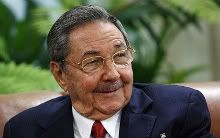
Raul Castro: Cuba Will Never Renounce the Revolution

THE SUNDAY TELEGRAPH: The Cuban president Raul Castro has warned the US and Europe he will not 'restore capitalism' and will never renounce the revolution.

Mr Castro said the Caribbean country's socialist political system was non-negotiable.

In a speech marking the end of the annual parliamentary session, which has been dominated by Cuba's grave economic crisis, he said he would be willing to "discuss everything" with foreign leaders except the island's political and social system.

The Cuban leader, who succeeded his ailing brother Fidel Castro as president three years ago, said he wanted to respond to comments by Hillary Clinton, the US secretary of state, who has linked dialogue with Cuba to democratic reform in the country.

"With all due respect, in response to Mrs Clinton, but also to the European Union ... I was not chosen as president to restore capitalism to Cuba or to renounce the revolution," he said to applause from Cuban politicians.

"I was chosen to defend, maintain and continue to perfect socialism, not to destroy it," said Mr Castro. >>> The Telegraph’s Foreign Staff and Agencies in Havana | Sunday, August 02, 2009

April 15, 2009

Cuba: Open for Business

THE GUARDIAN: For the last 50 years, Cuba has struggled under a crippling US trade embargo. But this week President Obama eased sanctions on the island. Rory Carroll reports from Havana on what this will mean for ordinary Cubans
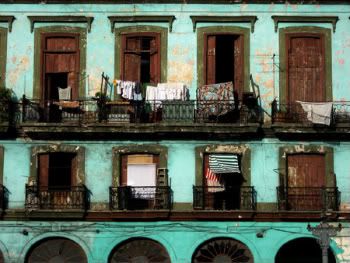
Photobucket
Photo: Google Images

They file into terminal 2 of José Martí international airport like any other ­tourists, wheeling and hauling luggage, checking mobile phones for reception, fumb­ling with passports. Navy blue passports, stamped with the image of a bald eagle with outstretched wings. American passports. ­History has yet to call time on half a century of enmity between the United States and Cuba, but these arrivals in jeans and sneakers are not awaiting a formal truce. A once forbidden island, they sense, is on the verge of opening up, and they are here to see it.

The trickle started a few weeks ago. ­Gum-chewing backpackers, middle-aged ­professionals, retirees, all bold enough to defy the US ­prohibition on spending money in Cuba, a de facto travel ban. Cubans half- jokingly call their new American visitors "los valientes", the brave ones, for carving a beachhead. Lenin, in a wry mood, might have called them a ­revolutionary vanguard. A more poetic soul would compare them to the first swallows of spring, harbingers of thaw.

The glacier in which the cold war remnant that is Cuba has been trapped may soon melt. Barack Obama this week lifted a broad set of sanctions that were designed to isolate the island. Cuban Americans, currently restricted on the amount of money then can send home and to one visit every three years, will be allowed to go as often as they wish and to send more money to relatives. Obama has also lifted restrictions on US telecommunications com­panies applying for licences to operate there, and on scheduled commercial flights to the island. Air travel is currently limited to charter flights from Miami, New York and Los Angeles for Cuban Americans with relatives on the island, and those with a special reason to visit, such as journalists.

The changes soften US policy but leave in place the economic embargo that John Kennedy imposed in 1962 - a ban on trade and investment designed to choke Fidel Castro's nascent ­revolutionary government. Over the decades the embargo was tightened and loosened, but the objective remained the same: topple Castro. It failed to do so. Cuba's ­economy staggered on and ­Castro strengthened his grip, but the embargo was maintained. >>> Rory Carroll | Wednesday, April 15, 2009

Guardian Audio: The Guardian's Latin America correspondent Rory Carroll explains why Barack Obama has been able to sidestep Florida's powerful Cuban exiles in breaking down barriers between the two nations >>>

May 03, 2008

Cuba Lifts Ban on Home Computers

BBC: The first legalised home computers have gone on sale in Cuba, but a ban remains on internet access.

This is the latest in a series of restrictions on daily life which President Raul Castro has lifted in recent weeks.

Crowds formed at the Carlos III shopping centre in Havana, though most had come just to look.

The desktop computers cost almost $800 (£400), in a country where the average wage is under $20 (£10) a month.

But some Cubans do have access to extra income, much of it from money sent by relatives living abroad.

Since taking over the presidency in February, Raul Castro has ended a range of restrictions and allowed Cubans access to previously banned consumer goods.

In recent weeks thousands of Cubans have snapped up mobile phones and DVD players.

But only now have the first computer stocks arrived.
Internet access remains restricted to certain workplaces, schools and universities on the island.

The government says it is unable to connect to the giant undersea fibre-optic cables because of the US trade embargo.

All online connections today are via satellite which has limited bandwidth and is expensive to use.

Cuba's anti-American ally, Venezuela's President Hugo Chavez, is laying a new cable under the Caribbean.

It remains unclear whether, once the connection is completed, the authorities will then allow unrestricted access to the world wide web. [Source: Cuba Lifts Ban on Home Computers >>> By Michael Voss, Havana | May 3, 2008

The Dawning of a New Dark Age (Paperback – USA)
The Dawning of a New Dark Age (Hardcover – USA)