Democracy is an illusion! It’s become a political system fostered by the élite, for the élite, in order to fool the people that they have a stake in the system. In actual fact, they have virtually none. The whole political system in the modern era, despite having noble beginnings, is now used to benefit the few at the expense of the many. – Mark Alexander, June 29, 2018
Showing posts with label economic crisis. Show all posts
Showing posts with label economic crisis. Show all posts
Greece is "coming out of the crisis with a more polarized society, with an opened gap between the rich and the poor," says economic scholar John Milios
The Caritas report says that as a result of economic measures[,] Greece's political scene has become increasingly toxic.
THE GUARDIAN: Survey shows increase in the number of new poor in seven countries and challenges the official European Union discourse
Far from being over Europe's economic crisis is getting worse with disturbing levels of poverty and deprivation being noted among children and youth, says a report compiled by the Catholic charity Caritas.
The survey, conducted over the course of the past year, not only challenges the official discourse – that Europe is on the mend – but documents a dramatic poor in the seven EU countries worst hit by the policies of austerity.
"We in Brussels keep hearing that the economic crisis is over," Thorfinnur Omarsson, a spokesman for Caritas Europa said in Athens where the network of Catholic relief organisations released the report. "These findings not only doubt that the crisis is over but show it is the poor who are paying for a crisis they did not cause." » | Helena Smith in Athens | Thursday, March 27, 2014
July 20, 2012
Italy's Economic Crisis Risks Sparking 'Civil War' in Sicily
THE DAILY TELEGRAPH: The misery caused by Italy's financial crisis could spark a "civil war" in the southern island of Sicily, the mayor of regional capital Palermo said on Friday.
"Because of an explosive mix of despair felt by many families and the stranglehold of organised crime, a civil war could even break out," mayor Leoluca Orlando told the economic daily Wirtschaftsblatt.
"Sicily is the Greece of Italy," said Orlando, a member of the anti-corruption Italy of Values party and a staunch anti-Mafia champion.
"We've managed to stay afloat only because we're a part of Italy," he added.
"Many businesses are shutting, families on low incomes can no longer pay their electricity bills," said Orlando, who has been mayor since May. » | Source: AFP | Friday, July 20, 2012
David Cameron: World on Brink of New Economic Crisis
THE DAILY TELEGRAPH: The world stands on the brink of a new economic crisis that would leave countries like Britain “staring down the barrel”, David Cameron has warned.
The Prime Minister said that the failure of leaders in the US and Europe to tackle government deficits now “threatens the stability of the world economy”.
Mr Cameron spoke as stock markets around the world fell sharply again, with the FTSE-100 suffering its biggest drop for more than two years.
Politicians, central bankers and investors are increasingly worried that the world’s biggest economies are sliding back into a recession, dragged down by government debts.
More gloomy economic data yesterday led one of the world’s leading economists to say that Britain, the US and the eurozone are all already in recession, and warn of a second financial crisis worse than that of 2008/9.
The Prime Minister spoke in Canada after delivering a blunt warning to President Barack Obama and eurozone leaders about the need to follow Britain’s example and curb their deficits.
In a speech in Ottawa, Mr Cameron said that Western politicians must show more “leadership” and warned that political indecision would only worsen the crisis. » | Jon Swaine, in New York and James Kirkup | Thursday, September 22, 2011
August 13, 2011
Counting the Cost - A North Atlantic Economic Crisis
July 01, 2010
No Such Thing as a Free Lunch, Cuba Tells Its Workers
Cubans queue up to buy bread in Havana. Dire economic conditions mean that they could lose their ration books. Photograph: The Times
THE TIMES: Ever since the tumultuous birth of communist Cuba, the one perk thousands of workers have been able to count on over the decades is a hearty meal to sustain them through the toil of providing for the socialist motherland.
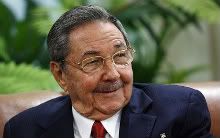
Today nearly a quarter of a million Cubans will discover that there is no such thing as a free lunch, when the Government closes work cafeterias to cut costs. The move is one of a series of reforms, brought in since Raúl Castro took over as President from his brother, Fidel, in 2006, and deigned to reduce the State’s involvement in Cubans’ daily lives.
Workers will receive a wage increase of 60 cents a day in compensation, or $18 (£13) a month — a substantial amount to add to the average monthly wage of $20.
Still, there are concerns among workers about the impact of the closures. “There aren’t enough cafés at the moment,” said Ada, 57, who works in a cafeteria for state employees restoring the old part of Havana.
“All these people looking for somewhere to eat — there isn’t enough food for so many people on their lunch hour.”
Cubans have been allowed to set up privately run snack shops since 1993 but the range of food on offer is still limited.
Among the options are small, doughy pizzas for 50 cents, or a box of fried rice for 60 cents. Juan, a 29-year-old architect, says that he will bring his lunch from home. “The only inconvenience is preparing it for yourself. But then it should be better than the food you get here.” He is pleased that he will not have to eat with construction workers any more. “It gets rid of the whole idea of the socialist cafeteria, where everyone is supposedly equal.” Continue reading and comment >>> Corrina Hayes, Havana | Wednesday, June 30, 2010
ADN KRONOS INTERNATIONAL: Vatican City - Pope Benedict XVI on Saturday offered advice for European banking and development officials trying to help countries recover from the current economic crisis. The pontiff said finance and the economy were nothing more than a means to help people realise their potential and keep their dignity.
Benedict told officials of the European Council's Development Bank during a speech at the Vatican that leaders must value human "capital".
He also said that Christianity in Europe will allow the continent to keep its laws and social structures responsible and ethical. [Source: AKI] | Saturday, June 12, 2010
January 18, 2010
A Greek Crisis May Well Become Germany’s Problem
TIMES ONLINE: This week the European Commission begins studying Greece’s latest plan for extracting itself from its financial crisis. But although the deployment of the Brussels machinery has taken the edge off the drama, any sense that the problem is now contained would be an illusion. The possibility that a country within the eurozone will get to the brink of defaulting on its sovereign debt remains real.
The new Greek Government’s plan remains incredible, based on a cut in the budget deficit from nearly 13 per cent to under 3 per cent in three years. That implies that Greece would, in one coherent sweep, push through profound reforms of the public and private sectors that it has not yet been able to tackle.
It remains likely, then, that Greece is headed for a crisis that tests the stability of the eurozone. The burden of Europe’s most difficult decision this year would fall on Angela Merkel, the German Chancellor, who would have to decide whether to rescue Greece to forestall a crisis throughout the currency club. But her Finance Minister openly rejects her declaration of a “common responsibility” for other members, and a rescue would be a hard sell to German taxpayers. Even more difficult, a real repair of the eurozone would require Germany to acknowledge that its financial management during the past decade has not been as virtuous as it likes to maintain.
Since October elections, Greece has been in an on-again, off-again crisis, since the new Government restated the budget deficit to 12.7 per cent of gross domestic product. Greece’s public debt is expected to rise this year from 113 per cent to more than 120 per cent of GDP. Markets have greeted with scepticism the assertion by George Papaconstantinou, the Finance Minister, that the plan is achievable. The costs of insuring against a default on debt have risen to the highest levels in six years since the market was launched — or $340,000 for every $10 million of debt annually over five years.
“I just think they can’t do it, and their growth prospects are worse than the Government is predicting,” Simon Tilford, chief economist at the Centre for European Reform think-tank, said. “They need to make cuts, but the country has shown little or no ability to do it” — either to cut the pension costs and early retirement extracted by the unions, to cut waste in hospitals and defence or to curb rampant tax evasion in the private sector.
Even if Greece made the cuts, that would push it into a slump and deflation; crippling for such a highly indebted country. “Whatever happens, it will be miserable for them,” Mr Tilford concluded. >>> Bronwen Maddox: Economic View | Monday, January 18, 2010
August 02, 2009
Raul Castro: Cuba Will Never Renounce the Revolution
THE SUNDAY TELEGRAPH: The Cuban president Raul Castro has warned the US and Europe he will not 'restore capitalism' and will never renounce the revolution.
Mr Castro said the Caribbean country's socialist political system was non-negotiable.
In a speech marking the end of the annual parliamentary session, which has been dominated by Cuba's grave economic crisis, he said he would be willing to "discuss everything" with foreign leaders except the island's political and social system.
The Cuban leader, who succeeded his ailing brother Fidel Castro as president three years ago, said he wanted to respond to comments by Hillary Clinton, the US secretary of state, who has linked dialogue with Cuba to democratic reform in the country.
"With all due respect, in response to Mrs Clinton, but also to the European Union ... I was not chosen as president to restore capitalism to Cuba or to renounce the revolution," he said to applause from Cuban politicians.
"I was chosen to defend, maintain and continue to perfect socialism, not to destroy it," said Mr Castro. >>> The Telegraph’s Foreign Staff and Agencies in Havana | Sunday, August 02, 2009
June 02, 2009
The Trillion Dollar Question: China or America?
THE TELEGRAPH: Who is going to come out of the economic crisis stronger and with the whip hand - China or America, asks Niall Ferguson.
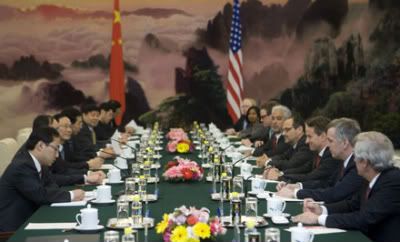
A delegation led by US Treasury Secretary Timothy Geithner, second from right, meets a Chinese led by vice-premier Wang Qishan in Beijing. Photo courtesy of The Telegraph
Two years ago, economist Moritz Schularick and I coined the word "Chimerica" to describe what we saw as the key relationship in the then-booming global economy: China plus America. Cheap Chinese labour was making US corporations highly profitable. Spendthrift American consumers, in turn, were keeping Chinese corporations busy with export orders. And the Chinese monetary authorities were converting export surpluses into dollar denominated reserves with the aim of preventing their own currency from appreciating. The unintended consequence was a multi-billion dollar credit line to the United States, financing America's deficit at rock-bottom rates.
It was those low long-term rates – combined with monetary policy errors by the Fed, excessive bank leverage and reckless financial engineering – that inflated the American property bubble, the bursting of which triggered this crisis.
To simplify the story, think of an unhappy marriage in which one partner does all the saving, while the other does all the spending. (We all know at least one couple like that.) But then the partner with the retail therapy habit maxes out on his/her credit cards. At the same time, the parsimonious partner finds her/his job under threat. What previously was a stable relationship is suddenly on the rocks.
In February, the People's Daily acknowledged the "global importance and influence" of Chimerica, but warned of an impending "period of chillness". Could this be one of those great turning points in history, when the balance of power tilts decisively away from an established power and towards a rising challenger? It is possible. Financial crises often accelerate the gradual shifting of the geopolitical tectonic plates; they are to history what earthquakes are to geology. >>> By Niall Ferguson | Monday, June 01, 2009
Niall Ferguson's 'The Ascent of Money: A Financial History of the World' is published in paperback by Penguin this week
May 20, 2009
Japan's Economy Suffers Record Plunge
THE TELEGRAPH: Japan's economy has suffered its worst quarterly performance since records began more than five decades ago as it continues to struggle with the economic crisis.
The world's second largest economy experienced a quarterly 4 per cent shrink in its gross domestic product (GDP) reflecting the continued impact of the recession on the export-dependent nation.
Hit hard by a global plunge in demand for cars and technology, Japan's economy shrank 15.2 per cent in the first quarter compared to last year, according to Cabinet Office figures.
The contraction eclipses that of other industrialised nations: the nation's GDP slide was more than double the 1.6 per cent recorded in the US and significantly higher than Europe's record 2.5 per cent.
A weakening in domestic demand has been the biggest contributor to Japan's decline, with consumer spending dropping 1.1 per cent and business investment plunging a record 10.4 per cent during the same period.
As companies continue to cut spending due to diminished demand, the number of underused factories and workers was continuing to grow, according to Hiromichi Shirakawa, chief economist at Credit Suisse Group AG in Tokyo.
"There is a huge problem of over capacity," he said. "That means capital spending is not likely to pick up." While the contraction is the biggest for Japan since records began in 1955, hopes have been raised that the economy will soon start to rebound following a slight surge in industrial production in March. >>> By Danielle Demetriou in Tokyo | Wednesday, May 20, 2009
March 10, 2009
Buffett: Crisis Is an Economic Pearl Harbor
TIMES ONLINE: Warren Buffett said yesterday that the US economy had “fallen off a cliff”, describing the current crisis as “an economic Pearl Harbor” as concern spread about the US Administration’s fitful attempts to halt the collapse of the American banking sector.
The leading investor, an informal adviser to President Obama whose financial diagnoses are widely respected – even though he conceded that he failed to predict the severity of the crisis – said that the economy had come “close to the worst case” imagined, and that recovery would be slow.
Mr Buffett, a multibillionaire, said that the entire banking sector had been hours from collapse in September, and would have imploded without the $700 billion Wall Street emergency bailout.
Mr Buffett also spoke of the growing fears over Mr Obama’s muddled approach to the central issue in solving the economic crisis: what to do with the banks’ $2 trillion of toxic debt that is threatening the collapse of the financial sector. Mr Obama and his Treasury chief, Timothy Geithner, have said that they do not want to nationalise any banks but they are coming under increasing pressure after massive and repeated injections of cash into crippled financial giants such as Citigroup, Bank of America and AIG have failed to stem losses. >>> Tim Reid in Washington | Tuesday, March 10, 2009
AOL: Warren Buffett Says Economy Fell Off Cliff
OMAHA, Neb. - Billionaire Warren Buffett remains confident that America's best days are ahead, but he says the nation likely will face higher unemployment and eventually inflation because of the current economic crisis. Buffett said the nation's leaders need to emphasize a consistent message, and they should support President Barack Obama's efforts to repair the economy because fear is dominating Americans' behavior.
Buffett said the economy has basically followed the worst-case scenario he envisioned six months ago.
"It's fallen off a cliff," Buffett said Monday during a live appearance on cable network CNBC. "Not only has the economy slowed down a lot, but people have really changed their habits like I haven't seen."
Buffett said the changes are reflected in the results of Berkshire Hathaway Inc.'s subsidiaries. He said Berkshire's jewelry companies have suffered, but more people have been willing to switch to Geico to save money on car insurance. The three-hour-long interview aired from another Berkshire subsidiary that has been hampered by the economy, the Nebraska Furniture Mart store in Omaha.
He predicted that unemployment will climb a lot higher before the recession is done, but he also reiterated his optimistic long-term view: "Everything will be all right. We do have the greatest economic machine that man has ever created."
Fear and confusion have been driving consumer and investor behavior in recent months, Buffett said.
The nation's leaders need to clear up the confusion before anyone will become more confident, and he said all 535 members of Congress should stop the partisan bickering about solutions. He said politicians should also stop trying to use the current economic crisis to force through other policy changes.
"We ought to defer most of the things that get people riled up," Buffett said. >>> By Josh Funk, AP | Monday, March 9, 2009
Crisis Creates Opportunity for Islamic Wealth Management
WEALTH BULLETIN: Beneficiaries from the financial crisis are few and far between but it could prove to be the making of Islamic wealth management. While sharia-compliant financial services have enjoyed strong growth among ordinary banking customers and institutions, the wealthy have been slower to embrace Islamic finance.
Humayon Dar chief executive of BMB Islamic, an alternative asset manager with a focus on Islamic finance, said: “Historically in the Middle East and North Africa region, the high net worth and ultra-high net worth families have not been interested in Islamic finance.”
Many wealthy individuals in the Gulf preferred to seek familiar western financial brands that could offer the latest hedge funds or structured products.
The regional head of a privately owned Swiss wealth manager, said: “Previously, the best shot at getting hold of the personal wealth of the local families was to offer commercial banking facilities. The big banks with good brands did well and pushed products as hard as they could. It was about packaging sexy products. But wealthy investors are realising that the big banner plus a familiar brand does not necessarily equal the safest place to put your money.”
The more constrained approach of Islamic institutions, which in theory do not engage in usury (charging interest on loans), short selling or leveraged investing, among other western practices, might look attractive by comparison. This, at least, is the bet being made by Bank of London and the Middle East, a UK-based institution that recently launched a sharia-compliant private bank.
Adrien Gayler, a former Merrill Lynch executive who is heading the private banking business, said: “It is a more conservative, simpler and safer approach with a range of products that is inevitably somewhat limited.
“It means clients probably will not benefit as much in a rapidly rising market, but in a downturn they will be protected.” >>> James Rutter | Monday, March 9, 2009
Growing Economic Crisis Threatens the Idea of One Europe
THE NEW YORK TIMES: PARIS — The leaders of the European Union gathered Sunday in Brussels in an emergency summit meeting that seemed to highlight the very worries it was designed to calm: that the world economic crisis has unleashed forces threatening to split Europe into rival camps.
An urgent call from Hungary for a large bailout for newer, Eastern members was bluntly rejected by Europe’s strongest economy, Germany, and received little support from other countries. Chancellor Angela Merkel of Germany, facing federal elections in September, said countries must be dealt with on a case-by-case basis.
“Saying that the situation is the same for all Central and Eastern European states, I don’t see that,” Mrs. Merkel told reporters. She spoke after Prime Minister Ferenc Gyurcsany of Hungary warned, “We should not allow that a new Iron Curtain should be set up and divide Europe.”
With uncertain leadership and few powerful collective institutions, the European Union is struggling with the strains this crisis has inevitably produced among 27 countries with uneven levels of development.
The traditional concept of “solidarity” is being undermined by protectionist pressures in some member countries and the rigors of maintaining a common currency, the euro, for a region that has diverse economic needs. Particularly acute economic problems in some newer members that once were part of the Soviet bloc have only made matters worse. >>> By Steven Erlanger and Stephen Castle | Monday, March 2, 2009