Showing posts with label Russian Federation. Show all posts

November 23, 2009

Russia 'Is Now a Criminal State', Says Bill Browder

BBC: Russia has now turned into a "criminal state", according to the man who was once its leading foreign investor.

Bill Browder of Hermitage Capital was reacting to the news that his lawyer had died in prison in Russia after being held for a year without charge.

He told the BBC that his lawyer, Sergei Magnitsky, had in effect been "held hostage and they killed their hostage."

Through Hermitage Capital, Bill Browder campaigned against corruption at some of Russia's largest companies.

Russian officials say they are investigating Mr Magnitsky's death.

In 2005, Mr Browder was banned from Russia as a threat to national security after allegations that his firms had evaded tax, but Mr Browder says his company was targeted by criminals trying to seize millions of pounds worth of his assets.

Mr Browder says he was punished for being a threat to corrupt politicians and bureaucrats.

Since then, a number of Mr Browder's associates in Russia - as well as lawyers acting for his company - have been detained, beaten or robbed.

Before the accusations of tax evasion were raised, Mr Browder had for many years been one of the most outspoken defenders of the Russian government and its then-president Vladimir Putin. With video >>> | Monday, November 23, 2009

June 02, 2009

Can Oligarchs Survive Russia's Slump?

Photobucket
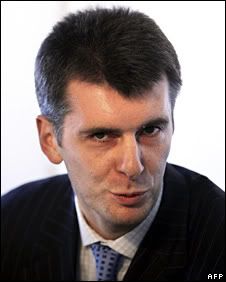
Mikhail Prokhorov has done better than others - but still lost billions. Photo courtesy of the BBC

BBC: Getting to talk to Russian billionaires is never easy. They are notoriously camera-shy, and with good reason.

In Russia, the "oligarchs", as they are generally known, are not very popular. Most ordinary Russians believe that their vast fortunes were stolen during the corrupt privatisations of the 1990s.

So news that the oligarchs are in trouble has been met by many here with a degree of Schadenfreude.

It is - if you like - the story of the incredible shrinking billionaires.

According to Forbes Magazine, a year ago Moscow was home to 74 of them - more than any other city in the world.

Now there are only 27 left. Even those that survive have seen their fortunes slashed.

So imagine my surprise when not one, but two of them, invited me round for a chat.

And they were not just any old second-rate billionaires - one was Russia's richest man, Mikhail Prokhorov.

To put it mildly, Mr Prokhorov is an impressive figure. He stands 2.03m (6ft 8in) in his socks. He is just 43 years old and, even after losing half his fortune, he is still worth close to $10bn (£6.1bn).

Sadly, Mr Prokhorov did not invite me to his country estate, or for a quick spin in his $60m jet.

Instead, it was 20 minutes over coffee in the business-class lounge of a grimy provincial airport. >>> By Rupert Wingfield-Hayes, BBC News, Moscow | Tuesday, June 02, 2009

January 20, 2009

Crisis-hit Russians Tighten Their Belts

BBC: What would you do if your income was slashed by 80% because of the continuing downturn?

What choice would you make if your bosses asked you and your colleagues to agree either to a 50% salary cut or to reducing the firm's workforce by half?

Such a choice might seem unreal to a lot of professionals in the West, whose rights are protected by laws and unions, as well as by history itself, as these rights have been in place for decades or even centuries.

But these questions are now a reality for some people in crisis-hit Russia as it comes to the end of a decade-long boom, the first time in its existence that this has happened in a free-market economy.

The problem is that many Russians still get the bigger part of their salaries "in envelopes", even despite a flat 13% rate of income tax. Their official salaries may be no more than a couple of hundred dollars.

It all seemed fine to them when they did not have to worry about their jobs. But now it leaves them unprotected.

Their bosses do not need to fear the cost of making them redundant, as the severance money, calculated as the sum of several official monthly salaries, would be tiny in comparison even with an employee's real one-month salary.

That is why many professionals, who have had to agree to a 30% salary cut, consider themselves relatively lucky. >>> By Konstantin Rozhnov, Business reporter, BBC News | Tuesday, January 20, 2009

The Dawning of a New Dark Age (Paperback & Hardback) – Free delivery >>>

April 24, 2008

Russian Billionaire Sets Up Mag for Snobs

Photobucket
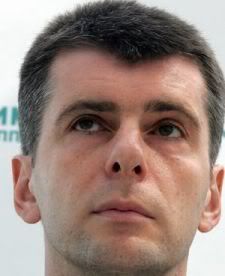
Photo of Mikhail Prokhorov courtesy of The Sydney Morning Herald

THE SYDNEY MORNING HERALD: Russia's super-rich love to flaunt their wealth. Soon they will have a magazine called Snob to help them.

Mikhail Prokhorov - whose wealth is estimated at around $US22 billion ($A23.3 billion) - plans to spend $US150 million ($A159 million) setting up a magazine, website and television station called Snob, the general director of the new venture said.

"It's for people who are successful and those who want to be successful," said Andrei Shmarov, who will run Snob.

Prokhorov, 42, made his fortune in the chaotic 1990s when businessmen bought up parts of former Soviet industries for a fraction of their real value.

The Forbes Rich List ranked Prokhorov as the 24th richest person in the world. He is one of the owners of Norilsk Nickel, the world's biggest nickel producer, and Polyus Gold, Russia's biggest gold producer. Billionaire Sets Up Mag for Snobs >>> | April 24, 2008

The Dawning of a New Dark Age (Paperback - UK)
The Dawning of a New Dark Age (Hardback - UK)

April 18, 2008

Russia Swaps Libya’s Debt for Deals

BBC: Russia has agreed to cancel $4.5bn (£2.3bn) of Libyan debt in exchange for major contracts for Russian firms.

The announcement came during a visit to Tripoli on Thursday by the Russian President, Vladimir Putin.

The two countries signed deals on energy co-operation, military assistance and construction of a 500km (310-mile) railway line in Libya.

Libya was a big importer of Soviet weaponry during the Cold War, when it accumulated large debts.

Russia's state gas monopoly Gazprom plans large-scale exploration and production projects with Libya's national energy company. They will include liquefied natural gas installations and gas-fired electricity plants in Libya.

Russia will provide the technology for Libya to build a major rail link between Sirte and Benghazi. Construction is expected to take four years.

Gazprom is also holding preliminary talks with Nigeria about a multibillion-dollar project to deliver Nigerian gas to Europe via a pipeline across the Sahara.

The project is costed at $10bn for the pipeline and $3bn for other installations, delivering up to 30bn cubic metres a year of gas to Europe. The 4,128km (2,580-mile) pipeline from Nigeria will cross Niger and Algeria.

Mr Putin said Libya "is orientated towards the most active co-operation with Russia in all areas".

President Putin is now in Sardinia for talks with Italian Prime Minister-elect Silvio Berlusconi.

The Italian firm Eni is also involved in big energy projects in Libya and already has a close partnership with Gazprom. [Source: Russia Swaps Libya Debt for Deals]

The Dawning of a New Dark Age (Paperback - UK)
The Dawning of a New Dark Age (Hardback - UK)

February 25, 2008

Moscow World’s Costliest City

DAILY EXPRESS: WHEN a ride in one of London’s black cabs empties your purse, it isn’t hard to swallow the popular myth that the capital is the most expensive city in the world.

So thank your stars you’re not in Moscow, where the average visitor to the city – now officially the world’s most expensive – forks out nearly £250 a night for a room, compared with £154 in London.


In fact, the latest poll by industry observer Hogg Robinson Group put London in 10th place – down from eighth in 2006.


Second to the Russian capital was New York, where visitors pay £192 per night. In third place was Paris (£171), followed by Dubai (£164), Milan (£164), Stockholm (£160), Mumbai (£160), Bangalore (£159) and Hong Kong (£154).


For Moscow, it was a case of reclaiming the dubious title it also held in 2005 and 2006.


Room prices there have risen 93 per cent since 2004 and Margaret Bowler, global hotel relations director for Hogg Robinson Group, believes this has less to do with the draw of the country and more to do with economic factors.


She said: “The cost and availability of land in central Moscow, restricting the development of new hotels, is set to continue room inflation into 2008.”

It is just the latest confirmation of the city’s sky-high prices. Moscow World’s Cosliest City >>> By Heather Meyer

Mark Alexander (Paperback)
Mark Alexander (Hardback)

February 04, 2008

Russian Economy Succumbs to the Oil Curse

THE TELEGRAPH: Moscow is the most expensive city in the world, like Tokyo before the Nikkei bubble burst. A taxi from Domodedovo airport to the Kremlin costs $170 (£86). Property in Ostozhenka trumps Chelsea. Space fetches $30,000 a square metre.

Nice Tsarist flats fetch $3m to $4m. Even Bolshevik boxes are booming. Moscow boasts 150,000 home millionaires in dollars, says Sergei Polonsky, the Mirax Group tycoon. In a good year, prices double.

This is the curse of commodity wealth, the "Dutch Disease" that eats at the competitive foundations of an economy and incubates a parasite culture. No doubt Russia's scientists, engineers, and cyber talent, will enrich the country, but first it must overcome the toxic effects of oil at $90 a barrel.

"We can no longer afford to buy Russian equipment," said Yevgeny Ivanov, head of Polyus Gold.

"The prices here are one and a half times higher than abroad so we're having to break our rigid rule and turn to foreign-made machinery. It is bad news for Russian firms. The commodity super-cycle is catching up with us through higher prices. It is a disheartening picture," he said.

"There's no infrastructure, no power, no roads. Electricity costs twice what they pay in Alaska and Canada. We face a Soviet bureaucracy passing decrees that make you weep," he said.

The government has declared an infrastructure emergency. Russia has hit the limits of durable growth on today's rickety foundations.China has built 25,000 miles of highways since 1988, Russia a few hundred. Russian economy succumbs to the oil curse >>> By Ambrose Evans-Pritchard International Business Editor

Mark Alexander (Paperback)
Mark Alexander (Hardback)

January 10, 2008

Interview with Russian Orthodox Metropolitan Kyrill

I post this excellent interview from SpiegelOnline International on this website because the possible successor to Patriarch Alexy II, Metropolitan Kyrill, raises many interesting and important economic issues. I think you will agree.
Photobucket
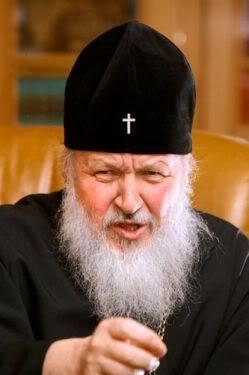
Photo of Metropolitan Kyrill, possible successor of Patriarch Alexy II, courtesy of SpiegelOnline International

SPIEGELONLINE INTERNATIONAL: Metropolitan Kyrill, foreign minister of the Russian Orthodox Church, discusses Christian values in the post-communist era, his relationship with the pope in Rome, Vladimir Putin the churchgoer -- and wrangles with SPIEGEL about homosexuality.

SPIEGEL: Your Eminence, after the collapse of the Soviet Union, the Russian Orthodox Church seemed to have prevailed over the godless communists. But has it been able to fill the spiritual vacuum that followed?

Kyrill: I wouldn't call it a vacuum. In communism, the church had no direct way of influencing society, but it did influence Russian culture and people's awareness. I remember a tour guide in a monastery in Vologda in the early 1970s. She talked about architecture and painting as if she were giving a sermon. There was no talk of Christianity, but her speech depended on a Christian system of values. This woman was not alone. Writers and artists spoke the same way. Or, someone would see a destroyed church and discover another world beyond the gloomy prefabricated high-rises where people lived. Christian values were always kept alive among the people. They ultimately brought about the fall of communism.

SPIEGEL: Crime and corruption were rampant after the collapse of the Soviet Union. Murder, robbery and fraud became mass phenomena. Wasn't this a defeat for the church?

Kyrill: Reviving morality is a long process. We also see high crime rates in other countries. Besides, Russia faced massive social changes. Our economy was in ruins, foreign influence was growing and so was the consumption mentality, the focus on performance, all of these postmodern ideas which treat everything as relative and no longer require us to distinguish between truth and lies.

SPIEGEL: It sounds as if the present is no better than the past, in your opinion.

Kyrill: The church should have taken time to regenerate. We were weakened by atheism, and then we were faced with a double burden. We were like a boxer who walks around for months with his arm in a cast and is then abruptly shoved into the ring, accompanied by shouts of encouragement. But there we encountered a well-trained opponent, in the form of a wide variety of missionaries from America and South Korea who tried to convert the Russian people to other faiths. Religion was also marginalized by a secular way of thinking.

SPIEGEL: Is capitalism ultimately worse than communism?

Kyrill: The free market economy has certainly proved to be more effective than the planned economy. Unlike corporate executives, however, the church also believes in justice. As far as that's concerned, we have no fewer problems today, perhaps even more, than in the Soviet era. The gap between rich and poor in Russia is scandalous. That's an issue we are addressing.

SPIEGEL: You must find it obscene, the way the Russian oligarchs, with their palaces and yachts, show off their wealth.

Kyrill: It isn't the church's place to point to someone and say: He owns yachts and airplanes, so let's take away his riches and redistribute them. That happened in the 1917 revolution. At the time, they were saying that paradise was the next step after expropriation. But what we got instead was hell. May God protect Russia from repeating the same mistake. However, the government must ensure that the gap doesn't become too wide. Russia's future depends on it. ’The Bible Calls it a Sin’ >>>

Part 2:
’Men Can Control Their Drives’

Mark Alexander (Paperback)
Mark Alexander (Hardback)