Showing posts with label privatisations. Show all posts

April 30, 2014

Abu Dhabi and Soros Got 'Golden Ticket' in Royal Mail Sale


THE DAILY TELEGRAPH: Sovereign wealth funds and billionaire investors among 16 firms given preferential treatment over small investors in the Royal Mail privatisation

Abu Dhabi Investment Authority, billionaire investor George Soros and activist hedge fund Third Point were among the 16 investors given preferential treament in the controversial Royal Mail privatisation.

The Government on Wednesday released details of these preferred investment firms, who saw their shares jump 38pc rise on the first day of trading, while thousands of small private investors missed out after the Government imposed a cap of £10,000 on them.

Other preferential investors included Lazard Asset Management, the investment arm of the government’s independent adviser on the privatisation, Capital Research, Fidelity Worldwide, GIC, Henderson, JP Morgan, Kuwait Investment Office, Lansdowne Partners, , Och Ziff, Schroders, Standard Life, and Threadneedle.

The Government, which has insisted that Royal Mail was not sold on the cheap, has been under pressure to release the names of "pilot fishing investors".

Ed Miliband, the Labour leader, clashed with David Cameron at Prime Minister's Question Time. He said some of the firms invited to invest in the business were given a "golden ticket" and had made a "fast buck" by selling the shares as their price soared, with some selling on the first day of privatisation. » | Telegraph Staff | Wednesday, April 30, 2014
January 10, 2011

Cuba Lays-off State Workers in Privatisation Drive

THE DAILY TELEGRAPH: Cuba has begun the process of laying-off a tenth of its state workforce in a drive to push employees into small businesses that could mark the beginning of the end of the 50-year communist experiment on the island.

The state labour union announced this week that the first of some 500,000 employees could expect to receive "pink slips" immediately, effectively terminating their employment in the public sector where, until now, almost 90 per cent of Cuba's workforce have been employed.

The lay-offs will begin in the ministries of agriculture, sugar, construction, health and tourism, according to Salvador Valdes, the leader of the Workers' Central Union of Cuba (CTC). Workers, who on average earn a monthly wage of $20 (£13), were told to expect compensation of one month's salary for every ten years on the job.

Committees have been set up in each workplace to draw up the list of those jobs to be cut, the CTC said – a process that "will be free of favouritism, nepotism and paternalism". >>> Fiona Govan, Madrid | Wednesday, January 05, 2011

June 02, 2009

Can Oligarchs Survive Russia's Slump?

Photobucket
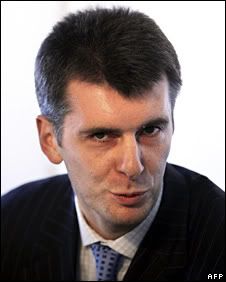
Mikhail Prokhorov has done better than others - but still lost billions. Photo courtesy of the BBC

BBC: Getting to talk to Russian billionaires is never easy. They are notoriously camera-shy, and with good reason.

In Russia, the "oligarchs", as they are generally known, are not very popular. Most ordinary Russians believe that their vast fortunes were stolen during the corrupt privatisations of the 1990s.

So news that the oligarchs are in trouble has been met by many here with a degree of Schadenfreude.

It is - if you like - the story of the incredible shrinking billionaires.

According to Forbes Magazine, a year ago Moscow was home to 74 of them - more than any other city in the world.

Now there are only 27 left. Even those that survive have seen their fortunes slashed.

So imagine my surprise when not one, but two of them, invited me round for a chat.

And they were not just any old second-rate billionaires - one was Russia's richest man, Mikhail Prokhorov.

To put it mildly, Mr Prokhorov is an impressive figure. He stands 2.03m (6ft 8in) in his socks. He is just 43 years old and, even after losing half his fortune, he is still worth close to $10bn (£6.1bn).

Sadly, Mr Prokhorov did not invite me to his country estate, or for a quick spin in his $60m jet.

Instead, it was 20 minutes over coffee in the business-class lounge of a grimy provincial airport. >>> By Rupert Wingfield-Hayes, BBC News, Moscow | Tuesday, June 02, 2009