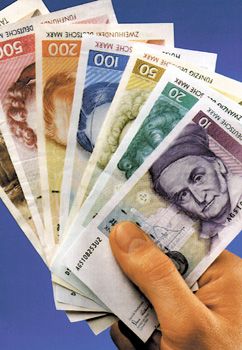
Showing posts with label deutschmark. Show all posts

January 19, 2011

Merkel Rules Out Return to Deutsche Mark

Photobucket
Chancellor Angela Merkel says there's no going back to the beloved deutsche mark. Photo: Spiegel Online International

SPIEGEL ONLINE INTERNATIONAL: German Chancellor Angela Merkel has snuffed out speculation about reintroducing the deutsche mark in Germany as a response to the current euro crisis. In a magazine interview, she renewed her support for the common currency and rejected the idea of splitting the euro zone in two.

Chancellor Angela Merkel has categorically stated that Germany will not abandon the euro and reintroduce the deutsche mark. Her comments are intended to quell speculation that Germany's love of the common currency is flagging in the wake of expensive bailouts of troubled euro-zone members Greece and Ireland.

In an interview to be published in Germany's weekly Stern magazine on Thursday, Merkel also rejected the idea of splitting the euro zone into north and south zones, reaffirming Germany's commitment to an economically united Europe.

"There can be no return to the deutsche mark," she said, adding that Germany would "continue to do everything necessary to guarantee a stable euro." She told the magazine that, while she took citizens' concerns very seriously, she was convinced that "we in Germany can handle everything." >>> jap - with wires | Wednesday, January 19, 2011

November 27, 2010

Finanzexperten fürchten den D-Mark-Alptraum

Photobucket
D-Mark-Münze: Rückkehr zu den alten Zeiten? Foto: Spiele Online

SPIEGEL ONLINE: In Europa macht ein Schreckensszenario die Runde: Bricht die Euro-Union auseinander? Kehren die Länder bald zu D-Mark, Franc und Lira zurück? Die Wahrscheinlichkeit dafür ist gering, trotzdem sind Experten alarmiert. Ein Comeback der nationalen Währungen wäre fatal - vor allem für Deutschland.

Hamburg - Eigentlich gibt es sie ja noch. Die D-Mark. Sogar in Massen. Auch fast neun Jahre nach der Einführung des Euro existieren 13 Milliarden Mark - in Verstecken, Sammlungen oder Omas Sparstrumpf. Und schenkt man Umfragen Glauben, dann wünscht sich fast die Hälfte der Bundesbürger die Mark als offizielles Zahlungsmittel zurück. So haben zum Beispiel die Meinungsforscher der EU-Behörde Eurobarometer festgestellt: "Die D-Mark war für viele Deutsche das Symbol für wirtschaftliche Sicherheit, Solidität und Prosperität."

Merkmale, die Euro-Skeptiker wohl nie mit der Gemeinschaftswährung verbinden werden.

Und ist es nicht wirklich so? Hat sich Europas Finanzkrise in den vergangenen Wochen nicht dramatisch verschärft? Nach Griechenland mussten auch die Iren unter den 750 Milliarden Euro schweren Rettungsschirm schlüpfen, der ein Auseinanderbrechen der Währungsunion verhindern soll. Und schon könnten weitere Pleitekandidaten folgen. Portugal zum Beispiel, zumindest spekulieren die Finanzmärkte darauf. Im schlimmsten Fall trifft es sogar Spanien - mit dem Euro in seiner bisherigen Form wäre es dann wohl vorbei.

Doch was würde bei einem Euro-Crash eigentlich passieren? Würden in Deutschland tatsächlich die guten, alten D-Mark-Zeiten zurückkehren? Oder drohen Chaos und wirtschaftliche Depression? >>> Von Jens Witte | Samstag, 27. November 2010

June 30, 2010

Majority of Germans Want Deutschmark Back

THE TELEGRAPH: A majority of Germans want to scrap the EU's single currency and bring back their beloved Deutschmark amid popular anger that Germany has bailed the euro zone out to the tune over £100 billion.

More than 51 per cent of Germans want to axe the euro after widespread fury that Germany's taxpayers have been forced to come to the rescue of Greece and other high spending southern European countries.

Only three in 10 people in Europe's largest economy now support the single currency, a flagship of EU integration and Germany's European policy. >>> Bruno Waterfield | Tuesday, June 29, 2010

May 23, 2010

Berliners Dream of Return to Deutschmark

THE OBSERVER: Enthusiasm for single currency fades as resentment grows over Greek bailout
Photobucket
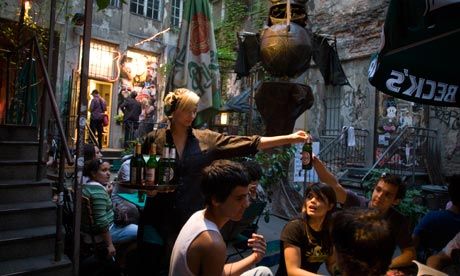
Waitress service in Berlin's Mitte district. The local joke is that the Greeks order and the Germans get the bill. Photograph: The Observer

In the back of the Berliner Republik bar on the banks of the river Spree, Matt, Otto and Christian's eyes are fixed on a screen in front of them. The names and prices of 18 German draught beers flash up, bright green on a black background, and change every few seconds, according to who has ordered what.

It's a pub game for the modern age, based on supply and demand. The trick is to buy the beer cheaply and then give yourself a pat on the back when demand pushes the price up.

"It gives a bit of a risqué edge to ordering," says Otto, a graphic designer. "But it also makes you feel strangely vulnerable."

The screen is more fruit machine than stock market, but it reflects the sense of playing a lottery common in Angela Merkel's Germany as it has pumped billions of euros into bailing out profligate Greece and propping up the single currency, without knowing whether the injection will do any good.

As the prices of the beers rise, news comes through from Frankfurt that in the real world Germany's DAX index has fallen 106.86 points, despite the €750m rescue package that the Bundestag has just narrowly approved. On Wall Street and elsewhere the markets wobbled, a sure sign that no one believed the crisis was anywhere near over.

On the pavement outside the bar, drawing on a cigarette, Pamela Schreiber pauses in contemplation. "Do I consider myself European? Well, of course, but first and foremost I'm a German," says the 33-year-old set designer with conviction.

The answer is not one that you would have expected a few years ago from a young person in Germany. This is the country where European enthusiasm has been easiest to find and where, since the war, European interests have taken precedence over nationalist ones. But, according to Schreiber, Germans feel increasingly torn over Europe.

"We always knew in our heart of hearts that the euro would never be as solid as our deutschmark, but we gave up our beloved currency, which was actually central to our identity, because we believed in the European project so fervently," she says.

Now there is talk, albeit based on blog gossip and a tabloid desire to whip up a good tale, of a return of the mark. Some even claim that secret supplies of the defunct currency – the strength of which was seen as a legacy of the sweat and tears that Germans spent to build up their ruined economy after the war – are being printed in secret underground locations. >>> Kate Connolly in Berlin | Sunday, May 23, 2010