Showing posts with label hyperinflation. Show all posts
Showing posts with label hyperinflation. Show all posts
August 25, 2010
THE TELEGRAPH: Adam Fergusson's 1975 book on hyper-inflation in the Weimar, When Money Dies, has become a cult read among Europe's top financiers after the Sage of Omaha Warren Buffet is said to have recommended it. He tells Robert Miller where parallels could occur if inflation were to take hold in Britain.
April 14, 2009
NZZ Online: Simbabwe schafft den Simbabwe Dollar für mindestens ein Jahr ab. Das meldet die staatlich-kontrollierte «Sunday Mail» unter Berufung auf den Wirtschaftsminister. Die Inflation erreichte zuletzt, auf ein Jahr hochgerechnet, 230 Millionen Prozent.
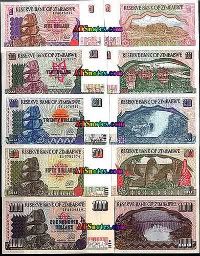
Erst wenn die Industrieproduktion wieder anspringe, könne über eine Wiedereinführung der eigenen Währung nachgedacht werden. Derzeit aber gebe es nichts, was die Währung stütze, zitierte die Zeitung den Wirtschafts- und Entwicklungsminister Elton Mangoma.
Die Regierung hatte bereits im Januar mehrere ausländische Währungen als Zahlungsmittel zugelassen in der Hoffung, so die galoppierende Inflation zumindest zu bremsen. Darunter sind der Euro, der US-Dollar und der südafrikanische Rand. >>> sda/Reuters | Sonntag, 12. April 2009
April 03, 2009
THE TELEGRAPH: Are we heading for another Great Depression?
Many baffled forecasters are asking just that, and studying what the US did wrong after the stock market crashed in 1929. But the more relevant policy errors might have been those made earlier across the Atlantic - in Weimar Germany from 1919 to 1923.
Policymakers have learned from the US mistakes. This time around, there has been no shrinkage of the money supply and no repetition of President Hoover's increase in tariffs in 1930 and income taxes in 1932. On the contrary, money supply has expanded rapidly while fiscal policies have been expansionary and protectionism limited.
But look at the Weimar government. Suffering from the trauma of defeat in the First World War and the burden of reparations, it was too weak to raise taxes. It ran large budget deficits instead. Interest rates were kept far below the rate of inflation, while money supply expanded rapidly. About half of government expenditure was funded by newly printed money. >>> By Martin Hutchinson, breakingviews.com | Wednesday, April 1, 2009
March 05, 2009
The Dawning of a New Dark Age – Paperback (US) Barnes & Noble >>>
The Dawning of a New Dark Age – Hardcover (US) Barnes & Noble >>>
September 11, 2008
THE TELEGRAPH: Robert Mugabe's government has bowed to financial reality and legalised the use of foreign currency in Zimbabwe's shattered economy.
It is the final humiliation for Zimbabwe's battered currency, which was worth more than the US greenback at independence in 1980.
Even after two revaluations that have knocked a total of 13 zeros off it, it was trading on the black market on Wednesday at around 6,000 to the USD – or 60,000,000,000,000,000 to one in terms of the original Zimbabwe dollar.
Gideon Gono, the reserve bank governor and a key player in the ruling Zanu-PF party, said that 250 wholesalers and 1,000 retailers would be licensed to accept foreign currency as an 18-month "experiment".
"These reforms are essentially a pragmatic response to the realities in the economy," he said. "We have watched and observed with heavy hearts the suffering of fellow Zimbabweans as they wait and continue to wait in long queues at the borders as they bring in basic commodities.
"We have also seen desperate mothers, youth and the elderly spending cold nights in foreign lands as they seek for basic commodities."
But while Mr Mugabe and his officials lament the country's woes, they consistently blame them on foreign plots and profiteering businessmen, rather than their own mismanagement, typified by the seizure of white-owned land from 2000 onwards, which destroyed commercial agriculture, the mainstay of the economy.
Since then the country has spiralled downwards, with millions leaving in search of work abroad, particularly in South Africa, and officially inflation in Zimbabwe is now running at 11.2 million per cent – unofficial estimates put it far higher.
The imposition of price controls failed to dampen inflation and instead merely saw goods and commodities vanish to the black market. Final Humiliation for Zimbabwe Dollar as Foreign Currency Legalised >>> By Sebastien Berger | September 11, 2008
The Dawning of a New Dark Age – Dust Jacket Hardcover, direct from the publishers (US) >>>
The Dawning of a New Dark Age – Paperback, direct from the publishers (US) >>>
Subscribe to:
Posts (Atom)