Democracy is an illusion! It’s become a political system fostered by the élite, for the élite, in order to fool the people that they have a stake in the system. In actual fact, they have virtually none. The whole political system in the modern era, despite having noble beginnings, is now used to benefit the few at the expense of the many. – Mark Alexander, June 29, 2018
June 11, 2010
Investors Pile into ‘Bargain’ BP Shares
Tony Hayward, CEO of BP. Photograph: The Times
THE TIMES: Investors piled back into BP stock this morning as the City gambled that recent sharp falls in the company’s value over the continuing oil spill crisis had left shares at a bargain price.
Shares in BP traded up 7.8 per cent at 393p despite the ongoing threat that the company may be forced to cut or suspend its dividend while a new, dramatically higher calculation of the amount of oil spilt into the Gulf of Mexico from the fractured BP oil rig emerged.
“Big institutional pension funds saw yesterday’s price drop [to as low as 352p] as a watershed level at which they would buy,” said one City trader, who also pointed out that the oil giant’s stock would remain volatile as long as there was uncertainty surrounding the progress of the clean-up.
BP, once Britain’s largest company, has lost almost half of its stock market value, about £56 billion, since the explosion on April 20.
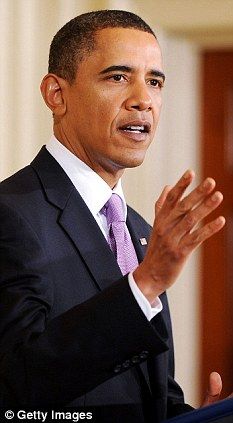
Shares in the company have been under renewed focus this week after political pressure from President Obama that BP cancel its dividend payment until the oil spill has been contained.
BP is due to pay its next quarterly dividend on July 27, a sum of about $2.5 billion (£1.7 billion). >>> Susan Thompson, Anne Barrowclough | Friday, June 11, 2010
That’s Enough ‘Kicking Ass’, Mr President
THE TIMES: Barack Obama’s attacks on BP may play well at home, but they are damaging millions of British people
The great British love-in with Barack Obama may be coming to an end. While there has been deep understanding of the environmental catastrophe that has struck the United States and of BP’s responsibility, there is also growing concern that the President’s angry rhetoric is going over the top and risks dividing the United States and the United Kingdom.
The Prime Minister is due to speak to the President at the weekend. BP will be high on his agenda. But already, I suspect, Sir Nigel Sheinwald, our Ambassador in Washington, has been on the phone to the Chief of Staff at the White House making it clear that serious damage is being done to many common British and American interests.
That BP deserves criticism is not in doubt. There is also much sympathy for the President as he seeks to assure the American public that he is in control of a disaster that has still not been fully resolved since the oil spillage began in April. His predecessor, George W. Bush, was widely criticised for his inadequate response to Hurricane Katrina. Any politician understands President Obama’s political imperative.
But, in the same way, Mr Obama must understand that an American president does not just have a domestic audience. Whatever their political purpose for his own electorate, his words resonate throughout the world and, however unintended, can have serious and damaging consequences.
That is what is now happening. >>> Malcolm Rifkind | Thursday, June 10, 2010
June 10, 2010
BP Oil Spill: David Cameron Backs Barack Obama's Hardline Stance
THE TELEGRAPH: David Cameron has backed Barack Obama in his criticism of BP over the Gulf oil spill.
Tony Hayward has been 'beaten up' by Barack Obama over the Gulf of Mexico oil spill. Photographs: The Telegraph
The oil firm has seen almost £50 billion wiped off its value since oil began leaking from one of its pipelines following an explosion on a gas platform in the Gulf of Mexico.
Investors say the hardline approach taken by Mr Obama – who has promised to "kick ass" over the incident – has contributed to the share price declines. The US administration last night threatened to block BP paying a dividend in order to ensure victims of the spill off the coast of Louisiana got sufficient compensation.
The pension funds of millions of Britons have been hard hit – as exposure to BP, Britain's biggest company, is high.
Boris Johnson, the Mayor of London, this morning became the most senior UK politician to defend BP, saying "anti-British rhetoric" levelled at the company was a matter of "national concern" and that the oil giant was paying "a very, very heavy price" for what had been an accident.
"I would like to see a bit of cool heads rather than endlessly buck-passing and name-calling," he said. "When you consider the huge exposure of British pension funds to BP it starts to become a matter of national concern if a great British company is being continually beaten up on the airwaves."
Speaking to reporters in Afghanistan, Mr Cameron refused to follow suit, instead offering his backing to Washington. >>> James Kirkup | Thursday, June 10, 2010
June 09, 2010
Iran State Shipping Company Beating Sanctions by Deception
Photo: Times Online
TIMES ONLINE: Iran’s state shipping company is carrying out a systematic campaign of deception to protect its international trade from looming sanctions at the United Nations Security Council.
The Islamic Republic of Iran Shipping Lines (Irisl), which has close links with the country’s Revolutionary Guards, is to be singled out in sanctions that are being voted on in the Security Council today.
Fresh concerns over how to implement the sanctions have emerged, however, after revelations about how the company evaded embargos by renaming scores of ships and setting up front companies to disguise their ownership.
According to a report in The New York Times published yesterday, as many as ten blacklisted ships are still insured in Britain and Bermuda and an unknown number whose ownership has been better disguised may have links to Britain. >>> Catherine Philp, Hugh Tomlinson, Martin Fletcher | Wednesday, June 09, 2010
U.N. Security Council Passes New Sanctions Against Iran
THE NEW YORK TIMES: UNITED NATIONS — The United States, moving firmly away from the Obama administration’s previous emphasis on wooing Iran, pushed through a new round of United Nations sanctions against the nation on Wednesday, taking aim at its military in yet another attempt to pressure Tehran over its nuclear program.
The new sanctions, a modest increase from previous rounds, took months to negotiate but still did not carry the symbolic weight of a unanimous Security Council decision. Twelve of the 15 nations voted for the measure, while Turkey and Brazil voted against and Lebanon abstained.
Beyond the restrictions imposed by the sanctions themselves, the vote sets stage for harsher measures that the United States and the European Union have promised to enact on their own once they had the imprimatur of the United Nations. European leaders are likely to discuss new measures at a summit in mid June. >>> Neil MacFarquhar | Wednesday, June 09, 2010
L'Espagne fait grève contre la baisse des salaires du public
Le divorce entre l'exécutif et les deux plus grandes centrales syndicales, Comisiones obreras (CCOO) et UGT, est officiellement consommé. Photo : Le Figaro
LE FIGARO: Pour les syndicats, 75% des fonctionnaires faisaient grève mardi. Selon le gouvernement, ils n'étaient que 11%.
Ce fut à la fois une première et une répétition générale. En six ans de gouvernement socialiste, les syndicats n'avaient jamais convoqué de grève nationale dans l'Espagne de José Luis Rodríguez Zapatero. Mais depuis la mobilisation des fonctionnaires mardi, le divorce entre l'exécutif et les deux plus grandes centrales syndicales - Comisiones obreras (CCOO) et UGT - est officiellement consommé. >>> Par Cyrille Lachèvre | Mardi 08 Juin 2010
June 08, 2010
David Cameron Faces EU Fight Over Budget Vetting
THE TELEGRAPH: David Cameron is facing a fight with European leaders at his first summit next week over demands for Britain to have its budget vetted by the EU before it is presented to parliament.
He will refuse to sign up to plans, supported by all Europe's finance ministers except Britain's, in which officials would assess the "main assumptions" of a budget before it was seen by MPs and the public.
The "budgetary surveillance" demand will overshadow the prime minister's first EU meeting next Thursday and will put him at odds with Angela Merkel, the German Chancellor and Nicolas Sarkozy, the French President.
Herman Van Rompuy, the EU President, and the European Commission have proposed that all treasuries must discuss their budget plans with other European finance ministers and officials before they are presented to national parliaments.
Mr Van Rompuy said: "The main assumptions underlying the budgetary plans, like the levels of growth or inflation, would be examined. So would the main aggregates, like total revenues, total spending and deficit targets.
"A government presenting a budgetary plan with a high deficit will have to justify itself in front of its peers. There would still be time to adjust the plans before the final budget is presented."
Mr Van Rompuy has defended the plan saying it will help national parliaments to better judge complicated budgets. "A national parliament would be able to judge its governments' budget plans knowing fully their credibility," he said.
The measure is intended to prevent a repeat of the Greek debt crisis and to help the EU police rules, applying to all 27 member states, limiting public spending in order to safeguard the euro. >>> Bruno Waterfield in Brussels | Tuesday, June 08, 2010
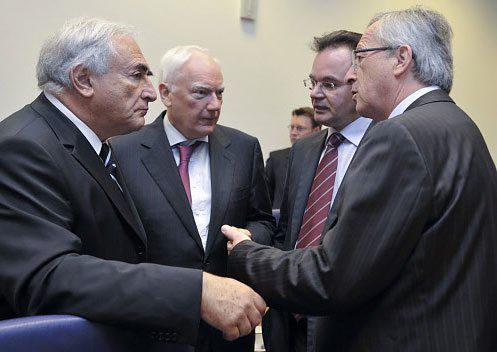
An dem Treffen in Luxemburg nahmen unter anderem IMF-Generaldirektor Strauss-Kahn (l.) und Eurogruppen-Chef Juncker (r.) teil. Bild: NZZ Online
Euro-Rettungsschirm einsatzbereit: Gesellschaft für Hilfe der Euro-Länder offiziell gegründet
NZZ ONLINE: Getrieben durch den Euro-Absturz haben die Finanzminister den beispiellosen Rettungsmechanismus für die Eurozone in Kraft gesetzt. Mit ihrer Unterschrift gründeten die Ressortchefs in Luxemburg die Zweckgesellschaft, die den Eurogruppen-Anteil am 750-Milliarden-Hilfspaket für Pleitestaaten aufbringt.
Der Rettungsschirm von 750 Milliarden Euro zur Absicherung kriselnder Euro-Staaten steht endgültig. Die Euro- Finanzminister einigten sich in Luxemburg auf die Gründung einer Finanzgesellschaft.
Sie nimmt notfalls Kredite für Wackelkandidaten auf, wie Diplomaten am Rande der Sitzung berichteten. Der Rettungsschirm war von der EU Anfang Mai unter dramatischen Umständen vereinbart worden. Seitdem war wochenlang über Einzelheiten verhandelt worden.
Mit dem System soll die Stabilität des Euro abgesichert werden. 500 Mrd. Euro entfallen auf die Europäer, die restlichen 250 Mrd. Euro auf den Internationalen Währungsfonds (IMF). >>> sda/dpa | Montag, 07. Juni 2010
Americans Like to Supersize Everything. Now They’ve Got Supersized Debt
MAIL ONLINE: America's $13trillion debt is set to overtake the country's GDP within the next two years as economists warn of a 'debt super cycle.'
Forecasters predict the U.S. debt will grow to surpass gross domestic product in 2012, based on data from the International Monetary Fund.
According to Bloomberg, the world's largest economy will expand at a slower pace than the 3.2 per cent average of the past five decades.
It comes as Barack Obama borrows record amounts to fund spending programs to help the economy recover from its longest recession since the 1930s.
'Over the long term, interest rates on government debt will likely have to rise to attract investors,' said Hiroki Shimazu, a market economist in Tokyo at Nikko Cordial Securities Inc.
'That will be a big burden on the government and the people.'
Watch What You Buy in Italy! You Might Get Fined for Buying It!
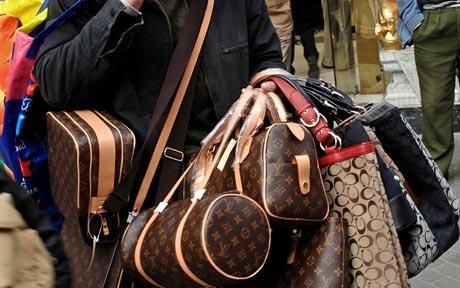
THE TELEGRAPH: Tourists buying fake designer goods on holiday in Italy have been warned to think twice after a woman was fined 1000 euros (£825) for buying a handbag.
Austrian pensioner Ursula Corel, 65, was spotted handing over seven euros for a Louis Vuitton handbag copy from a street vendor.
She was spotted by the officers as they scanned crowds with high powered binoculars from a lifeguards watch tower in the resort of Jesolo, near Venice.
Hotel owners worried that tourists will be put off visiting Jesolo on holiday have clubbed together to help pay Mrs Corel's fine. Fake bag fines for tourists in Italy >>> Nick Pisa in Rome | Monday, June 07, 2010
Luxury Storefronts at Rock-bottom Prices
Pedestrians walk past the Versace store on Fifth Avenue in New York. Photograph: The Globe and Mail
THE GLOBE AND MAIL: Compared to Paris, New York, even Athens, Canada’s best retail spaces come cheap
Rents for prime retail space in Canada’s swankiest fashion districts may seem high by Canadian standards, but the most expensive storefronts in the country are still being rented at bargain-basement prices compared to other global centres.
Montreal’s Saint Catherine Street and Toronto’s Bloor Street districts were the priciest in the country, with average lease rates at $294.12 (U.S.) a square foot. The cost of space placed the cities in a tie for 32nd place in the world, sandwiched between Honolulu and Amsterdam.
Globally, space along the Champs Élysées in Paris was the most expensive at $1,255.90 a square foot. New York’s Fifth Avenue, Hong Kong’s Russell Street and London’s Bond Street all saw rents higher than $1,100 a square foot. >>> Steve Ladurantaye | Monday, June 07, 2010
European Markets Head South
THE WALL STREET JOURNAL: LONDON—European stocks slipped Monday amid concerns that the European sovereign-debt crisis could widen and as the euro tumbled to a fresh four-year low.
Sentiment remained fragile following Friday's disappointing U.S. nonfarm payrolls data, despite the Hungarian government's denial that it is facing a Greek-style debt crisis.
Other factors playing into the uncertainty included a drop in oil prices, a German court considering a ban on the European Union-International Monetary Fund aid packages, and a Group of 20 meeting that has failed to provide any form of relief. European Markets Pare Losses >>> Andrea Tryphonides and Ishaq Siddiqi | Monday, June 07, 2010
News Hub: Easy Money to Stick Around a While
Gold Mine Controversy
David Cameron: Economic Measures Will 'Change Our Way of Life'
THE TELEGRAPH: David Cameron has warned that his plans to tackle Britain's economic woes will affect the way we live for decades.
In a keynote speech on the economy, the Prime Minister said that the economic situation he had inherited from Labour was worse than he expected.
If drastic cuts were not implemented, the Treasury would be spending an annual £70 billion on debt interest within five years - more than on schools in England, transport, and fighting climate change put together, he said.
Speaking alongside new Treasury Chief Secretary Danny Alexander, Mr Cameron told an audience in Milton Keynes that now the Tory-Liberal Democrat coalition had been given access to the books, it was clear that the ''overall scale of the problem is even worse than we thought''.
''How we deal with these things will affect our economy, our society - indeed our whole way of life,'' he said.
''The decisions we make will affect every single person in our country. And the effects of those decisions will stay with us for years, perhaps decades, to come.
''It is precisely because these decisions are so momentous, because they will have such enormous implications, and because we cannot afford either to duck them or to get them wrong that I want to make sure we go about the urgent task of cutting our deficit in a way that is open, responsible and fair,'' he said. >>> | Monday, June 07, 2010
Britain to Emulate Canada's Radical Solution to Tackle Debt
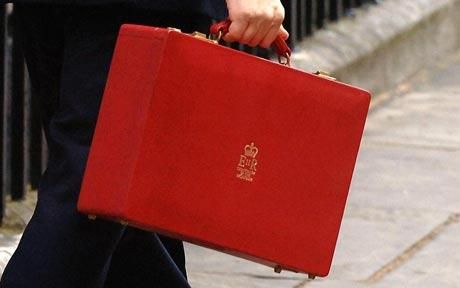
THE SUNDAY TELEGRAPH: George Osborne is planning to eradicate Britain's budget deficit by emulating Canada, where borrowing was brought under control within just three years by spending cuts of 20 per cent.
The Chancellor will announce a "once-in-a-generation" revolution in public spending inspired by Canada in the mid-1990s, when the government turned a budget deficit of nine per cent of GDP into a surplus.
Canada brought public spending under control guided by the principle that people should ask "what needs to be done by government and what we can afford to do".
Mr Osborne and his Liberal Democrat deputy, Danny Alexander, will attempt to bring about a similar change of mindset in Britain.
The ambitious plan will be welcomed by those who believe swift and decisive action is necessary to bring Britain's budget deficit and spiralling national debt under control quickly.
However, it is likely to prove controversial with those who believe it could tip Britain back into recession and public sector workers who face losing their jobs. >>> Andrew Porter, Political Editor | Sunday, June 06, 2010
June 06, 2010
Cameron: 'Years of Pain Ahead'
THE SUNDAY TIMES: DAVID CAMERON has warned that the economy is in a far worse state than previously thought and signalled that Britain faces years of “pain” as the spending axe falls.
The prime minister indicated a sharp downgrade in official growth forecasts and revealed that welfare and public sector pay would bear the brunt of budget cuts.
It is understood that tough measures being considered to help control the £156 billion budget deficit include benefit freezes and cuts in child tax credits. There are also likely to be below-inflation pay rises for state employees on top of next year’s planned freeze.
In an interview with The Sunday Times, Cameron said: “Proper statesmanship is taking the right action, explaining to people the purpose behind the pain.”
The prime minister said there would be no “trampoline recovery” of the economy. He warned there was a “serious problem” with forecasts inherited from Labour of robust 3% growth next year.
“There is a huge amount of debt that has got to be dealt with. Crossing our fingers, waiting for growth and hoping it will go away is simply not an answer,” he said.
“The country has got an overdraft. The interest on that overdraft is swallowing up things that the nation should otherwise be spending money on. We have got to take people with us on this difficult journey.” Read on and comment >>> Jonathan Oliver, Political Editor | Sunday, June 06, 2010
The Opinion of Clever Dicks in the City*: Euro 'Will Be Dead in Five Years'
THE TELEGRAPH: The euro will have broken up before the end of this Parliamentary term, according to the bulk of economists taking part in a wide-ranging economic survey for The Sunday Telegraph.
The single currency is in its death throes and may not survive in its current membership for a week, let alone the next five years, according to a selection of responses to the survey – the first major wide-ranging litmus test of economic opinion in the City since the election. The findings underline suspicions that the new Chancellor, George Osborne, will have to firefight a full-blown crisis in Britain's biggest trading partner in his first years in office.
Of the 25 leading City economists who took part in the Telegraph survey, 12 predicted that the euro would not survive in its current form this Parliamentary term, compared with eight who suspected it would. Five declared themselves undecided. The finding is only one of a number of remarkable conclusions, including that:
• The economy will grow by well over a percentage point less next year than the Budget predicted in March.
• The Government will borrow almost £10bn less next year than the Treasury previously forecast, despite this weaker growth.
• Just as many economists think the Bank of England will not raise rates until 2012 or later as think it will lift borrowing costs this year.
But the conclusion on the euro is perhaps the most remarkable finding. A year ago or less, few within the City would have confidently predicted the currency's demise. But the travails of Greece, Spain and Portugal in recent weeks, plus German Chancellor Angela Merkel's acknowledgement that the currency is facing an "existential crisis", have radically shifted opinion. >>> Edmund Conway | Saturday, June 05, 2010
Bin Taxes and Planning Laws to Be Ditched by Coalition
THE SUNDAY TELEGRAPH: A raft of Labour laws which have been criticised for penalising Middle England will be consigned to the scrap heap by the new Government this week.
Bin taxes will be ditched, along with laws allowing developers to build on back gardens, as the Coalition embarks on a bonfire of "meddling" legislation.
Ministers will say they are scrapping controversial Labour proposals to allow local authorities to charge for household rubbish collections or fine those who fail to cut their waste.
And in a major review of planning law, back gardens will no longer be classified as "brownfield" land which can be built on.
The Government will also announce that it is getting rid of a requirement on builders to squeeze more smaller homes onto new housing developments, after complaints that the rule leads to overcrowding.
The shake-up follows years of campaigns, including one in this newspaper against proposed refuse taxes, and is clearly aimed at pacifying core Conservative voters. >>> Melissa Kite and Richard Gray | Sunday, June 06, 2010
June 05, 2010
BP Oil Spill: The British Backlash Has Begun
THE TELEGRAPH: Could the US backlash against BP extend to other British companies, asks Tom Leonard
Protest outside of the Washington DC headquarters of BP. Photograph: The Telegraph
When the US Interior Secretary Ken Salazar promised to keep “the boot on the neck of British Petroleum” over its giant Gulf of Mexico oil spill, the Republican Rand Paul rounded on the White House for being “really un-American” in attacking business.
If so, almost everyone is guilty of un-American activities, as the US has declared open season on the British oil giant. Just 50 yards up the street from The Daily Telegraph’s Manhattan office, the local BP petrol station had its sign daubed in paint the colour of drilling mud last week when 200 protesters turned up. “BP – a bunch of ----ing murderers!” said the message on a protester’s T-shirt. The chant was better: “BP, your heart is black, you can have your oil back.”
There have been similar protests at BP outlets across America and a call for a boycott which appears to have been roundly ignored. The demonstrations may be primarily anti-corporate and anti-oil but occasionally nationality of the corporation slips out. In New Orleans, a demonstrator stood on a Union flag. “We are all at the mercy of BP, a British-owned company,” wailed a Louisiana seaplane company boss in a letter to her senator after she was barred from taking US journalists to a possibly oily beach.
Notwithstanding the irony of a situation in which Americans are accusing a European corporation of putting “profits before people”, it is difficult to recall a more vicious backlash against a company here. The question of whether BP would have received so much vitriol if the initials had stood for, say, Boston Petroleum, has concerned those who worry about the implications for US-UK relations.
Although there is no sign of such a backlash at present, British officials in the US are concerned that if BP continues to fail to plug the leak or if it faces criminal charges, then other British businesses could suffer. >>> Tom Leonard | Saturday, June 05, 2010