Showing posts with label Dubai. Show all posts

September 09, 2026

Can Dubai’s Luxe Image Survive the War with Iran? | BBC News

Sep 8, 2026 | As the summer holiday season draws to a close, foreigners travelling to and from Dubai in the United Arab Emirates are facing delays, cancellations and severe travel warnings.

The disruption comes as a result of the UAE’s position in the ongoing US-Israel war with Iran. Throughout the conflict, Iran has attacked the UAE more times than any other country, including Israel.

Until the war with Iran began, Dubai was a major tourist destination, famous for its modern skyscrapers, luxurious beaches and low crime rate.

For decades, the Gulf city has promised residents and tourists alike safety, security and stability – so has that promise fallen apart? And what could that mean for the city’s future?

The Global Story’s Asma Khalid speaks to Sameer Hashmi, an independent journalist based in Dubai, about how Brand Dubai is weathering a major regional war.


August 22, 2026

Broken DUBAI: 10 Areas Turning Into Ghost Zones as Tourism Collapses in 2026

July 25, 2026 | What is really happening across Dubai in 2026?

After years of record-breaking tourism, some of Dubai's most famous destinations began experiencing quieter streets, changing visitor patterns, and growing economic uncertainty. But is Dubai really in decline, or is the reality more complex?

In this documentary, we explore 10 areas across Dubai that have sparked discussion about the city's future, including Jumeirah Beach Residence (JBR), Palm Jumeirah, Downtown Dubai, Dubai Marina, Business Bay, Jumeirah Lakes Towers (JLT), Jumeirah Village Circle (JVC), DIFC, Global Village, and The World Islands.


June 04, 2026

Wie der Iran-Krieg die Emirate ins Wanken bringt | SRFglobal | SRF

Jun 4, 2026 | Luxusvillen, Steuerfreiheit und Sicherheit: Die Vereinigten Arabischen Emirate sind zum Magneten für Superreiche geworden. Doch der Krieg im Iran bringt das Geschäftsmodell der Emirate ins Wanken. Hinter der glitzernden Fassade von Dubai und Abu Dhabi beginnt eine neue Machtverschiebung am Golf.

March 11, 2026

‘The Shine Has Been Taken Off’: Dubai Faces Existential Threat as Foreigners Flee Conflict

THE GUARDIAN: Tens of thousands of residents and tourists have left UAE since the US and Israel started bombing Iran two weeks ago, leaving beach bars, malls and hotels eerily empty

In the playground of the rich, nobody wanted this war. For decades, Dubai built itself up as a sanctuary of unadulterated consumerism visited by tourists the world over.

But now, the city in the United Arab Emirates faces an existential threat, as the war between the US and Israel and Iran has shaken the foundations of the “Dubai dream” that so many foreigners had bought into.

The UAE has borne the brunt of more than two-thirds of Iran’s strikes; the state targeted in part, say analysts, for its deep military and intelligence partnerships with western powers, and Dubai’s reputation as a favoured centre for global finance and western holidays.

“The shine has definitely been taken off,” said John Trudinger, a British resident of Dubai for 16 years, who is a headteacher at an Emirati school in Dubai. He employs more than 100 teachers from the UK and said most have been so “deeply traumatised and really struggling to cope” with the sudden arrival of war in Dubai that they have left and won’t come back.

They are among the tens of thousands of residents and tourists that have fled Dubai since the US and Israel launched joint strikes on Iran almost two weeks ago. The city’s large population of migrant workers largely don’t have that privilege. » | Hannah Ellis-Petersen in Dubai | Wednesday, March 11, 2026

April 28, 2011

British Businessmen in Dubai Sentenced to 10 Years for Fraud

THE DAILY TELEGRAPH: Two of the Gulf's most prominent British expatriates have been jailed for ten years in Dubai and fined $500 million for defrauding a bank over projects including a giant polo hotel project.

The downfall of Bahrain-based Charles Ridley, a private banker, and Ryan Cornelius, a hotelier, property developer and investor, has sent shock-waves through the expatriate community and cast a harsh light on the way Dubai handles financial crime.

The two men, along with a Dubai-based British property developer, Arthur Fitzwilliam, who was acquitted, and two Pakistani officials of the Dubai Islamic Bank were arrested in mid-2008. Their first trial collapsed last year when the judge refused to give a verdict.

Mr Ridley was accused of conspiring with the two bank officials to obtain a $501 million loan under false pretences. The money was to be lent to Mr Cornelius to invest in a variety of projects, including buying a Canadian oil refinery to rebuild it in Pakistan, and Mr Fitzwilliam's ambitious plans for a polo, equestrian, hotel and luxury villa complex in the desert outside Dubai. » | Richard Spencer, Dubai | Wednesday, April 27, 2011

April 28, 2010

April 04, 2010

”Tribal Capitalism”

THE SUNDAY TELEGRAPH: The death of Abu Dhabi's Sheikh Ahmed bin Zayed al-Nahyan, controller of the world's largest sovereign wealth fund, has thrown the spotlight on one of the world's most powerful families.
Photobucket
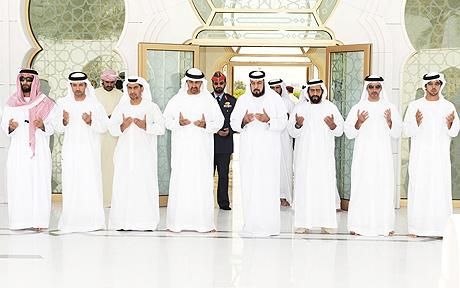
Mourners at the funeral of Sheikh Ahmed bin Zayed al-Nahyan. The two in the centre of the pic are Crown Sheikh Mohammed bin Zayed, Crown Prince (L) and Sheikh Khalifa bin Zayed, Ruler of Abu Dhabi, President of the UAE. On the far right is Sheikh Mansur, deputy prime minister and owner of Manchester City. Photograph: The Sunday Telegraph

He was a multi-billionaire, and scion of one of the world's most powerful families. But until his microlight aircraft crashed into a Moroccan lake last weekend few outside the narrow confines of the Gulf, and the even narrower confines of sovereign wealth finance, would have heard of Sheikh Ahmed bin Zayed al-Nahyan.

To some extent, that is understandable. In the world of Gulf princes, he was one among a secretive cast of thousands. As managing director of the world's biggest sovereign wealth fund, discretion was his watchword.

He himself was one of 19 brothers, led by the eldest, Sheikh Khalifa bin Zayed, Ruler of Abu Dhabi and President of the United Arab Emirates. With his close-trimmed beard and standard-issue white robes and kaffiyeh, he could pass for any one of the powerful royals who run the emirates and neighbours such as Saudi Arabia.

Even so it was odd that his death at the age of 41 attracted only a few passing newspaper paragraphs in the West. The Nahyan family, Abu Dhabi's hereditary emirs, are significant players on the world stage, and their ability to avoid the limelight is itself beginning to attract attention.

"They are not interested, they don't want it," says one Abu Dhabi insider. "They don't give interviews, they just get on with it."

But in terms of publicity, Sheikh's Ahmed's death is likely to be just the start of it. What they are "getting on with" nowadays is running boardrooms, influencing geopolitics and - above all - growing the richest family business in the world. Slowly, they are becoming aware that as the spotlight turns on them, they will become fodder for front-page headlines and, no doubt, gossip columns too.

Sheikh Ahmed, 41, died after apparently fouling up a landing in a microlight he was learning to pilot. He had been holidaying at a Nahyan family palace by a lake in the Moroccan hills. His instructor survived and got ashore; Sheikh Ahmed's body was eventually found on Tuesday.

Immediately, the whispers started. No-one in authority suspects anything other than an accident, but his half-brother, Sheikh Nasser bin Zayed, also died in a crash when the helicopter he was piloting plunged into the Gulf two years ago.

It was an unfortunate coincidence: could the Nahyans be suffering the "curse of the Khaleej Kennedys", asked one gossip - Khaleej being the Arabic for Gulf.

Comparison with the Kennedys would cause the conservative Nahyans to shudder with horror. But if the United Arab Emirates is not yet the United States, the Nahyans are just as handsome as the Kennedys and much, much richer. Inside the world of the 'Kennedys of the Gulf' >>> Richard Spencer in Abu Dhabi | Easter Sunday, April 04, 2010

March 05, 2010

Azerbaijan President's Son, 12, 'Buys £30m Worth of Luxury Dubai Property'

THE TELEGRAPH: The 12-year-old son of the Azerbaijan president has gone on a multi-million pound property spending spree, buying up a series of luxury Dubai waterfront mansions.

Heydar Aliyev, the son of Ilham Aliyev, the oil-rich country’s president, allegedly spent almost £30 million (US$44 million) on nine waterfront mansions in the southern Gulf emirate earlier this year, reports said.

The boy, who was 11 at the time, made the purchase in the Palm Jumeirah development over two weeks, the Washington Post reported on Friday.

Heydar’s name and his date of birth appeared on Dubai Land Department records, which were obtained by the paper.

The details listed on the property records were the same as those of the son of the former Soviet Republic’s president, whose annual salary is about £150,000 ($228,000).

The purchases are about the equivalent to 10,000 years' worth of salary for the average citizen of the country. >>> Andrew Hough | Friday, March 05, 2010

November 29, 2009

Abu Dhabi Will Not Race to Dubai's Rescue

THE SUNDAY TELEGRAPH: Sheikh Mohammed of Dubai is under mounting pressure to explain the emirate’s debt problems, after Abu Dhabi indicated that it will not write a blank cheque to bail out its neighbour.

According to officials, Abu Dhabi, the richest state in the United Arab Emirates, will be cautious about how and whether to assist Dubai World, the state holding company that this week suspended repayments on a $3.5bn (£2.1bn) Islamic bond due in mid-December.

Any sign that Abu Dhabi’s support may not yet be secured could push global markets further into turmoil tomorrow, analysts said, especially if Dubai’s ruler maintains his silence on the crisis beyond this weekend’s Eid religious holiday. Sources said he may be forced to disrupt the 10-day Islamic break to make a statement as early as tomorrow.

“We will look at Dubai’s commitments and approach them on a case-by-case basis. It does not mean that Abu Dhabi will underwrite all of their debts,” a senior Abu Dhabi official said.

“Until things become clearer, it is very difficult to make any further investment decision on the bonds. Many things have to be clarified by Dubai.”

Dubai World’s $59bn of liabilities make up the majority of the emirate’s total $80bn debts. >>> Rowena Mason and Louise Armitstead | Sunday, November 29, 2009

November 27, 2009

Dubai Tries to Stem Panic as Financial Crisis Shakes Investors Around World

THE GUARDIAN: FTSE 100 opens down 70 points before regaining ground / Japan's Nikkei closes down 3.2%; Hang Seng falls 5.3%

The Dubai financial crisis continued to send shares and commodities falling around the world this morning, despite efforts by the emirate's ruling family to calm the panic.

In London, the FTSE 100 tumbled by 70 points, or nearly 1.4%, to 5123 when trading began – but by 9.15am had erased nearly all of its losses. HSBC and Barclays were among the biggest fallers, along with mining companies.

There was also a bout of heavy selling in Asia. The Nikkei 225 closed 3.2% lower, with Japan's biggest banks leading the fallers. Hong Kong's Hang Seng index fell by 5.3%.

Major building firms in Asia also fell sharply, as traders anticipated that the Dubai building boom was over.

Predictions that Dubai could drag the world economy downwards again knocked $5.50 off the price of a barrel of oil, to $72.49.

Yesterday the FTSE 100 suffered its worst day's trading since March, falling by 170 points. This followed the news that Dubai World – the government-owned conglomerate that has led the dramatic growth in the Emirate – has asked to defer repaying some debts for six months.

It is still unclear whether Dubai World will default on its $80bn debts, which would be a major blow to the banking sector, or be bailed out by the United Arab Emirates.

Sheikh Ahmed bin Saeed al Maktoum, the uncle of Dubai's ruler Sheikh Mohammed bin Rashid al Maktoum, attempted to calm the situation last night. >>> Graeme Wearden | Friday, November 27, 2009

May 23, 2009

Britons Face Losing Savings as Dubai Property Market Collapses

THE TELEGRAPH: Britons who invested hundreds of thousands of pounds in unbuilt property during Dubai's boom years face losing the money after a collapse in the market.

Photobucket
Falling property prices and the credit crunch have hit Dubai's financial model hard, with work stopped on hundreds of building sites. Photo credit: The Telegraph

An 800-strong group of investors, from individuals who put deposits on holiday flats to property brokers, says hundreds of millions of pounds is at risk.

Work has slowed or stopped on swathes of building sites, including on a second "Palm Island". The city was planning a series of artificial peninsulas in the shape of palm trees packed with seafront holiday villas, but only one is finished.

Of all the world's property crashes, Dubai's has been among the most spectacular. According to an estimate from Morgan Stanley, projects worth £165 billion have been delayed or cancelled across the United Arab Emirates. Prices in Dubai have fallen by more than 40 per cent since September.

As prices soared, many investors bought off-plan, either because it was cheaper, in the case of small-time buyers looking for a home in the sun, or because they could "flip" or sell on for a quick profit without ever having to pay the full value.

Investors on the end of a chain of "flippers" have been hit particularly hard as prices fell while building was put on hold. But even those who bought from developers now face the dilemma of whether to keep paying or cut their losses. >>> By Richard Spencer in Dubai | Saturday, May 23, 2009

April 15, 2009

Scholar's Critique Spurs Ijara Islamic Bond

REUTERS: DUBAI - Since a revered Islamic scholar spoke out against some sukuk structures more than a year ago, issuers have refocused their attention on the ijara Islamic bond model, bankers said on Wednesday.

Some bankers have attributed last year's downturn in issuance of sukuk, the Islamic alternative to Islamic bonds, to comments by Sheikh Muhammad Taqi Usmani that musharaka and mudaraba sukuk should not promise guaranteed returns.

Most Islamic bonds should be treated as equity instruments, said Usmani, chairman of the board of scholars at the Accounting and Auditing Organization for Islamic Financial Institutions (AAOIFI).

His February 2008 comments marked a shift for Muslims seeking fixed-income returns and, in the following months, coincided with a slowdown in the sukuk market as the global financial crisis deepened.

But bankers at the Reuters Islamic Finance Summit on Wednesday downplayed that link, saying the general slump in the global debt market was behind the drying up of sukuk, not a fear the structures failed to comply with the spirit of Islam.

"The sukuk market has shrunk as a direct result of the market conditions rather than an issue with the structures themselves," said Raphael de Ricaud, head of Islamic finance at Rothschild, an investment bank providing advisory services. >>> By Daliah Merzaban | Wednesday, April 15, 2009

February 28, 2009

Dubai Falls on Hard Times

NRC HANDELSBLAD: The wealthy Gulf state of Dubai has been hit hard by the global economic crisis. Tens of thousands of workers have been laid off and forced to return to their homelands. The Dutch community in Dubai is also feeling the pinch.

Jan Demmink has lived in Dubai for 28 years. It's the pleasant atmosphere, the entrepreneurial spirit and the climate that keep him in the Gulf state. He witnessed the transformation of what was once a tranquil and prosperous town into the vast collection of skyscrapers that makes up modern-day Dubai.

Under the leadership of Sheik Mohammed and his father Maktoum III, the emirate invested in the financial sector, tourism and real estate. The bigger, more expensive and more luxurious the better. Yet these are the very sectors that have been shaken to their foundations by the crisis and meanwhile Dubai has no major oil reserves to fall back on.

Financial nosedive

Jan Demmink works in the electronic security of complexes such as refineries, palaces and roads. His position is safe for the time being. "I work on long-running projects, so I have yet to feel the effects of the crisis," he explains. "But in construction you can see the signs already. A halt has been called to projects that were only started recently, or which have yet to get under way."

Dutch dredging company Van Oord is one of those in the firing line. The company hit the headlines worldwide with the construction of Palm Jumeirah, the first of Dubai's famous Palm islands and the construction of The World archipelago. Van Oord was all set to embark on a third island project, Palm Deira, an order worth 2.5 billion euros, the largest in the company's history. Part of the order has already been realised but the rest is on the back burner for the foreseeable future. The funding simply isn't there. Spokesman Bert Groothuizen says no one saw the rapid changes coming. "It was a nosedive. Especially in the fourth quarter of 2008. And I don't think these problems will be solved in six months' time." Expats Feeling the Economic Nosedive in Dubai >>> By Willemien Groot for Radio Netherlands Worldwide | Friday, February 27, 2009

The Dawning of a New Dark Age (Paperback & Hardback – The Netherlands) >>>

January 14, 2009

Dubai Halts Work on New Tallest Skyscraper as Even Oil-rich Arab Countries Feel the Pinch of the Credit Crunch

MAIL Online: The developer of potentially the world's tallest skyscraper is halting work on the project for a year as the Middle East's business and entertainment capital grapples with the financial crisis.

State-owned builder Nakheel's decision to shelve the landmark development - which it unveiled only in October - came as a leading credit rating firm warned that falling real estate prices will likely hurt banks in Dubai and elsewhere in the United Arab Emirates.

Home values in the emirate tumbled 8 percent in the last three months from the previous quarter, a report said, marking what analysts say is the first such decline in years.

The halted skyscraper was planned to soar the length of more than 10 American football fields. Analysts said its unveiling late last year showed a lot of confidence amid the souring global economy.

State-owned Nakheel said in a brief statement that 'further work' on its building's foundations '[would] commence in 12 months'.

The developer did not say how much work, if any, had already been completed.

'This is part of our readjustment of our immediate business plans to better reflect the current market trends and match supply with demand,' the company said. >>> By Mail Foreign Service | Wednesday, January 14, 2009

The Dawning of a New Dark Age (Paperback & Hardback) – Free delivery >>>

December 01, 2008

The Party’s Over in Dubai

TIMESONLINE: Local banks are in trouble and property prices have crashed. Is the bubble about to burst?

Lorna Davidson and her husband Mike gave up Leicester for Dubai this summer looking for a better life. They didn’t find it. The marketing jobs they thought they had in a property firm were withdrawn the day after they arrived and they cannot find alternatives. Nor can they get a mortgage to buy a flat.

“We were told we had jobs at 25,000 dirhams (£5,000) a month and that we could get a property with a 10% deposit,” said Lorna, 24. “There are no jobs and the banks won’t lend without 40% upfront.”

It’s of little comfort to the Davidsons that they are not alone. After a few months when oil-rich Middle Eastern states seemed immune to the effects of the banking crisis and the global economic slow-down, the credit crunch has crashed on to the biscuity shores of the Gulf with the force of an economic tsunami.

With struggling local banks being bailed out, liquidity drying up, the property market transformed from a bazaar of eager buyers into a den of sellers, and the government creating a crisis committee to tackle the slump, observers are asking: is the Dubai bubble bursting?

“Confidence has collapsed,” said Mustafa Alani of the Dubai-based think tank, the Gulf Research Center. Chris Dommett of John Charcol Dubai, a mortgage advisory firm, added: “People have really begun to fear a crash.” >>> John Arlidge | November 30, 2008

The Dawning of a New Dark Age (Paperback & Hardback) – Free delivery >>>

May 01, 2008

Targeting Opportunities in the United Arab Emirates

EMIRATES BUSINESS 24/7: Dow Jones Indexes has opened its first office in the region in Dubai. While the office will promote all the company's indexes, attention is likely to be given to the Dow Jones Islamic Market Indexes, which were launched in 1999. The Dubai office will target investment banks, asset managers, fund managers and exchanges across the region. Sumeet Nihalani, senior director for Asia Pacific and Middle East, spoke to Emirates Business about what Dow Jones Indexes hopes to achieve from its presences in the region and the general outlook for Islamic banking.


Why has Dow Jones Indexes decided now is the time to establish a new presence in the Middle East? 


We have been in the Islamic market and business index for a long time. But we have been growing our business with the licensees in the Middle East. As this business grew, it was important to have somebody in terms of proximity to be able to efficiently and in a timely manner to serve and support potential clients. We have seen a lot of growth in the Middle East – mainly in GCC countries. And we have seen a lot of growth in the Middle East around Islamic index opportunities. It is important to have somebody on the ground to see what are the emerging trends. And to see how we can fit our competence with local knowledge and understanding to the local market place to create more products or different products. 


What are the challenges facing Islamic financial banking?

I would like to use the word opportunities rather than challenges. I do think there are a number of opportunities. As a lot of banking and financial professionals engage themselves with Islamic finance activities, they are able to create new products and services that can be [useful] across regions. And they can address the different aspects of Islamic finance in insurance, mortgages, etc. Our office has given us a good opportunity to contribute to this and bring our global experience to Dubai and the region in similar services in this market place. Also, the members of our Sharia board who provide Islamic Finance expertise to Dow Jones Indexes and provide the Sharia rules that we apply to our index components are located here.
Targeting Opportunities in UAE >>> By Rami Eljundi | April 29, 2008

The Dawning of a New Dark Age (Paperback - UK)
The Dawning of a New Dark Age (Hardback - UK)

March 09, 2008

Islamic Finance Expands as Wealth Grows

KHALEEJ TIMES: DUBAI - The market for Islamic finance and banking is growing rapidly in the Gulf thanks to burgeoning wealth and attractive financial instruments.

Studies have put the total value of Islamic equity funds in the Gulf region at around 30 billion dollars (19.5 billion euros), said Khaled al-Masri, partner in asset management at Dubai-based Rasmala Investments.

“Investable wealth in the Gulf Cooperation Council is growing by one of the highest rates in the world ... This increase is being met with more product providers and products being launched in the GCC market,” he said.

The Islamic finance industry worldwide is worth around 700 billion dollars, Moody’s Investors Services estimated in a February report.

Economies of the six GCC member states -- Bahrain, Kuwait, Oman, Qatar, Saudi Arabia and the United Arab Emirates -- have been enjoying remarkable growth over the past few years on the back of record oil prices.

The robust economic performance has inflated local wealth in this Muslim region where many might prefer to seek profit through investments that do not contradict their beliefs.

The basic principle of Islamic finance is the prohibition of Riba (usury), which is correlated with interest in today’s banking.
Islamic funds are also banned from investing in companies associated with tobacco, alcohol, pornography, pork or gambling, all considered taboo by devout Muslims.

Some 125 Islamic equity funds are based in the GCC out of around 320 globally, said Mark Smyth, UK-based managing director of Failaka Advisors, an Islamic fund research company.

“Increasing familiarity with Islamic products combined with the presence of longer and more established funds seems to be driving the current growth, combined with strong returns,” Smyth told AFP.

Islamic finance provides a “solution for investors and consumers who want to adhere to sharia-compliant principles in their investment and consumption decisions,” said Masri, referring to principles in line with Islamic law.

He also pointed out that the sukuk (Islamic bonds) have become appealing at the corporate and government levels as a tool to raise finance, which in turn increased the size of the sector.

A report by the US-based Morgan Stanley investment bank published by the local press in February put outstanding issued sukuk at more than 90 billion dollars worldwide. Islamic finance expands as wealth grows >>>

Mark Alexander (Paperback)
Mark Alexander (Hardback)

November 26, 2007

Le luxueux empire
des frères Chalhoub

LE FIGARO: Deux frères français, les Chalhoub, ont bâti un empire de 200 boutiques au Moyen-Orient.

Lunettes de soleil siglées Versace sur le front, sacs baguette Dior sous le bras et téléphones Prada à la main, des jeunes femmes furètent parmi les dessous affriolants de la marque Agent provocateur. Scène banale d’un shopping entre copines… sauf que rien ne dépasse de leurs abayas noires et qu’elles sont au BurJuman, le plus chic des malls de Dubaï, dédié aux élégantes du golfe Arabo-Persique avec ses fontaines vertes, ses escaliers en bois doré, ses restaurants libanais et son magasin Vuitton décoré de moucharabieh. Ces jeunes femmes auraient-elles seulement pu passer leurs journées dans un tel mall, il y a seulement dix ans ? Pas sûr.

Grâce aux Chalhoub, un vrai vent de révolution souffle sur la vie de l’élite orientale. Sans cette dynastie d’entrepreneurs visionnaires, le Golfe ne serait pas la nouvelle plaque tournante du luxe mondiale. Des maisons comme Vuitton, Dior, Baccarat, Bonpoint, Christofle, Fendi et Chanel n’y feraient pas autant d’affaires. Des millions de touristes n’afflueraient pas à Dubaï. Et les élégantes autochtones, oisives à 99 % et richissimes grâce aux cours élevés du pétrole, connaîtraient la même vie recluse que leurs mères. Au lieu de quoi, elles peuvent s’adonner à leur passe-temps favori : faire du shopping, sept jours sur sept, de 10 à 22 heures non plus au souk mais dans de gigantesques centres commerciaux lumineux et climatisés. >>

Mark Alexander