Democracy Now! can be supported here.
Showing posts with label bailout. Show all posts
Showing posts with label bailout. Show all posts
October 16, 2025
Why Is Trump Bailing Out Argentina's President Milei While Firing Thousands of Workers in US?
Democracy Now! can be supported here.
June 24, 2015
Tsipras Summoned to Brussels for Emergency Talks over Greek Bailout Deal
Greece’s prime minister, Alexis Tsipras, is to travel to Brussels on Wednesday for critical talks with the country’s creditors as the outlines of the latest proposed deal to avoid bankruptcy threatened to unravel, worsening the intractable crisis.
In advance of the third meeting of eurozone finance ministers in less than a week, Tsipras was summoned to the office of Jean-Claude Juncker, the president of the European commission, to try to thrash out remaining differences.
Christine Lagarde, the head of the International Monetary Fund, Mario Draghi, the president of the European Central Bank, and Jeroen Dijsselbloem, the Dutch finance minister who runs the Eurogroup committee of finance ministers, are to confront Tsipras over his tax raises and spending cuts tabled on Monday in the hope of securing more bailout funds and avoiding default next week. » | Ian Traynor and Jennifer Rankin in Brussels and Helena Smith in Athens | Tuesday, June 23, 2015
August 28, 2013
'Euro System Failed, States Can Go Back to National Currencies'
June 09, 2012

THE DAILY TELEGRAPH: Spain is poised to receive up to €100bn (£81bn) to rescue its debt-laden banking sector after eurozone finance ministers today held emergency talks on its financial crisis.
Economy Minister Luis de Guindos will hold a news conference at 6.30pm UK time to explain “actions on the recapitalisation of the Spanish banking system,” the ministry said in a statement.
He will speak after ministers from across the shared currency nations on Saturday afternoon embarked on a conference call to outline a rescue deal, as a formal request by the eurozone's fourth biggest economy appeared imminent.
Fellow euro nations are expected to demand that Spain carries out reforms in its financial sector in exchange for coming to the aid of its stricken lenders - but the deal is not expected to come with economic conditions.
"The amount on the table at the moment is as much as up to €100bn but this hasn't been decided yet," a senior EU official told AFP during the nearly three-hour call. The money will come with conditions attached entailing a "clean-up of the financial sector", the source said.
The Swedish prime minister signalled the package would be in that region. "There was a question of more than €80bn," Fredrik Reinfeldt said in a radio interview. "It is in fact a question of one of the biggest financial rescues in recent history." » | Bruno Waterfield, in Brussels, and Telegraph staff | Saturday, June 09, 2012
December 01, 2011

The US Central bank – the Federal Reserve – promised the cash-strained European Central bank a practically unlimited amount of American taxpayer money for cheap, effectively bailing out the Euro.
Markets are rallying, traders are full of optimism and the Euro is up. The only loser is the dollar: the good old buck has weakened compared to other currencies. The reason? An announcement from the Fed, the European Central Bank, the Bank of Canada, the Bank of Japan, the Bank of England and Swiss National Bank reveals that they are going to provide troubled European banks with massive amounts of cash – cheaper and faster than ever before. Obviously, the lion’s share of assets will be provided by the US Federal Reserve. » | Thursday, December 01, 2011
November 09, 2011
THE GUARDIAN: With bond yields at 7.4%, Italy may soon need a bailout – and Germany will have to choose between printing euros and a breakup of the single currency
"There is a feeling in Asia that this crisis could go terribly wrong," said Stuart Gulliver, chief executive of HSBC, this morning as the yield on 10-year Italian bonds approached 7%.
Actually, there's a feeling everywhere this morning that it's already going wrong. As Gulliver also said, the reality is dawning that the crisis is moving faster than politicians' ability to deal with it.
With Italian yields now at 7.4% (at 11am), Italy will need a bailout if prices were to stay even roughly were they are. That's just arithmetic.
As a Lombard Street Research note pointed out, International Monetary Fund (IMF) simulations show that if Italy's funding costs rose to 8%, its interest payments on outstanding debt would reach 20% of government revenues by 2015. That 20% level is generally regarded as intolerable for any country.
The problem, of course, is that Italy cannot be bailed out – or, at least, not easily or quickly. » | Nils Pratley | Wednesday, November 09, 2011
September 11, 2011

Greece’s embattled prime minister, George Papandreou, has moved to counter growing fears that Athens is about to default on its debts, saying there was a clear route back to economic health.
Speaking amid high security as protesters converged on the northern city of Thessaloniki for its annual international trade fair on Saturday, the socialist leader said: "There are two paths. One is the path of major change that will lead to a productive and creative Greece.
"The other path, the supposedly easier one, does not look problems straight in the eye and leads to disaster. We insist on the path of change."
Despite strong denials that the country is heading for a default, rumours have grown that the end game is approaching. Wolfgang Schäuble, the German finance minister, has insisted that a sixth, €8bn (£6.8bn) instalment of aid will not be released unless Greece enacts corrective measures to kickstart its economy and improve competitiveness. Experts from Washington and Brussels will fly into Athens this week to assess whether Greece is sticking to its programme of drastic spending cuts and tax rises, amid fears that its creditors could be ready to pull the plug. Continue reading and comment » | Helena Smith and Heather Stewart | Saturday, September 10, 2011
June 28, 2011
THE DAILY TELEGRAPH: Greek police fired tear gas at demonstrators in central Athens at the start of a 48-hour strike to protest austerity measures demanded by international lenders as the price for more financial aid.
As Greece teeters on the edge of bankruptcy, parliament is due to vote this week on a package of spending cuts, tax increases and privatisations agreed as part of a massive bail-out aimed at averting the euro zone's first default.
Following weeks of protests and rolling strikes, ADEDY, the public sector union representing half a million civil servants, and GSEE, which represents 2 million private sector workers, are stepping up pressure on deputies before the votes.
As thousands rallied in Syntagma square near the parliament, hundreds of hooded youths threw stones and bottles at police who responded with tear gas as the initially peaceful mood turned violent. A street umbrella was set fire outside a record-and-book store sending black smoke spiralling into the air above Syntagma Square near the parliament.
The protesters had marched through the capital chanting slogans, banging drums and carrying banners attacking the bail-out deal which many Greeks feel imposes harsh and unjust penalties on ordinary pensioners and workers while sparing the wealthy.
Transport and public services were hit, schools were shut and many shops and businesses were closed, while the streets of central Athens were virtually deserted. » | Tuesday, June 28, 2011
Verbunden »
June 05, 2011
In return for a $114 billion EU-IMF rescue package Portugal will have to implement austerity measures -- already a key issue of its current election.
The country which is experiencing its highest unemployment rate in 30 years - 12.6 per cent -- must implement tax hikes, a freeze on pensions and wages, as well as introduce a big reduction in welfare benefits.
Al Jazeera's Sonia Gallegos reports from Lisbon.
May 16, 2011
May 26, 2010
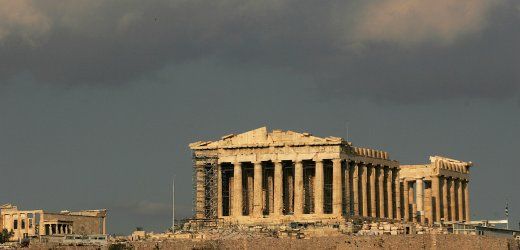
TIMES ONLINE: It is a gloriously sunny Pentecôte bank holiday, and hundreds of people have descended on Morschwiller-le-Bas, a suburb of the French city of Mulhouse, for its annual marché aux puces — flea market.
The eurozone crisis is hardly uppermost in their minds as they pick through the mounds of second-hand clothes and bric-a-brac, but they respond when asked, and their views could scarcely be more different from those we found in Germany, a mere 15km (9 miles) to the east.
The hard-working Germans were furious at the €148 billion euros (£126.1 billion) in loan guarantees that their Government has offered the Greeks and other states of the southern eurozone. Here in France, nobody even knows how much their Government has put up (the answer is €111 billion) and there has been scarcely a murmur of dissent.
“If we consider Europe a serious matter we have to help the Greeks,” said Jacqueline Wertz, a retired hotel worker eating pizza in the shade. “They have to have more discipline, but we have a duty of solidarity and have to help,” agreed Martial Fixalis, 39, a businessman manning his own stall.
“We’re European, and it’s our role to help others,” said Josiane Mehlen, who was queueing at a beer stand and turned out to be Morschwiller’s mayor.
There are many explanations for this Gallic insouciance. The French believe in state intervention. Like the Greeks, they have their own sizeable black economy. Unlike the Germans, they are no fiscal saints themselves. Their national debt is 84 per cent of GDP — 6 per cent higher than Britain’s.
“Money is a means to an end. If you can live well with a deficit it’s not a big problem,” chuckled Denis Fauroux, a Mulhouse lawyer, as we ate lunch in his garden and admired the distant mountains of Les Vosges.
The French, with their 35-hour working week and propensity to retire early, do not share the German work ethic evident this week in Ludwigshafen, a four-hour train ride north up the Rhine valley. “Here it’s a Latin culture. The French have more sympathy with the Greeks than the Germans,” observed Marc Sarwatka, 44, the head of a large recruitment agency, over an early evening beer in the elegant Place de la Bourse.
Nor are they such sticklers for rules, as our translator observed when a French driver sped over a pedestrian crossing. “The Germans always stop,” she remarked.
Amongst the cognescenti, there is even a certain pride that President Sarkozy pressed Angela Merkel, the German Chancellor, into backing the €750 billion bailout package. Read on and comment >>> Martin Fletcher | Wednesday, May 26, 2010
May 07, 2010
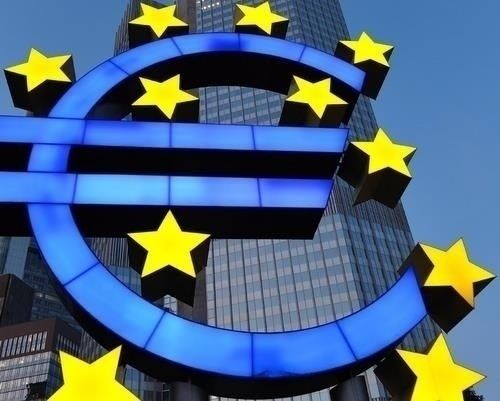
THE GUARDIAN: Turmoil in international markets hangs over emergency summit of European leaders
European leaders are battling a crisis of confidence in the euro single currency tonight, desperately seeking a formula to reassure the markets as the emergency triggered by Greece's huge debt levels and Europe's response threatened to go global.
An emergency summit of the 16 leaders of the countries using the single currency was held in Brussels, with chancellor Angela Merkel of Germany and president Nicolas Sarkozy of France demanding tougher and quicker regulation of the financial markets in what looked like a doomed attempt to contain contagion from the Greek drama.
With the pace of developments outstripping the ability of political leaders to respond, what was initially called as a summit to bless a €110bn (£95bn) rescue package for Greece turned into a frantic exercise in global crisis management.
Alarm bells were ringing in major capitals across the world where leaders voiced their exasperation with European attempts to contain the fallout from Greece. In what may have been Alistair Darling's last part in trying to manage international financial turbulence, the chancellor took part in a phone conference of G-7 finance ministers discussing the implications for the international bond markets of the Greek debt debacle.
Australia's prime minister, Kevin Rudd, was scathing about the EU package for Greece over three years agreed last weekend by 15 eurozone countries and the International Monetary Fund: "Markets have judged those arrangements to be inadequate," he [said]. >>> Ian Traynor, Brussels | Friday, May 07, 2010
May 04, 2010
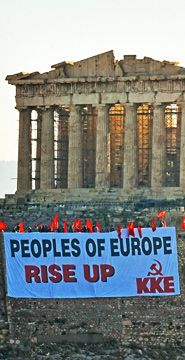
TIMES ONLINE: Greek public sector workers today began a 48-hour national strike that is a first test of the Government’s ability to enact new austerity measures agreed with the EU and IMF in return for billions of euros in aid.
Ministries, tax offices, schools, hospitals and public services were shutting down ahead of a midday rally of civil servants outside Parliament, organised by Adedy, the country’s main public sector union.
“We want an end to the freefall of our living standards,” said Spyros Papaspyros, the head of Adedy, which represents about half a million workers. “I think this will be one of the biggest protests we’ve seen in the last decade.”
Private sector workers are due to join the walkout tomorrow, the third joint strike since the beginning of the year, when worries about Greece’s swollen debt and deficit levels made the country a target of financial markets. Some flights are already affected today.
The workers' protests began hours after the European Central Bank (ECB) was forced to execute an embarrassing U-turn on its lending rules in order to stave off the collapse of the Greek banking system.
In a statement the ECB said that it was suspending a rule preventing it accepting junk-rated government bonds in return for loans. It said that the indefinite suspension applied to Greek government debt only. >>> Jenny Booth | Tuesday, May 04, 2010
May 02, 2010
THE TELEGRAPH: As Greeks face changing their way of life, rioters in Athens clash with police at the start of a very long, painful summer for the country.
The week was already going badly enough for mild-mannered Greek prime minister George Papandreou. After months of insisting that his country would be able to claw its own way out of decades of mismanagement and corruption, his belated SOS to the International Monetary Fund (IMF) ensured that Greece's world famous ruins are now financial, not archaeological.
But then things got worse. Even as Mr Papandreou likened himself to Homer's great survivor, Odysseus, his country's fortunes were being sunk between a modern Scylla and Charybdis: German intransigence over a financial bailout on one side, and market jitters that downgraded Greek bonds to junk status on the other.
On Sunday, however, as the details of an economic life raft from the EU and IMF are due to be announced, Mr Papandreou will be forced to survey not simply the wreckage of the Greek economy, but the beginnings of "cultural revolution" that analysts say his homeland's crisis is set to unleash across the continent of Europe. >>> Harry de Quetteville and Paul Anast in Athens | Saturday, May 01, 2010
April 27, 2010
THE GUARDIAN: Left and right unite to condemn Greece's 'blank cheque' rescue / Election in Germany's NRW state inflames opposition to bailout

Proposals for a rescue package for debt-ridden Greece have stoked a fierce political row in Germany with opposition towards a bailout growing within parties from both the left and the right.
Germany's reluctance to participate in the deal is summed up today in a single newspaper headline, which read 'Angst surrounds giving Greece blank cheque'.
The rescue plans have even caused a rift within the German government as arguments rage over how much Europe's largest economy should contribute to the fund, under what conditions and even whether any help should be forthcoming at all.
Among the loudest opponents are the liberal Free Democratic Party (FDP), junior coalition partners in chancellor Angela Merkel's government, who have warned against turning the European Union into a 'transfer union' at the expense of Germany, the club's biggest economic power.
"We cannot issue any blank cheques," said the FDP's chief, Guido Westerwelle. "Greece has first and foremost to do its homework and sort out its own household."
Meanwhile leading members of the Christian Social Union, (CSU), the sister party to Merkel's Christian Democrats, have even suggested that Greece should withdraw from the euro. >>> Kate Connolly in Berlin | Monday, April 26, 2010
April 19, 2010
THE SUNDAY TELEGRAPH: Portugal, not Greece, poses the greater existential threat to Europe's monetary union.

The long-drawn saga in Athens can perhaps be deemed a case apart. Greece lied. Its budget deficit was egregious at 16pc of GDP last year on a cash basis. It wasted its EMU windfall, the final chance to bring public debt back from the brink of a compound spiral.
You cannot blame the euro for this, although EMU undoubtedly created a risk-free illusion that lured both Athens and creditors deeper into the trap – and now prevents a solution. Nor would an orderly default under IMF guidance along Uruguayan lines necessarily imperil Europe's banks. The Bundesbank hints that letting Greece go would prove a healthier outcome for EMU in the long run, upholding discipline.
However, Portugal did not cheat (much) and did not start as an arch-debtor. It did mishandle the run-up to EMU in the 1990s, failing to offset a fall in interest rates from 16pc to 3pc with fiscal tightening. Boom-bust ensued. But that was a long time ago. Portugal has since settled down to a decade of sobriety. The reward never came.
Brussels admitted last week that Portugal's external accounts have switched from credit in the mid-1990s to a deficit of 109pc of GDP. This has been caused by the incentive structures of EMU itself. "The more broadened access to credit induced a significant reduction in the saving rate, while consumption kept growing faster than GDP. This development led to an increase in Portuguese indebtedness," it said.
The IMF's January report said "The large fiscal and external imbalances that arose from the boom in the run-up to adoption of the euro have not been unwound, resulting in the economy becoming heavily indebted and growing banking system vulnerabilities. The longer the imbalance persists, the greater the risk the adjustment will be sudden and disruptive." The IMF noted the "heavy reliance" of banks on foreign wholesale funding, equal to 40pc of total assets. >>> Ambrose Evans-Pritchard | Sunday, April 18, 2010
April 12, 2010

TIMES ONLINE: The euro surged to a one-month high and stock markets in Europe and Asia rallied today as traders welcomed a €30 billion (£26.5 billion) loans package for Greece, agreed by the currency's member countries to help the country tackle its debt crisis.
The euro surged to $1.3691 against the dollar, its highest level since mid-March, although concerns about the long-term nature of Greece's debt burden and worries about how the loans package would be implemented limited its gains.
The euro later dropped to $1.3574. Having fallen off sharply last week, it closed in New York on Friday at $1.3497.
"The euro is firmer as traders took heart from the Sunday announcement of the aid package for Greece,” said Daisuke Karakama, a currency analyst at Mizuho Corporate Bank. >>> Miles Costello, David Charter, Brussels | Monday, April 12, 2010
April 06, 2010
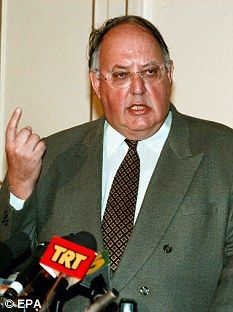
MAIL ONLINE: Greece accused Germany yesterday of taking a racial approach to its financial crisis.
The claim came from deputy prime minister Theodoros Pangalos, who earlier this year accused Germany of not compensating Greece properly for its suffering during the Second World War Nazi occupation.
In a newspaper interview he said the Berlin government was more concerned in pleasing its own people - vehemently opposed to paying for a Greek bailout - than showing solidarity with a euro nation under pressure.
Mr Pangalos said Germany had taken a 'moral, racial' approach to the crisis, adding sarcastically: 'The Greeks have problems. Why do they have problems? Because they don't work enough.
'And why is that? Because they have a good climate, music and drink and they are not as serious as the Germans.' Germany won't bail us out due to 'racial prejudice' that we don't work hard, says Greek deputy PM in new outburst to fuel row >>> Mail Foreign Service | Tuesday, April 06, 2010
Subscribe to:
Posts (Atom)