Showing posts with label investment banking. Show all posts

January 19, 2013

Snakes and Ladders: Investment Banking on the Brink

SPIEGEL ONLINE INTERNATIONAL: For decades, investment bankers have held the key to untold riches -- but now they're being laid off by the tens of thousands. As the crisis forces the industry to search for a new identity, is it ready to mend its ways?

The suicide victims chose a location with symbolic significance. Last fall, only a few weeks apart, a businesswoman and a banker went to the Coq d'Argent, an upscale restaurant and hot spot in the world of London high finance, located on the top floor of a shopping complex, to end their lives.

The woman put down her purse and jumped from the restaurant's cozy rooftop terrace. The banker, an investment specialist, jumped into the building's atrium around lunchtime.

The "City," the casual term the financial center uses in reference to itself, was shocked. The suicides are the most glaring expression of an apocalyptic mood that seems to have gripped all of London. Hospitals are reporting a high incidence of patients with alcohol problems, while top restaurants are fighting for every customer.

The crisis has struck at the heart of the financial center. In 2012, banks began to downsize their investment banking activities. For years, the area had been seen as a playground for those seeking instant riches and guaranteed success, and it provided tens of thousands with sometimes exorbitant incomes.

October 30 would become a horrific day for the financial district after the Swiss bank UBS announced that it was slashing 10,000 jobs in the sector. On one morning alone, the bank's London office let hordes of bankers go. Some were intercepted at the entrance, still carrying their coffee in to-go cups, only to be shown the door a short time later with a piece of paper filled with instructions.

All he felt was hate, says a 51-year-old who was among those affected by the recent layoffs. For him and others like him, the chances of finding a new job are slim. The competition is also doing its utmost to downsize. Morgan Stanley plans to lay off 1,600 employees in the coming weeks, Lloyds is cutting as many as 15,000 jobs worldwide, and Deutsche Bank has just eliminated 1,500 jobs in its investment banking division.

An era seems to be coming to an end, the era of an industry that led us to believe that what it did was useful. In reality, though, it was lining its pockets by conducting more and more reckless transactions and involving itself in increasingly insane deals and products. Senior executives say the business is merely shrinking to a healthy level and characterize it as something like a catharsis.

As former investment bankers search for new identities, arrogance is being replaced with humility. It's important to "improve the way we operate as an organisation," Antony Jenkins, the new CEO of the major British bank Barclays, wrote in a memo to employees. Anshu Jain, co-CEO of Deutsche Bank and the former head of its investment banking division, has promised "cultural change." » | Martin Hesse, Thomas Schulz, Christoph Scheuermann and Anne Seith | Friday, January 18, 2013

November 17, 2011

'Thousands More' City Banking Jobs Could Go

THE DAILY TELEGRAPH: The wave of City redundancies has prompted finance professionals to warn that several thousand investment banking industry jobs could be lost in the coming months.

BNP Paribas, Merrill Lynch and Nomura became the latest major banks to announce job cuts on Wednesday as falling revenues forced them to follow several rivals and shed staff.

"This is the beginning of a major structural shift and I think you will see a lot more cuts in the New Year," said Stéphane Rambosson, a former City banker and managing partner of executive search firm Veni Partners.

BNP Paribas said it would cut about 1,400 jobs in its investment banking division, which employs several thousand staff in London, while Bank of America Merrill Lynch (BoAML) has begun cutting broking employees, with about 15pc of roles at risk, according to two sources. » | Harry Wilson, and Anna White | Thursday, November 17, 2011

November 17, 2010


HSBC Doubles Salaries Of Investment Bankers

SKY NEWS: Banking giant HSBC is doubling the basic pay of hundreds of its senior investment bankers, Sky News can reveal.

Sky's City editor Mark Kleinman reports that the bank began informing staff in London, Hong Kong and New York about the pay rises last week.

A source close to the bank said some senior managers outside the global banking and markets (GBM) division were also being handed the pay increases.

HSBC's move comes ahead of the annual bank bonus round in the New Year.

"As UK politicians intensify warnings about the payment of mega-bonuses, HSBC may legitimately be able to point to a sharply reduced bonus pot by virtue of the fact that it will have only recently awarded large salary increases," noted Kleinman. Read on and comment >>> Hazel Baker, Sky News Online | Tuesday, November 16, 2010

February 01, 2010

Why Don’t They Jail the SOBs and Wipe the Smile Off Their Faces?

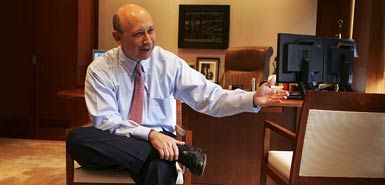
Lloyd C. Blankfein was paid $67.9 million in 2007. His bank’s profits in 2009 were higher than that year. Photograph: Times Online

TIMES ONLINE: Goldman Sachs, the world’s richest investment bank, could be about to pay its chief executive a bumper bonus of up to $100 million in defiance of moves by President Obama to take action against such payouts.

Bankers in Davos for the World Economic Forum (WEF) told The Times yesterday they understood that Lloyd Blankfein and other top Goldman bankers outside Britain were set to receive some of the bank’s biggest-ever payouts. “This is Lloyd thumbing his nose at Obama,” said a banker at one of Goldman’s rivals.

Goldman Sachs is becoming the focus of an increasingly acrimonious political and financial showdown over the payment of multimillion-pound bonuses.Last week the US President described bonuses paid out by some banks as “the height of irresponsibility” and “shameful”.

“The American people understand that we have a big hole to dig ourselves out of, but they do not like the idea that people are digging a bigger hole, even as they are being asked to fill it up,” he said last week. Lloyd Blankfein of Goldman Sachs 'Expecting $100 Million Bonus' >>> Helen Power in Davos | Monday, February 01, 2010

January 24, 2010

Obama Rips Up the Rule Book

THE TELEGRAPH: The President's attempt to reform US banks may have unintended consequences, as billions are wiped off their shares prices and opponents sharpen their knives

Just over two years ago, a junior trader on Société Générale's proprietary trading desk in Paris was celebrating after making his bank a profit of almost £1bn. His success, he reckoned, would justify a bonus of about £200,000 and catapult him up the corporate hierarchy and on to greater riches. And why not? He had taken bold positions on a number of European stock exchange indices and they'd come good.

Within weeks, though, the positions had unravelled. The £1bn profit turned into a £3.7bn loss and nearly broke his bank. The SocGen individual was Jérôme Kerviel, the biggest rogue trader of them all.

As Kerviel went on the run and the bank launched an investigation into how he had evaded its controls, it emerged that the loss-making positions he held totalled £37bn – more than the value of the bank. Such huge exposures were only possible on the proprietary trading desk ("prop desk") – the casino in the bank – where a select group of traders are trusted to gamble with the lender's own money.

When it works, prop trading can be a source of great riches – for both the bank and the banker. Citigroup's prop trading oil unit Phibro made an average profit of $371m (£230m) a year between 2003 and 2008. With performance like that, some might say its British-born boss, Andrew Hall, deserved the $100m he was paid.

President Barack Obama, though, was not among them. When details of Hall's deal emerged last year, the White House described it as "out of whack" given that Citigroup had been rescued by the state. Last week, as he unveiled the biggest potential shake-up of banking since the Great Depression, the President went one step further. He described such payments as "obscene" and illustrative of the "binge of irresponsibility". >>> Philip Aldrick | Saturday, January 23, 2010

November 08, 2009


The Man We Love to Hate: Mr Goldman Sachs

THE SUNDAY TIMES: Number 85 Broad Street, a dull, rust-coloured office block in lower Manhattan, doesn’t look like a place to stop and stare, and that’s just the way the people who work there like it. The men and women who arrive in the watery dawn sunshine, dressed in Wall Street black, clutching black briefcases and BlackBerrys, are very, very private. They walk quickly from their black Lincoln town cars to the lobby, past, well, nothing, really. There’s no name plate on the building, no sign on the front desk and the armed policeman stationed outside isn’t saying who works there. There’s a good reason for the secrecy. Number 85 Broad Street, New York, NY 10004, is where the money is. All of it.

It’s the site of the best cash-making machine that global capitalism has ever produced, and, some say, a political force more powerful than governments. The people who work behind the brass-trim glass doors make more money than some countries do. They are the rainmakers’ rainmakers, the biggest swinging dicks in the financial jungle. Their assets total $1 trillion, their annual revenues run into the tens of billions, and their profits are in the billions, which they distribute liberally among themselves. Average pay this recessionary year for the 30,000 staff is expected to be a record $700,000. Top earners will get tens of millions, several hundred thousand times more than a cleaner at the firm. When they have finished getting "filthy rich by 40", as the company saying goes, these alpha dogs don’t put their feet up. They parachute into some of the most senior political posts in the US and beyond, prompting accusations that they "rule the world". Number 85 Broad Street is the home of Goldman Sachs.

The world’s most successful investment bank likes to hide behind the tidal wave of money that it generates and sends crashing over Manhattan, the City of London and most of the world’s other financial capitals. But now the dark knights of banking are being forced, blinking, into the cold light of day. The public, politicians and the press blame bankers’ reckless trading for the credit crunch and, as the most successful bank still standing, Goldman is their prime target. Here, politicians and commentators compete to denounce Goldman in ever more robust terms — "robber barons", "economic vandals", "vulture capitalists". Vince Cable, the Lib Dem Treasury spokesman, contrasts the bank’s recent record results — profits of $3.2 billion in the last quarter alone — and its planned bumper bonus payments with what has happened to ordinary people’s jobs and incomes in 2009.

It’s even worse in the US. There, Rolling Stone magazine ran a story that described Goldman as "a great vampire squid wrapped around the face of humanity, relentlessly jamming its blood funnel into anything that smells like money". In his latest documentary, Capitalism: A Love Story, Michael Moore drives up to 85 Broad Street in an armoured Brinks money van, leaps out carrying a sack with a giant dollar sign on it, looks up at the building and yells: "We’re here to get the money back for the American people!"

Goldman’s reputation is suddenly as toxic as the credit default swaps and other inexplicably exotic financial instruments it used to buy with glee. That’s bad for the one thing it values more than anything else: business. Being the prime target for popular and political outrage could put Goldman first in line for draconian new regulation. So it has, reluctantly, decided that the time has come to speak out, to fight its corner. That’s how, on one of those bright autumnal New York mornings when anything seems possible — even an invitation to break bread with the masters of the universe — I find myself walking past the security guard who held up Michael Moore and into the building with no name. I'm doing 'God's work'. Meet Mr Goldman Sachs >>> John Arlidge | Sunday, November 08, 2009

Michael Moore – Capitalism: A Love Story – Trailer

November 03, 2009

No Whiff of PC in Japanese Investment Banks!

MAIL ONLINE: Two women City high-flyers who claim they were hounded out of their jobs by sexist Japanese bosses are both suing a leading investment bank for £1.5 million.

Maureen Murphy, 30, alleges that a woman trader at Nomura bank had to endure her breasts being referred to as 'honkers' during a meeting.

She says that a male colleague claimed that women 'belong at home cleaning the floors'.

And another allegedly said that the key to cheating on wives was 'not getting caught'.

Miss Murphy, a senior analyst earning £55,000 a year, and Anna Francis, 37, a director on £250,000 including bonus, had worked in Asian equities sales at Lehman Brothers in Canary Wharf before the bank collapsed in September last year.

The two women moved to Nomura as part of a buyout by the Japanese bank and expected equally prominent roles.

But they claim sexist Japanese bosses withheld work and fired them because they were female and non-Japanese.

Their barrister Michael Duggan told Central London Employment Tribunal: 'This organisation is institutionally racist and sexist.' Two women City high-flyers 'hounded from bank for not being male or Japanese' sue for £3million >>> | Tuesday, November 03, 2009

September 23, 2008

Goldman Sachs Brings to an End an Era in Investment Banking

THE TELEGRAPH: 'It's the end of an era. Wall Street has changed forever.” It may have been Paul Mortimer-Lee, research analyst at BNP Paribas, who spoke the words yesterday but they might have been anybody’s.

Across newswires and television channels, hundreds of commentators and bankers were making the same utterance.

Goldman Sachs and Morgan Stanley, the last venerable names of investment banking, on Monday shocked the markets by ditching their free-wheeling broker-dealer status to become regulated banks, bringing the curtain down on 75 years of Wall Street history.

Wall Street was born out of the depression era Glass-Steagall legislation of 1933 that separated investment and commercial banking. Great names such as Salomon Brothers, Paine Webber, Smith Barney and Kidder Peabody built it into the financial powerhouse it now is.

Most investment banks have since merged or been taken over as Glass-Steagall was gradually eroded through the 1990s, but the giants remained. Until now.

With Lehman Brothers dead, Merrill Lynch sold and Bear Stearns rescued, the “Masters of the Universe” tag now looks like little more than a tombstone engraving. Goldman and Morgan Stanley, by changing status, have etched their names on, too. “Some colleagues think this it is the death of Wall Street,” Mr Mortimer-Lee said.

“They remember when there were 45 broker dealers and are mourning it as the passing of an era.”

For Mr Mortimer-Lee, there is an appropriate symmetry to it all. “It is ironic that the broker dealers were born as a result of the bank and broker-dealer separation that was deemed necessary as a result of the 1930s crisis, and now broker-dealers and banks get put back together as a result of the nearest thing since to a 1930s-style crisis.” Goldman Sachs Brings to an End an Era in Investment Banking >>> By Philip Aldrick | September 22, 2008

SPIEGELONLINE INTERNATIONAL:
'Bad News for the Ferrari Salesmen of the World': The US investment banks Goldman Sachs and Morgan Stanley have announced that they will become full-service banks. Some German commentators see it as the end of the age of big gamblers. Others aren't so sure.
Right when everyone thought the roller-coaster ride of the US financial crisis was over, along came another jarring twist. Since 1933, when the Glass-Steagall Act was passed, US banks have been segregated into investment banks and retail banks. While retail banks plodded along using depositor capital, Wall Street investment banks could take enormous risks -- with enormous payoffs.

And so it was for 75 years until Sunday night's announcement that Morgan Stanley and Goldman Sachs -- America's last two independent investment banks -- had decided to switch sides and transform themselves into retail banks. In doing so, they have sounded the death knell for the Glass-Steagall structure and -- for now, perhaps -- for a high-risk, high-roller era.
In their new incarnations, Morgan Stanley and Goldman Sachs will offer consumer-banking services and gain permanent access to the discount window of the Federal Reserve. At the same time, they will be subject to the much more stringent regulations of the Fed rather than just those of the Securities and Exchange Commission. In effect, they will need to have more capital on hand relative to the amount they wish to borrow. That means less risk to play with. >>>
Rachel Nolan | September 23, 2008

The Dawning of a New Dark Age – Paperback (US) Barnes & Noble >>>
The Dawning of a New Dark Age – Hardcover (US) Barnes & Noble >>>

May 06, 2008

New Head of Islamic Banking Unit Appointed by Citigroup

HOT FINANCIAL NEWS!: Citigroup steps up its Islamic banking operations. It has appointed the former head of its Middle East debt capital markets group as its chief executive of business.

Samad Sirohey has become the head of Citi Islamic investment bank and the head of global investment banking.

Investment banks are redeploying much of their top talent to the Middle East, hoping to secure revenues from one of the fastest-growing regions in the world at a time when their more established businesses are struggling because of the credit crisis.

The Dawning of a New Dark Age (Paperback – USA)
The Dawning of a New Dark Age (Hardcover – USA)