Showing posts with label greed. Show all posts
Showing posts with label greed. Show all posts
July 20, 2017
September 16, 2016
Greed - A Fatal Desire
"People like to have a lot of stuff because it gives them the feeling of living forever," says social psychologist Sheldon Solomon, who believes today's materialism and consumerism will have disastrous consequences. How much is enough?
February 01, 2014
Meltdown: The Men Who Crashed the World
November 22, 2011

A year-long inquiry by the High Pay Commission finds the pay of some top executives has soared by more than 4,000 per cent in the last 30 years, undermining productivity and ''damaging'' trust in British business.
The report criticised ''stratospheric'' pay increases which have seen wealth flow upwards to the top 0.1 per cent of people in the UK.
Average wages in the UK today are a ''modest'' £25,900 - up from £6,474 in 1980 - a three-fold increase.
The commission called for a number of reforms, including a ''radical simplification'' of executive pay, putting employees on remuneration committees, publishing the top 10 executive pay packages more widely, forcing companies to publish a pay ratio between the highest paid executive and the company median, and making firms reveal the total pay figure earned by executives.
The commission also said a new national body to monitor high pay should be established.
The report, Cheques With Balances: Why Tackling High Pay Is In The National Interest, showed that decisions to award huge pay packages are set by a ''closed shop'', shrouded in highly complex detail, effectively hidden from shareholders, staff and the public.
''Stratospheric increases in pay are damaging the UK economy - distorting markets, draining talent from key sectors and rewarding failure. Read on and comment » | Tuesday, November 22, 2011
My comment:
This is NOT capitalism! Capitalism rewards risk-takers. What risks do these executives take? They are in secure positions, and are rewarded with monopoly-figure salaries and bonuses even if they achieve little or nothing. This is unfair, corrosive, and a disincentive for others to take any risks or make any effort to better themselves. Faced with this scenario, why should anyone bother to make the effort to pull himself up by the bootstraps? This is a total disincentive to effort. And that's a very destructive situation for a capitalist economy to be in.
Further, it cannot be overemphasised that societies with such inequalities of wealth are a breeding ground for socialism, and even for communism. If you think that socialist/communist revolutions cannot happen in this day and age, and in this country, think again! Now do we really want to continue with this breeding ground for such a scenario? I think not. It is therefore high time to turn the screws on these obscene, vulgar fat cats. Tax them, until the pips squeak if necessary. The alternative scenario might well not be a pretty sight. – © Mark
This comment also appears here.
November 14, 2011

As the Business Secretary said he shares the anger of the anti-capitalist protesters at St Paul's in London, another group was setting up camp in Exeter.
Cable said the demonstrators were right to point out that those who caused the financial crisis have not paid the price while ordinary people suffer.
He set up a review of spiralling executive pay in September and yesterday he said he was prepared to back up the plans with new laws.
The Business Department is working on proposals to give shareholders more powers to limit sky-high payouts to bosses who have failed to boost their businesses.
Mr Cable stepped in after it emerged that the average salary for a chief executive of one of Britain’s 100 biggest firms has quadrupled from £1million to £4.2million over the past 12 years – without a corresponding uplift in share prices.
He said: ‘I think that’s what causes a lot of public anger and indignation and you know we’ve seen some of that spilling over into protests in recent weeks.
‘I have sympathy with the emotions that lie behind it. Some of their recommendations aren’t terribly helpful, but that’s not the point.
‘I think it does reflect a feeling that a small number of people have done extraordinarily well in the crisis, often undeservedly, and large numbers of other people who have played no part in causing the crisis have been hurt by it.’
The Government’s consultation exercise is designed to ensure greater transparency on management pay and perks and ensure a closer link between salaries and performance.
Asked if he would change the law to force companies to adhere to new rules that may result from it, Mr Cable said: ‘It depends on the consultation. If it does require legislation of course we’ll introduce it.’ » | Richard Hartley-Parkinson and Tim Shipman | Monday, November 14, 2011
November 12, 2011

The Prime Minister said the Government could and would ensure that the pot for pay and perks is much smaller.
RBS – which is 83 per cent owned by the taxpayer – has suffered a collapse in profits over the past three months.
Its revenues plunged to £112million between July and September – compared with £589million over the same quarter last year.
Yet this dramatic fall is not reflected in the enormous pay pool from which its salaries and bonuses are funded.
There is just under £2billion in the pool – only marginally lower than the £2.14billion it contained last year.
Insiders expect about £500million of it to be paid out in bonuses this year – with more than £1million going to some investment bankers.
There is ongoing public fury at the way bankers have continued to rake in huge salaries and end-of-year bonuses, while the taxpayers who bailed out their banks three years ago are suffering pay freezes and public spending cuts.
Mr Cameron said that the Government would have a ‘very big influence’ on the level of bonuses paid out by RBS this year. Read on and comment » | Tim Shipman | Friday, November 11, 2011
November 05, 2011

Archbishop Sentamu, the second most important figure in the Church of England, said that excesses in the financial sector have helped to create huge inequalities in wealth, "demonstrating how scandalously unfair our society is".
Writing in the Yorkshire Post, Dr Sentamu called for a change in public attitudes towards excessive personal wealth as profound and rapid as moves against racism, homophobia and sex discrimination in recent decades.
He said: "If they [FTSE 100 chief executives] have a responsibility to their staff, it is hard to imagine a more powerful way of telling someone that they are of little value than to pay them one-third of one per cent of your salary.
"Top pay has been found to bear little or no relation to company performance, but even if it did, isn't the performance of a company dependent on the work and well-being of all its staff?
"Among the ill-effects of very large income differences between rich and poor are that they weaken community life and make societies less cohesive." » | Saturday, November 05, 2011
YORKSHIRE POST: Sentamu hits out at greed culture of fat cats: THE Archbishop of York has urged the Government to introduce a radical overhaul of the tax system and called for greed to be made as socially unacceptable as racism and homophobia. ¶ Dr John Sentamu claimed many of the wealthiest in society are avoiding paying their dues in a stinging attack on the growing divide between Britain’s rich and poor. » | Saturday, November 05, 2011
YORKSHIRE POST: WITH renewed public outrage at the excesses of the financial sector and the huge inequalities in wealth it has helped to generate, we are being confronted daily with new evidence of extremes of wealth and poverty, demonstrating how scandalously unfair our society is.
But how is this to be addressed? This is the urgent task for us all. The news that chief executives (CEOs) of the FTSE 100 companies last year received average pay increases of almost 50 per cent adds urgency to our cause.
Typically, these CEOs receive 300 times as much as the least well paid British employees in their companies. If they have a responsibility to their staff, it is hard to imagine a more powerful way of telling some people that they are of little value than to pay them one-third of one per cent of your own salary.
Top pay has been found to bear little or no relation to company performance, but even if it did, isn’t the performance of a company dependent on the work and well-being of all its staff?
Among the ill effects of very large income differences between rich and poor are that they weaken community life and make societies less cohesive.
If the concept of the Big Society is to become a reality, so that people come to know and take more care of each other, income differences must surely be reduced. No one wants a “dog eat dog” society in which people feel obliged simply to fend for themselves.
But over the last few decades, the gains from economic growth have gone disproportionately to those who already have most. In contrast, forecasts suggest that child poverty will increase. The danger is that rather than increasing equality of opportunity, social mobility will slow down and people will become more divided by class and status. » | Dr. John Sentamu | Saturday, November 05, 2011
October 28, 2011
February 06, 2011
 THE SUNDAY TELEGRAPH: Stuart Gulliver, the new chief executive of HSBC, is expected to accept a bonus of as much as £9m later this month in reward for his stewardship of the bank's investment arm.
Mr Gulliver, who took over from Mike Geoghegan at the turn of the year, is set to be awarded the windfall as part of an overall compensation package which could take the total amount he receives for 2010 to in excess of £10m.
Although the bank's remuneration committee, chaired by HSBC's deputy chairman, John Thornton, has not yet finalised any executive bonuses, City sources with knowledge of the situation believe that a bonus of £9m is highly possible.
If so, it would mirror the amount Mr Gulliver received for 2009, and would be in line with the amount his counterpart at Barclays, Bob Diamond, is set to be paid.
Stephen Hester, the chief executive of Royal Bank of Scotland, and Eric Daniels, the chief executive of Lloyds Banking Group, are likely to be in line for awards of £2.5m and £2m respectively. >>> James Quinn and Kamal Ahmed | Sunday, February 06, 2011
David Cameron Won’t Stop the Bonuses >>>
 THE INDEPENDENT ON SUNDAY: Britain’s bankers are celebrating bumper bonuses. Whatever happened to the Government’s pledge to tackle them?
After umpteen calls for restraint by ministers, weighing the public relations impact, and consulting colleagues and advisers, Barclays chief executive Bob Diamond has made his most difficult decision. The multi-millionaire is set to accept a £9m bonus, one of the largest in the world, and will be followed by the bosses of the other major banks. This shows that they are all in something together, even if it's not what the rest of us are in.
Mr Diamond canvassed close City friends before deciding to take the bumper bonus which he fears will reignite the row over bankers pay. Sources close to him said: "Bob's been in a real dilemma as he can't stand this country's culture of banker-bashing and finds our attitude to bonuses extraordinary. But he is also aware of public opinion, so sounded out people about whether he should turn down his bonus again for the third year, take less or give some to charity."
Despite rising public anger about the scale of City payouts, David Cameron insisted last night that he was not interested in "headlines satisfying people today and tomorrow that I've given the banks a good kick in the pants. Can we do more on bonuses, particularly on those banks we own? Yes we can, and yes we will," he told The Sunday Telegraph. "But look, we've just been talking about growth. I don't believe actually in the long run, you can deliver the enterprise-growth agenda while having a running war with the British banking industry at the same time."
Some of those whom Mr Diamond – or his advisers – have consulted counselled him to show restraint. But the American decided that when he is offered the pay package – somewhere between £7m and £10m – he is minded to take it. >>> Margareta Pagano, Business Editor | Sunday, February 06, 2011
Why don’t they jail these SOBs? Then they would show some restraint! – © Mark
January 09, 2011
THE SCOTSMAN: NO-ONE should be surprised that the banks are expected to defy public opinion and once again pay multi-million pound bonuses.
Difficulties in controlling the bonus culture have been made plain by the frustrations felt by politicians across the spectrum and were highlighted here as far back as August 2009 after the then shadow chancellor George Osborne demanded that bonuses should be banned altogether in banks that had been bailed out by the taxpayer.
Well, he's moved a long way from that particular argument and now doesn't even see eye-to-eye with the bite-your-legs business secretary Vince Cable, who has found himself muzzled over the issue.
The bankers believe the Lib Dems who have been making most of the noise on this issue are now a bit of a spent force in the debate and that the slightly more banker-friendly tone emanating from Osborne and Prime Minister David Cameron will leave them free to award themselves the sums they see as their right.
The banks argue that they contributed towards the £53.4 billion paid in taxes last year by the financial services industry, equal to 11.2 per cent of Britain's total tax receipts. No wonder the Treasury should consider it inappropriate to bite the hand that feeds it.
Before Christmas there were more threats of a new bonus tax, an idea revisited by Deputy Prime Minister Nick Clegg, and warnings from Cable that the banks would be punished if they didn't change their ways. But opinion in the City is that there is not much substance behind them.
The bankers are now said to feel so confident of getting away with paying large bonuses that they see no further need for Project Merlin, the initiative led by Barclays former chief executive John Varley to repair relations with the government. Expect the next round of bonuses to be trimmed, but only marginally, and as an acknowledgement of, rather than a concession to, public outrage. >>> Terry Murden | Sunday, January 09, 2011
THE SUNDAY TIMES: Lib Dems tear into Tories on bonuses: Ministers are furious at George Osborne’s apparent cave-in over unacceptable bank bonuses in a time of austerity >>> Marie Woolf, Whitehall Editor | Sunday, January 09, 2011 (£)
THE OBSERVER: Britain's best-paid bank boss set for showdown with MPs over huge bonus: Barclays chief Bob Diamond is under intense pressure to lead by example and give up payout >>> The Observer | Sunday, January 09, 2011
November 17, 2010

SKY NEWS: Banking giant HSBC is doubling the basic pay of hundreds of its senior investment bankers, Sky News can reveal.
Sky's City editor Mark Kleinman reports that the bank began informing staff in London, Hong Kong and New York about the pay rises last week.
A source close to the bank said some senior managers outside the global banking and markets (GBM) division were also being handed the pay increases.
HSBC's move comes ahead of the annual bank bonus round in the New Year.
"As UK politicians intensify warnings about the payment of mega-bonuses, HSBC may legitimately be able to point to a sharply reduced bonus pot by virtue of the fact that it will have only recently awarded large salary increases," noted Kleinman. Read on and comment >>> Hazel Baker, Sky News Online | Tuesday, November 16, 2010
April 23, 2010

MAIL ONLINE: President Barack Obama rebuked fat cat executives for shady dealings as he pushed last night for sweeping reforms to stop another financial meltdown.
Without laws imposing stronger scrutiny of the financial industry America is doomed to repeat the past, the Presidents believes.
In a speech today at New York's Cooper Union college, near Wall Street, Mr Obama was outlining the need for new financial regulations and explaining what the nation would be risking if the existing framework is allowed to remain in place unchanged.
Echoing remarks he made in the same place two years ago, he said: 'A free market was never meant to be a free licence to take whatever you can get, however you can get it.
'That is what happened too often in the years leading up to the crisis. 'A free market was never meant to be a free licence to take what you can get': Obama slams Wall St in push for more regulation >>> Mail Foreign Service | Friday, April 23, 2010
March 26, 2010
THE TELEGRAPH: A French millionaire [billionaire?] has become the first person in the country to go on trial for being paid too much, in a ground-breaking move against "corporate greed".

Antoine Zacharias is facing criminal charges despite the £90 million pay and pension deal being approved by his company’s directors.
He is accused of misusing funds by accepting the money to run Vinci, the world’s biggest construction company.
The sum was set by a remuneration committee chaired by Quentin Davies, Britain’s junior Defence Minister.
Mr Zacharias, 71, is the first French industry captain to face criminal charges over earnings and faces up to five years in prison and a fine of £336,000.
French bosses are anxiously awaiting the outcome of the two-day trial at the court in Nanterre outside Paris, as a guilty verdict could lead to a wave of prosecutions in France over executive pay.
France is notoriously mistrustful of its patrons, and the country was hit by a wave of “boss-nappings” last year in the wake of the financial crisis.
Under French law, company bosses can be prosecuted for misusing funds. However, this is the first time a case has been brought against someone who appeared to have acted within company rules on pay.
Hailed as France’s boss of the decade by the Harvard Business Review, Mr Zacharias transformed Vinci into a construction powerhouse, raising profits by more than 300 per cent and turnover by 81 per cent in six years.
But in 2006 he was ousted by his number two, and successor, who accused him of corporate greed. >>> Henry Samuel in Paris | Thursday, March 25, 2010
*We, the British, should follow suit, as should the Americans. In fact, this should happen wherever corporate greed is a problem. What about jailing and punishing severely those fat cat, greedy bankers? Five to ten years in the slammer would do them a world of good. It would sober them up. They would become examples for all the others just waiting to milk (shouldn’t that be cream?) the system. You’d soon find that corporate greed would become a thing of the past if these ‘can’t-get-enough-types’ were put through their paces in clink. Let the show begin! – © Mark
January 23, 2010
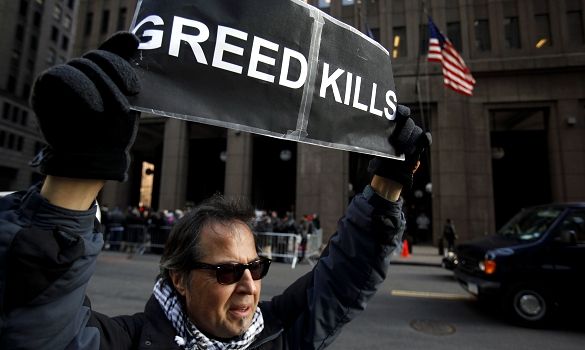
TIMES ONLINE: Banking industry lobbyists are preparing to do battle, buoyed by a landmark US Supreme Court ruling striking down limits on corporations’ political spending, against the ambitious and agressive plans laid on Thursday by President Obama.
Despite the pointed attacks made by the President on the “army of industry lobbyists from Wall Street”, the Financial Services Roundtable, a body which represents 100 of the largest financial firms, said that Mr Obama’s proposal would do little to protect consumers.
“The proposal will restrict lending, increase risk, decrease stability in the system, and limit our ability to help create jobs,” said Steve Bartlett, chief executive of the roundtable.
Individual bankers by and large kept quiet, preferring to weigh up the best response in private. As they did so, Mr Obama flew to the struggling rust-belt state of Ohio in hope that the attack would re-energise his popularity in middle America.
In Washington the attack on bankers was seen as a “policy pivot” designed to accommodate voters’ populist rage after the Democrats’ loss of Edward Kennedy’s Senate seat in Massachusetts. “I’ll never stop fighting for you. I’ll take my lumps, too,” Mr Obama told an audience in Elyria, at the start of a day of campaign-style events aimed at reinvigorating the Democrats before the November mid-term elections.
The President has become increasingly strident about what he calls the “fat cats” in the big banks as the American public has reacted with revulsion to big bonuses being handed out in Wall Street. Mr Obama’s political capital is dwindling, however, after the Democrats’ loss on Tuesday of the 60-seat “super-majority” that enables them to overcome a Republican filibuster in the Senate.
Yesterday, the Senate was forced to postpone the confirmation of Ben Bernanke for a new term as Federal Reserve chairman after two more Democratic senators said that they would join a revolt against him. >>> James Bone in New York | Saturday, January 23, 2010
November 08, 2009
THE SUNDAY TIMES: Number 85 Broad Street, a dull, rust-coloured office block in lower Manhattan, doesn’t look like a place to stop and stare, and that’s just the way the people who work there like it. The men and women who arrive in the watery dawn sunshine, dressed in Wall Street black, clutching black briefcases and BlackBerrys, are very, very private. They walk quickly from their black Lincoln town cars to the lobby, past, well, nothing, really. There’s no name plate on the building, no sign on the front desk and the armed policeman stationed outside isn’t saying who works there. There’s a good reason for the secrecy. Number 85 Broad Street, New York, NY 10004, is where the money is. All of it.
 It’s the site of the best cash-making machine that global capitalism has ever produced, and, some say, a political force more powerful than governments. The people who work behind the brass-trim glass doors make more money than some countries do. They are the rainmakers’ rainmakers, the biggest swinging dicks in the financial jungle. Their assets total $1 trillion, their annual revenues run into the tens of billions, and their profits are in the billions, which they distribute liberally among themselves. Average pay this recessionary year for the 30,000 staff is expected to be a record $700,000. Top earners will get tens of millions, several hundred thousand times more than a cleaner at the firm. When they have finished getting "filthy rich by 40", as the company saying goes, these alpha dogs don’t put their feet up. They parachute into some of the most senior political posts in the US and beyond, prompting accusations that they "rule the world". Number 85 Broad Street is the home of Goldman Sachs.
The world’s most successful investment bank likes to hide behind the tidal wave of money that it generates and sends crashing over Manhattan, the City of London and most of the world’s other financial capitals. But now the dark knights of banking are being forced, blinking, into the cold light of day. The public, politicians and the press blame bankers’ reckless trading for the credit crunch and, as the most successful bank still standing, Goldman is their prime target. Here, politicians and commentators compete to denounce Goldman in ever more robust terms — "robber barons", "economic vandals", "vulture capitalists". Vince Cable, the Lib Dem Treasury spokesman, contrasts the bank’s recent record results — profits of $3.2 billion in the last quarter alone — and its planned bumper bonus payments with what has happened to ordinary people’s jobs and incomes in 2009.
It’s even worse in the US. There, Rolling Stone magazine ran a story that described Goldman as "a great vampire squid wrapped around the face of humanity, relentlessly jamming its blood funnel into anything that smells like money". In his latest documentary, Capitalism: A Love Story, Michael Moore drives up to 85 Broad Street in an armoured Brinks money van, leaps out carrying a sack with a giant dollar sign on it, looks up at the building and yells: "We’re here to get the money back for the American people!"
Goldman’s reputation is suddenly as toxic as the credit default swaps and other inexplicably exotic financial instruments it used to buy with glee. That’s bad for the one thing it values more than anything else: business. Being the prime target for popular and political outrage could put Goldman first in line for draconian new regulation. So it has, reluctantly, decided that the time has come to speak out, to fight its corner. That’s how, on one of those bright autumnal New York mornings when anything seems possible — even an invitation to break bread with the masters of the universe — I find myself walking past the security guard who held up Michael Moore and into the building with no name. I'm doing 'God's work'. Meet Mr Goldman Sachs >>> John Arlidge | Sunday, November 08, 2009
October 19, 2009
THE TELEGRAPH: City pockets are bulging with bonuses, says Boris Johnson. Have the banks no shame?

If you pressed a rifle into the hand of the man in the street and asked him to choose between two targets – an MP or a banker – who do you think would get the bullet? Tricky, eh? It is hard to know which of these two formerly respectable professions has fallen further in public esteem.
Some people might hesitate, like Buridan's ass, the rifle barrel weaving indecisively between two such luscious hate-objects. Most people would simply call for two bullets.
But then let me ask you a slightly different question. Which of the two species has managed to steer itself most effectively through the crisis? Which type of cockroach has scuttled through the nuclear blast of public disapproval? On the face of it, there is an obvious answer, and it is getting more blatant by the day.
Most of the MPs I know seem to be in a state of nervous collapse. Some of them are on suicide watch. Some of them face the task of sacking their wives and selling the house, or possibly the other way round. Some face penury. Never has Parliament been subjected to such protracted humiliation at the hands of the people.
Then look at the bankers, the bankers whose high-rolling risk-taking triggered the recession that has so exacerbated public rage at MPs. The bankers seem to be waltzing off with a song on their lips and their hands in their pockets – at least, their hands would be in their pockets if they were not stuffed with money. And when I say stuffed, I mean bulging, bursting, ballooning with the biggest bonuses you ever saw.
London estate agents say they cannot believe the wheelbarrows of dosh that are suddenly crashing through their doors. Savills says the number of buyers from the financial services sector has risen by 48 per cent in the third quarter of this year, purely in the expectation of yet another ginormous Christmas bonus.
A knuckle-cracking realtor in Knight Frank's Kensington office says he has never seen anything like it: email after email from the boys and girls at Goldman Sachs. "We did our first Goldman's deal in June," he tells the FT, "and we are now doing five times as many for its employees as for any other bank." >>> Boris Johnson | Monday, October 19, 2009
September 22, 2009

THE SYDNEY MORNING HERALD: New Zealand's conservative Prime Minister, John Key, a former investment banker, summed up the state of the world financial system brilliantly during a recent visit to Sydney: "Six months ago, The Wall Street Journal came to interview me and asked me if capitalism was dead. Now Goldman Sachs is paying record bonuses."
After a near-death experience, the world financial system is returning to business as usual - only worse.
The Group of 20 countries, meeting at the end of this week in Pittsburgh, is supposed to be restructuring the system so that it "never happens again". Or, as Barack Obama put it last week: "We will not go back to the days of reckless behaviour and unchecked excess that was at the heart of this crisis."
But we already are. Even if the G20 succeeds in every aspect of its well-intentioned agenda this week, the two greatest systemic problems stand unchanged and uncorrected.
The big investment banks, and Goldman Sachs is the biggest of them, have feasted on public money and, now, restored to strength, are throwing themselves back into the markets as recklessly as ever - only more so.
The big US investment banks are not just symbolic of the greed and excess of the pre-crisis craze. They were instrumental. They created, sold and traded the derivatives the world later came to know as "toxic assets''. But now, after restoring themselves with emergency government loans, they have repaid the US Treasury and rushed back into the markets. Goldman reported a record profit for the three months to the end of June of $US3.4 billion ($3.9 billion).
And the company - where average employee pay is $US700,000 - set aside a record $US11.4 billion for staff bonuses for the first half of the year alone. Guess where the firm made its biggest profit? From trading all the Treasury bonds the US Government issued to pay for the $US787 billion stimulus it injected into the economy to save it from the financial crisis.
Criticism of its bonuses sent Goldman's chief, Lloyd Blankfein (2007 salary plus bonus: $US70 million), out to give a contrite speech. But behind the facade, his firm was betting the bank once again. >>> Peter Hartcher* | Tuesday, September 22, 2009
*Peter Hartcher is the Herald's international editor and author of Bubble Man: Alan Greenspan and the Missing Seven Trillion Dollars
August 13, 2009
TIMES ONLINE: The City watchdog was accused of giving banks a green light to continue paying multimillion-pound bonuses yesterday when it backed away from introducing tough rules to curb excess pay.
The Financial Services Authority’s proposals on City pay embarrassed Gordon Brown, who had promised to sweep aside the bonus culture in the financial sector. Opposition politicians branded the FSA’s new proposals a capitulation. The Treasury also indicated that they did not go far enough.
Some of the most onerous provisions in the FSA’s original proposals from March have been softened. Under the new guidelines the banks must link risk and reward. But they will have more freedom to structure bonus packages than was previously suggested and many bank executives and some smaller City firms are excluded from the plan altogether.
The row came as unemployment rose to a 14-year high and the Bank of England admitted that the recession was deeper than previously thought and that recovery would be slow, partly because banks were still not lending enough money.
It will be exacerbated by the disclosure that Royal Bank of Scotland, in which taxpayers have a 70 per cent interest, has hired two bankers on multimillion-pound packages. One of them, Antonio Polverino, who has been headhunted from Merrill Lynch, will earn £7 million in his first year. Watchdog 'gives green light' for huge City bonuses >>> Philip Webster, Political Editor, and Katherine Griffiths, Banking Editor | Thursday, August 13, 2009
Subscribe to:
Posts (Atom)