Showing posts with label dollar. Show all posts

February 18, 2009

Gold Hits Record against Euro on Fear of Zimbabwean-style Response to Bank Crisis

THE TELEGRAPH: Gold has surged to an all-time high against the euro, sterling, and a string of Asian currencies on mounting concerns that global authorities are embarking on a "Zimbabwe-style" debasement of the international monetary system.

"This gold rally is driven by safe-haven fears and has a very different feel from the bull market we've had for the last eight years," said John Reade, chief metals strategist at UBS. "Investors are seeing articles in the press saying governments should deliberately stoke inflation, and they are reacting to it."

Gold jumped to multiple records on Tuesday, triggered by fears that East Europe's banking crisis could set off debt defaults and lead to contagion within the eurozone. It touched €762 an ounce against the euro, £675 against sterling, and 47,783 against India's rupee.

Jewellery demand – usually the mainstay of the industry – has almost entirely dried up and the price is now being driven by investors. They range from the billionaires stashing boxes of krugerrands under the floors of their Swiss chalets (as an emergency fund for total disorder) to the small savers buying the exchange traded funds (ETFs). SPDR Gold Trust has added 200 metric tonnes in the last six weeks. ETF Securities added 62,000 ounces last week alone.

In dollar terms, gold is at a seven-month high of $964. This is below last spring's peak of $1,030 but the circumstances today are radically different. The dollar itself has become a safe haven as the crisis goes from bad to worse – if only because it is the currency of a unified and powerful nation with institutions that have been tested over time. It is not yet clear how well the eurozone's 16-strong bloc of disparate states will respond to extreme stress. The euro dived two cents to $1.26 against the dollar, threatening to break below a 24-year upward trend line.

Crucially, gold has decoupled from oil and base metals, finding once again its ancient role as a store of wealth in dangerous times. >>> By Ambrose Evans-Pritchard | Wednesday, February 18, 2009

SKY NEWS: Bank To 'Print Money' To Tackle Recession

The Bank of England could begin 'printing money' next month in a bid to tackle the recession.

Minutes of the Bank's Monetary Policy Committee (MPC) showed members were in agreement that more radical measures were needed to ward off deflation.

The committee voted 8-1 in favour of the half point rate reduction of the interest rate to an historic low of 1%.

The Bank of England does not actually print money when it moves to increase the amount of cash in the economy.

Instead it engages in a process known as quantitative easing, whereby it creates money to buy up Government securities - gilts - and private sector assets. >>> | Wednesday, February 18, 2009

THE NEW YORK TIMES: Fed Offers Bleak Economic Outlook

The Federal Reserve cut its economic outlook for 2009 on Wednesday and warned that the United States economy would face an “unusually gradual and prolonged” period of recovery as the country struggles to climb out of a deep global downturn.

In gloomy economic projections released by the central bank, the Fed’s Open Market Committee said it expected that the economy would contract by 0.5 percent to 1.3 percent this year, that unemployment would rise to 8.5 to 8.8 percent and that inflation would remain under greater pressure.

Bleak economic data reflecting a sharpening slide in housing, trade, industrial production, spending and employment rates “more than offset” any potential impact from an economic stimulus plan, the Fed said, forcing it to cut its economic outlook. >>> By Jack Healy | Wednesday, February 18, 2009

The Dawning of a New Dark Age (Paperback & Hardback) – Free delivery >>>

August 12, 2008

The Dollar Rebounds

BBC: The dollar has hit a six-month high against the euro and its highest in almost two years against the pound.

The US currency has bounced back from record lows against euro on fears that European growth may slow sharply.

The UK is also struggling with high inflation and faltering growth, causing a slide in sterling.

The European currency hit a six-month low of $1.4812, while the pound hit a 21-month low of $1.9012 in trading on Tuesday morning.

Commodity boost

The US economy is still suffering from the credit crisis but analysts say the deteriorating outlook elsewhere in the world has buoyed the currency's standing. Pound Suffers as Dollar Rebounds >>> | August 12, 2008

The Dawning of a New Dark Age – Dust Jacket Hardcover, direct from the publishers (US) >>>
The Dawning of a New Dark Age – Paperback, direct from the publishers (US) >>>

March 14, 2008

Dollar erstmals weniger als einen Franken wert

NZZ Online: Der Dollar ist am Freitag erstmals weniger als einen Franken wert gewesen. Am Nachmittag kostete ein Dollar vorübergehend 0,9986 Franken. Auch gegenüber anderen Währungen kam er wegen schlechten US-Wirtschaftsnachrichten stark unter Druck.

(ap) Erstmals in der Währungsgeschichte ist der Wert des amerikanischen Dollars am Freitag unter einen Franken gefallen. Ein Dollar wurde zeitweise zu 99,86 Rappen gehandelt. Der Euro, gegen den sich der Franken ebenfalls stärker zeigte, buchte mit 1,5690 Dollar einen weiteren Höchstwert.

Der Absturz des Dollars begann kurz nach 14 Uhr. Um 15 Uhr 05 landete er bei 0,9986 Franken, dem bisher tiefsten Kurs aller Zeiten. Am späteren Nachmittag stand er bei 1,0048 Franken, verglichen mit 1,0145 Franken am Vorabend. Die US-Währung sackte nicht nur gegen die Schweizer und die Europa-Einheitswährung ab, sondern auch gegen den japanischen Yen, gegen den er mit 99,56 Yen den tiefsten Stand seit rund 13 Jahren erreichte. Dollar erstmals weniger als einen Franken wert: Amerikanische Währung auf historischem Tief

Mark Alexander (Paperback)
Mark Alexander (Hardback)

December 03, 2007

The Credit Crunch Could Crush the Euro

Photo Sharing and Video Hosting at Photobucket
Photo courtesy of Reuters

THE TELEGRAPH: The credit crunch is hammering the US, which now faces a likely recession. Things don’t look great for the UK either; here growth could plunge to 1 per cent next year.

There is a near-consensus among economists, in fact, that the Anglo-Saxon world created this credit crunch and will likely bear the most pain.

The eurozone, it is widely assumed, has been less affected by sub-prime. Most investment banks predict the 13-country region will out-perform the UK in 2008.

A slew of recent data tells me we should now question that assumption. If I’m right, and the eurozone does a face serious drop, us Brits would be foolish to grin. We like to revel in Continental misfortunes, but the single currency area matters hugely – accounting for three-fifths of UK trade, more than four times as much as the States.

The reason the eurozone now worries me is the emerging picture of sharply rising consumer prices on the one hand, and falling output on the other. Just like the Bank of England, the European Central Bank will on Thursday try to set monetary policy not only to deal with inflation, but also bolster growth.

Eurozone base rates are likely to be held at 4 per cent – for the sixth month in a row. Most observers think if they do shift this week, the only possible move is up.

That’s because, despite the credit crunch, the ECB’s rhetoric has remained very hawkish. But, in reality, eurozone policy makers now face a classic growth-inflation dilemma – one they share with other Western central banks.

The ECB’s predicament is made worse, though, by the euro/dollar exchange rate, and the single currency’s structural flaws. These two unique aspects of the region’s quandary are why its prospects are more gloomy than assumed. The credit crunch could crush the euro >>> By Liam Halligan, Economics Editor

Mark Alexander

November 21, 2007

Der Euro so stark wie noch nie

WELTONLINE: Der Euro setzt im Verhältnis zum US-Dollar setzt seine Rekordjagd fort. Nachdem der Euro die Marke von 1,48 US-Dollar geknackt hat, ist noch nicht Schluss. Doch EU-Politiker machen sich Sorgen um die Wirtschaftkraft: Nicht nur das Exportgeschäft wird dadurch schwieriger.

Der Euro hat seine Rekordjagd fortgesetzt. Er stieg am 21. November morgens auf 1,4856 Dollar. Damit kostet die europäische Gemeinschaftswährung so viel wie nie seit ihrer Einführung 1999. Angetrieben wurde der Eurokurs von einer Wachstumsprognose der US-Notenbank Fed. Demnach wächst die US-Wirtschaft 2008 weniger stark. Am Markt wurde dies als Hinweis darauf gewertet, dass die Fed die Zinsen bald weiter senken könnte.

Wegen der Eurostärke droht der Wirtschaft der Euro-Zone nach Einschätzung von Eurogruppen-Chef Jean-Claude Juncker Gefahr von mehreren Seiten. Die Krise am Finanzmarkt werde sich 2008 stärker auf die Konjunktur auswirken und Kredite verteuern, sagte Juncker bei einer Anhörung im Europäischen Parlament in Brüssel. Auch sei unsicher, ob die Wirtschaft im Währungsgebiet in Zukunft die Euro-Stärke noch so gut meistern könne wie bisher. Über den derzeitigen Kurs müsse man scharf nachdenken. Der Euro ist stark wie nie – und gefährlich (mehr)

Mark Alexander
Protests Grow as Euro Hits $1.48

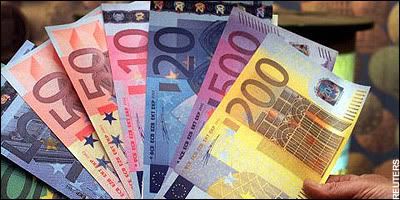
THE TELEGRAPH: The euro has surged to an all-time of $1.48 against the dollar, prompting bitter protests from European export industry and hints of possible intervention from top EU officials.

Jean Claude-Juncker, chair of the Eurogroup of finance ministers, said the dramatic rise in the currency since August had begun to inflict damage on vulnerable parts of the 13-nation bloc.

'We deplore the sudden changes in the exchange rates. We will be keeping a very watchful eye on the exchange rate markets,’ he told the European Parliament. Mr Juncker said the countries worst effected were those that “haven’t done enough to increase their competitiveness”, a reference to the southern tier of states that let rip on inflation after the launch of the euro and failed match Germany in holding down costs.

Mr Juncker is leading an EU troika to Beijing next week to pressure the Chinese authorities into speeding up the glacial pace of yuan revaluation. China’s currency is linked to the dollar by a crawling peg. It has been steadily falling against the euro, even though China’s trade surplus with Europe has reached $135bn over the last year, up 46pc. Protest grow as Euro hits $1.48 By Ambrose Evans-Pritchard

Mark Alexander