January 22, 2008

A Letter from Saudi Arabia: A Bush visits a Saud, but much has changed

Osama bin Laden couldn’t have wished for a ‘better’ outcome from 9/11 than this scenario: A seriously weakened America!
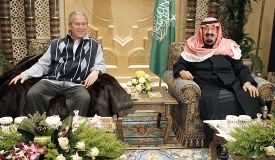
Photobucket
Photo of George Bush with King Abdullah courtesy of the International Herald Tribune

INTERNATIONAL HERALD TRIBUNE: RIYADH: The Saudi monarchy once depended on the United States to protect its reign and its oil from foes like Saddam Hussein. These days, President George W. Bush needs the world's biggest exporter of crude more than it needs him.

With oil at about $90 a barrel, the U.S. economy at risk of sliding into recession and American banks trying to raise cash to ride out the subprime-mortgage crisis, Bush has become a supplicant for Saudi financial help. He also needs the kingdom to get behind his Palestinian peace push, to keep Iran at bay and to support political stability in Iraq.

"It's very late in his tenure," says Craig Unger, author of "House of Bush, House of Saud," which probed the relationship between the two families, and a new book, "The Fall of the House of Bush." "He's in a much weaker position now, and he has very little leverage."

It wasn't always this way. During the presidency of Bush's father, George H.W. Bush, "the United States had an extraordinarily close and cooperative relationship with Saudi Arabia across the board," says Chas Freeman, who was then U.S. ambassador to the kingdom. "Saudi Arabia made a special effort to remain the principal supplier of oil to the U.S., something it no longer does. We had forces in Saudi Arabia. We no longer have that relationship." A Bush visits a Saud, but much has changed >>> By Janine Zacharia

Mark Alexander (Paperback)
Mark Alexander (Hardback)

On the Cusp of Economic History

INTERNATIONAL HERALD TRIBUNE: DAVOS, Switzerland: Is economic history about to change course? Among the chieftains of politics and industry gathering in Davos for the World Economic Forum on Wednesday, a consensus appears to be building that the capitalist system is in for one of those rare and tempestuous mutations that give rise to a new set of economic policies.

As the prospect of a U.S. recession overshadows a tense and drawn-out election campaign in the world's most emblematic market economy, a corrosive cocktail of factors is eating away at old certainties: Power is steadily leaking from West to East. Income inequalities are rising in rich countries.

And signs of a protectionist backlash are multiplying as worries about climate change, the rise of state-run investment funds and the bursting of the recent credit bubble give novel ammunition to those in the West who question free markets and clamor for more shelter from globalization.

What exactly will emerge when the dust settles is hard to predict, economists and executives say. But this much seems clear: With the frontier between state and market once again up for grabs, the era of easy globalization is over - and big government in one form or another is back.

"The pendulum between market and state is swinging back," Pascal Lamy, director general of the World Trade Organization, said by telephone before traveling to Davos. "The year 2008 is a crucial year that could end up setting the tone for some time to come. What we need is an ideological mutation without falling into the trap of protectionism." On the cusp of economic history >>> By Katrin Bennhold

Mark Alexander (Paperback)
Mark Alexander (Hardback)
Asian Markets See Further Losses

BBC: Share prices in Japan and South Korea continued to fall sharply on Tuesday, a day after global stock indexes tumbled amid fears of a recession.

Japan's benchmark Nikkei index plunged 1.5% in the first minute of trading.

Korea's Composite Stock Price Index, meanwhile, had dropped 3.4% shortly after the markets opened.

The falls came a day after stock indexes around the world saw the biggest drop since the terrorist attacks of 11 September 2001.

On Monday, London's FTSE 100 index tumbled 5.5% to 5,578.2, wiping £77bn ($149bn) off the value of its listed shares.

Indexes in Paris and Frankfurt slumped by about 7%, while share prices in South America also dropped.

Markets across Asia from China to India and Taiwan to the Philippines all fell. Global recession feared >>>

WATCH BBC VIDEO:
Major Falls for Global Markets

Mark Alexander (Paperback)
Mark Alexander (Hardback)

January 21, 2008

Euro Bosses to Bet on Turkey

TURKISH DAILY NEWS: 'Turkey is already a member of the EU for us,' Volvo Group's CEO says. This world-leading company is making positive noises about Turkey's future as it considers Turkey a regional hub to ease its distribution to the Middle East, Caucasus and the Balkans, and talks of plans for introducing more 'environment friendly' vehicles in the country

The world's leading car, truck and construction equipment manufacturing giant, the Volvo Group, has chosen Turkey as its regional hub for future investments.

“We consider Turkey as a center to distribute our products to the Middle East and the Caucasus. As a first step we have decided to establish an assembly factory for Renault Trucks,” Leif Johansson, president and the CEO of the Volvo Group, told the Turkish Daily News, in an exclusive interview here Friday.

Renault Trucks, a member of the Volvo Group since 1992, which produces light and heavy commercial vehicles, plans to sell more than 100,000 vehicles by 2010. The trucks that are manufactured in factories in France and Spain are assembled in 11 different countries. Turkey will be the 12th, according to Johansson.

“For us Turkey is already a member of the European Union. Not only important due to its geographic location in its region, Turkey is also a good market for us in itself,” he said. Euro bosses to bet on Turkey >>> By SERKAN DEMİRTAŞ

Mark Alexander (Paperback)
Mark Alexander (Hardback)
Billions Wiped Off London Shares

TIMESONLINE: About £77 billion was wiped from UK blue chip share values this morning as fears of a US recession reverberated around the globe, sending the FTSE 100 index down to its lowest level in 19 months.

London's benchmark index of blue chips dived by as much as 324 points, sliding through the 5,600 mark for the first time since June 2006, to plumb 5,578. By late morning it had rallied slightly to 5,596, still down 306 points.

Following frenzied trading in Asia as investors drained cash from the Tokyo and Hong Kong markets, European traders joined the gloom-fest. Germany's DAX index slumped by 381 points to 6933, while the CAC 40 in France was down 238 points at 4854.

In the UK, mining companies, retailers and banks bore the brunt of the markdown in prices as dealers decided that President George W Bush's proposed stimulus package for the US economy, that was revealed last week, would not be enough. The threat that the credit ratings of monoline insurers - which insure bond investors against default - could be downgraded added to the general anxiety. US recession fears wipe £77bn from London shares: London's FTSE 100 fell to an 18-month low as markets took a dim view of President Bush's plan to fight off a US downturn By Patrick Hosking and Leo Lewis

NZZ Online:
Ein schwarzer Montag an den Börsen: Weltweite Verunsicherung auf den Finanzmärkten

Mark Alexander (Paperback)
Mark Alexander (Hardback)
Britain’s Tax and Benefit System Harsh on the Traditional Family

DAILY MAIL: Married couples are being brutally punished by Labour's tax and benefit system, according to research to be published tomorrow.

Experts say that couples where one partner works and the other stays at home are the worst affected, paying a far higher proportion of their incomes to the taxman than in almost any other civilised country.

Britain is almost alone in failing to reward couples that stay together, according to the first international study of its kind.

A one-earner couple on average earnings of £30,800 a year pays 40 per cent more tax in Britain than in comparable members of the OECD group of developed nations.

And, compared to European Union states, the average family is paying 25 per cent more tax.

The study, carried out for Care, a Christian charity that tackles poverty, concludes that single people with no children do far better than families.

In other OECD countries, the tax paid by one-earner married couples on average wages is around 50 per cent of that paid by a single person on the same income.

But in Britain the figure is 75 per cent - even when tax credits and child benefit are taken into account. The findings will fuel concern that Labour's tax and benefit policies are helping to destroy family life. How Labour's tax system punishes couples for being married >>> By James Chapman

Mark Alexander (Paperback)
Mark Alexander (Hardback)

January 19, 2008

Globaloney

DEFENDING AMERICA FOR KNOWLEDGE AND ACTION (DAFKA): There is something surreal about the spectacle of President Bush touring the Persian Gulf. It calls to mind the signature line of Mad Magazine's mascot, Alfred E. Neuman: "What, me worry?"

Mr. Bush's trip is, after all, premised on the notion that the Arab leaders he is courting there are reliable allies. Such a proposition should be subjected to the closest of critical scrutiny by Congress, the press and the American electorate since a number of highly debatable, and increasingly portentous, policies are predicated on this assumption. These include:

--Saudi Arabia and the other, smaller desert principalities are "moderates" who are as opposed as we to the totalitarian political agenda of fanatical ideologues such as Osama bin Laden.

--The Gulfies share our concern about the rising power of Iran and therefore can be counted upon to join us in countering that region's would-be Islamofascist superpower. It follows not only that we can safely provide these autocracies with an array of advanced weapons, but we must do so.

--The Arab regimes in the Persian Gulf will help broker a peace between Palestinians and Israelis — if only the United States pressures the Jewish State to make territorial and other concessions that may imperil the latter.

--And the willingness of the Gulf's potentates to recycle the immense wealth they have accumulated in recent years — primarily through oil sales at exorbitantly inflated prices — to purchase big stakes in U.S. companies and capital markets is a welcome development. Such investment is to be encouraged, and those who say otherwise should be condemned as "Chicken Little xenophobes" in the words of former General Electric Chairman Jack Welch and his wife, Suzy.

In fact, the Welch tag-team used a Jan. 21 Business Week column to admonish a letter-writer worried about Arab and other sovereign wealth funds buying up American corporations: "In trying times, U.S. companies always attract opportunistic, activist shareholders. Sometimes they look like Carl Icahn or Nelson Peltz. Sometimes they look like shiny-faced hedge fund managers just out of Wharton or Harvard Business School. And sometimes — like now — they look Chinese or Saudi or whatever. It doesn't matter. They're all after the same thing: the opportunities in America's capitalistic market."

Unfortunately, this confidence in the inexorable forces of "globalization" is as misplaced in the case of the so-called "pro-Western" Arab states as are the other assumptions driving American policy towards the region at the moment. Globaloney >>> By Frank Gaffney (from The Washington Times)

Mark Alexander (Paperback)
Mark Alexander (Hardback)
Bush Calls for Kick-Start for the Economy

BBC: President George W Bush has called for a special package of measures worth billions of dollars to avoid a downturn in the world's biggest economy.

He said the growth package would have to be big enough to make a difference to the "large and dynamic" US economy.

Mr Bush said it had to include tax incentives for US business and direct tax relief for the American people.

The package should total at least 1% of gross domestic product, or about $145bn (£74bn), the White House said. Bush calls for economy kick-start >>>

Mark Alexander (Paperback)
Mark Alexander (Hardback)

January 18, 2008

Bush will Konjunktur mit Steuernachlässen ankurbeln

NZZ Online: Der amerikanische Präsident befürwortet Steuernachlässe, um die Wirtschaft des Landes wieder anzukurbeln. Insgesamt soll es Steuererleichterungen in Höhe von etwa 145 Milliarden Dollar geben.

(sda/dpa/afp/Reuters) Der amerikanische Präsident George W. Bush will angesichts von Rezessionsängsten der weltgrössten Volkswirtschaft mit einem milliardenschweren Konjunkturprogramm unter die Arme greifen. Das Paket fusse auf «Steuererleichterungen auf breiter Basis» und müsse einen Umfang von etwa einem Prozent des Bruttoinlandprodukts haben, sagte Bush am Freitag in Washington. Das entspricht nach Regierungsangaben zwischen 140 und 150 Mrd. Dollar.

Prinzipielle Zustimmung der Demokraten

Das Programm solle sowohl für Unternehmen Investitionsanreize bieten wie auch die Konsumenten zu Ausgaben stimulieren. «Ein neues Wachstumspaket zu schnüren, ist unsere dringendste wirtschaftliche Priorität», erklärte Bush.

Zwar stehe die Wirtschaft auf einem «soliden Fundament», doch gebe es Bereiche, die grosse Sorgen bereiteten, sagte der Präsident. Er forderte den Kongress zur Zusammenarbeit auf, um das Konjunkturpaket so rasch wie möglich zu verabschieden. Die Demokraten hatten im Vorfeld prinzipiell ihre Zustimmung zu einem derartigen Notprogramm erklärt. Bush will Konjunktur mit Steuernachlässen ankurbeln: Erleichterungen von insgesamt 145 Milliarden Dollar geplant >>>

TRIBUNE DE GENÈVE:
Bush dévoile un plan de relance pour stimuler la croissance américaine

Mark Alexander (Paperback)
Mark Alexander (Hardback)
Recession Fears Unsettle Markets

BBC: Fears of a recession sent US shares reeling again, after weak manufacturing data and a massive loss at investment bank Merrill Lynch unsettled investors.

The benchmark Dow Jones industrial average fell 306.95 points, or 2.46%, to close at 12,159.21.

A survey showed that factory activity in the US mid-Atlantic region slowed to levels that typically signal recession.

Merrill shares dropped 10.2% to $49.45 after the firm reported its biggest quarterly loss in its history.

It made a net loss of $7.8bn (£3.9bn) in the 12 months to the end of December from a net profit of $7.5bn in 2006.

In the final three months of 2007 alone, it chalked up losses of $9.83bn[.] Recession fears unsettle markets >>>

BBC:
US Economy in Slowdown

Mark Alexander (Paperback)
Mark Alexander (Hardback)

January 17, 2008

Banking on Piety

Photobucket
Image of Muhammad’s name in calligraphic art form courtesy of Google Images

ARABIAN BUSINESS.COM: There is no such thing as an Islamic Sukuk; these are conventional bonds that are coated with an Islamic shell." To say Hassan Heikal, the CEO of the leading home-grown investment bank in the Middle East, EFG-Hermes, is sceptical about Islamic finance is an understatement. On the other side of the spectrum, Dr Abdul Moman Al-Olaby, a professor who was one of the pioneers in the industry agrees that some Sharia-compliant structures are questionable, but says "Sharia-compliant finance is our jewel, and even in its infancy, it is well positioned to compete among global banking giants."


Dr Ibrahim Warde, a professor of international business at Tufts University in the USA, and author of Islamic Finance in the Global Community, has been studying the industry for the past decade. As an academic, he takes a more nuanced approach, and tells Arabian Business "the initial hope of the sector was that it would be a completely different approach to finance and it would have many economic and social benefits, and would be based on the principle of sharing profits and losses." Critics today claim that "it evolved into a mimicking of conventional finance" and some question if it is a "new model", but supporters defend the approach on the grounds that they are leading the much needed modernisation of the financial sector.


While the debate will undoubtedly continue, it is undeniable that the cat is out of the bag. Sharia-compliant finance is a growth sector all over the world, and has now become a US$600bn industry. Given the immense wealth of the Arab world and the billion-plus global Muslim population, market dynamics forced the creation of Sharia-compliant finance. From Singapore to London, from Doha to New York, bankers are developing new products, chasing new clients, and laying the groundwork for global expansion.

In this report, Arabian Business examines the origins of Sharia finance, modern banking products, and the rise in corporate finance. We also speak to some of the players behind the burgeoning Takaful (insurance) market, see the Qatari innovation of Sharia-compliant private equity, and look at the scholars and boards endorsing the various structures. Banking on piety >>> By Christina Corbett and Mohammed Aly Sergei

Mark Alexander (Paperback)
Mark Alexander (Hardback)
Dow Plunges More than 300 Points on Grim Outlook

NEW YORK TIMES: Stock markets plunged on Thursday as investors confronted a troubling manufacturing report and new indications of the depth of subprime losses and housing woes. The Dow Jones industrial average lost more than 300 points.

The Standard and Poor’s 500-stock index, a broad measure of the financial markets, tumbled below its low for last year, set in March. At the close, it was down 2.9 percent after giving up early morning gains, bringing its decline since Jan. 1 to 9.2 percent.

The Dow Jones industrial average ended down 306.95 points, or 2.5 percent, at 12,159.21, and the technology-heavy Nasdaq composite index was off 2 percent.

A dismal report on manufacturing activity caught investors by surprise on Thursday morning, sending the main indexes into the red after an early stint in positive territory.

The Federal Reserve reported that a survey of Philadelphia-area manufacturers contracted much more than expected. A similar drop in the index occurred in early 2001, just before the onset of the last recession.

“Basically every day now, you have more and more investors leaning toward the camp that yes, this is going to be a recession, and it could be a severe one,” said David Kovacs, a quantitative investment strategist at Turner Investment Partners in Berwyn, Pa.

Recession fears have been roiling the market of late, sending the S.& P. down 8 percent since the beginning of the year. Dow Plunges More Than 300 Points on Grim Outlook >>> By Michael M. Grynbaum

Mark Alexander (Paperback)
Mark Alexander (Hardback)

January 16, 2008

Gold Fever

Photobucket
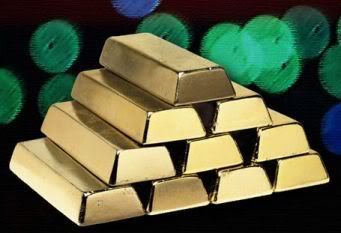
Photo of gold ingots courtesy of Google Images

SPIEGELONLINE INTERNATIONAL: Concerns over the financial markets and the global economy are driving the price of gold to historic heights. But is all that glitters really worth investing in?

Deep beneath London's streets lies a treasure greater than anything that even the Bank of England possesses: Thousands of gold ingots, each weighing in at more than 12 kilograms (26 pounds). The ingots, neatly arranged on wooden pallets and stacked high to the ceiling, glow softly in the dim neon light of the vault. And every week a forklift adds new stacks of ingots to the existing inventory.

Financial services provider StreetTracks Gold Shares uses the heavily secured and guarded vaults to store unimaginable quantities of the precious metal for its customers. The vaults already contain more than 641 tons of gold, with a market value, at today's prices, of more than $18 billion (€12 billion).

Gold Shares is a publicly traded fund with a unique business model: Investors buy shares in the fund and, in return for a fee, the company turns their invested cash into real gold. It's a lucrative business for Gold Shares, because most banks stopped dealing in precious metals with private customers long ago.

These financial products are called exchange traded funds. The gold-based funds were introduced more than three years ago and have recently seen a massive influx of investor cash. In the third quarter of 2007, the demand for the funds skyrocketed by 617 percent over the same period in the previous year. It was a phenomenal increase, especially coming during those weeks in which investor confidence was shaken by signs of a looming US financial crisis.

Now that images of long lines in front of British bank branches have circled the globe and government-run German banks like SachsenLB have run into difficulties, investors have been thrown into an even deeper state of uncertainty. Amid growing fears that the US dollar will continue to lose value and that consumer prices, especially for energy, will keep on rising, pessimists are predicting a recession with potentially devastating consequences for the entire global economy.

Worried investors have fled to the relative safety of a form of payment that inspired confidence in the Egyptians as far back as 5,000 years ago, and that has since been seen as the embodiment of stabile prosperity and eternal wealth. Currencies come and go, but gold is eternal. Investors Seized by Gold Fever amid Economy Worries >>> By Alexander Jung

Mark Alexander (Paperback)
Mark Alexander (Hardback)
Finanzmärkte in Angst vor US-Rezession

NZZ Online: Die US-Börsen haben am Mittwoch ihre Talfahrt fortgesetzt. Enttäuschende Geschäftszahlen von Intel schürten erneut die Furcht vor einer Rezession.

(sda/Reuters) Auch am Mittwoch haben an der Schweizer Börse Verluste auf breiter Front vorgeherrscht. Händler sprachen von einem richtigen Ausverkauf. Als sich im frühen Handel in den USA eine technische Erholung abzuzeichnen schien, erholten sich viele Aktien jedoch vorübergehend von den Tiefstkursen.

Grosse Einbussen erlitten die Banken. Schlechte Nachrichten aus dem amerikanischen Bankensektor belasteten den Markt und schürten Befürchtungen vor weiteren Abschreibungen und einem Abrutschen in die Rezession.

Der Swiss Market Index (SMI) ging 1,59% tiefer mit 7847,52 Punkten aus dem Handel. Bei 7779 Zählern markierte er einen neuen Tiefststand. Nur einer der 20 SMI-Titel konnte Kursgewinne verbuchen. Der breite Swiss Performance Index (SPI) verlor 1,65% auf 6356,56 Punkte. Finanzmärkte in Angst vor US-Rezession: Börsen setzen Talfahrt fort - auch SMI schliesst im Minus >>>

Mark Alexander (Paperback)
Mark Alexander (Hardback)
Cash for Air. Hmm! I Beg Your Pardon: Cash for Blair

THE TELEGRAPH: Is Tony Blair batting for both sides?
The former PM will be working for rival Goldman Sachs later this week, despite just signing up on a £2.5m stipend to the JP Morgan rest home (his salary's rising faster than the price of British groceries).

He will appear in Florida on Friday at Goldman Sachs' client jamboree focusing on foreign exchange, a little pep talk for which Blair is apparently charging £300,000 - which should help with the winter heating bills.

"He's speaking for us at a conference in Florida," confirms a reluctant Goldman Sachs spokesman.

"But you'll have to rely on your source for the other information."

I'll take my chances with that. [Source: Blair rakes in Sachs of cash] Edited by Simon Goodley

Mark Alexander (Paperback)
Mark Alexander (Hardback)

January 15, 2008

Shares Slump on Recession Fears

BBC: European and US shares have fallen sharply as poor US retail sales figures and Citigroup's first quarterly loss added to fears of a US recession.

In London the FTSE 100 index of leading shares slumped by more than 3% - its biggest one-day fall since the height of the credit crunch in August.

Meanwhile France's Cac 40 index lost 2.8% while Germany's Dax slid 2.1%.

Sales in US shops fell by 0.4% in December from a year earlier, as consumers tightened their belts.

And Citigroup, the giant US banking firm, reported a $9.83bn (£5bn) net loss for the last three months of 2007, taking its total writedowns as a result of exposure to sub-prime loans to $18bn.

"The losses at Citigroup - whilst fully expected - still seem to be unsettling traders across the Atlantic, whilst at the same time the lacklustre US retail sales figures are confirming that the economy is slowing," said CMC Markets trader Jimmy Yates. Shares slump on recession fears >>>

Mark Alexander (Paperback)
Mark Alexander (Hardback)

January 14, 2008

Pound in Bad Shape

THE TELEGRAPH: The pound has suffered the biggest fall of any major currency over the past year, it has emerged.

Sterling's dramatic recent decline means it has now weakened by even more than the dollar in the past 12 months.

The news, which comes only days after the pound dropped through the 75p mark against the euro, underlines how fast sterling's value has diminished in past months. Economists warned it may also prevent the Bank of England from cutting rates as fast as many expect. Sterling takes bigger beating than the dollar >>> By Edmund Conway

Mark Alexander (Paperback)
Mark Alexander (Hardback)

January 13, 2008

”Toxic Mix” for British Economy

THE SUNDAY TIMES: BUSINESS is warning of a “toxic mix” for Britain’s economy of sharply weaker growth and profits alongside powerful inflationary pressures. This poses a growing dilemma for the Bank of England, which held off cutting interest rates last week but is widely expected to cut next month.

According to Ernst & Young, profit warnings from UK-quoted companies have hit their highest level since the final quarter of 2001, when the economy was rocked by the fallout from the September 11 terrorist attacks on America.

Meanwhile, this week’s British Chambers of Commerce (BCC) quarterly economic survey is said by insiders to be “flashing red”. Output, orders and expectations are all down sharply, except for firms’ expectations of price rises, which are at a record high.

A YouGov poll of more than 2,100 voters for today’s Sunday Times shows that people are gloomy about economic prospects, with 34% expecting a slowdown, 21% no growth at all, and 22% a recession. Firms face toxic mix of rising prices and falling profits >>> By David Smith

Mark Alexander (Paperback)
Mark Alexander (Hardback)

January 11, 2008

Weak Pound, Strong Euro

BBC: The pound has fallen to an all-time low against the euro after weak manufacturing data underscored a gloomy outlook for the UK economy.

Sterling is now at its weakest since the single currency was introduced in 1999, it now takes 75.86 pence to buy a euro. One pound was worth 1.3243 euros.

The pound also hit a 10-month low versus the dollar at $1.9485.

After a strong 2007, the pound is expected to weaken in 2008 as interest rates fall and the UK economy slows.

The pound hit a 26-year high against the dollar last year, above $2.

Analysts said investors were moving out of high yielding currencies in favour of the lower-yielding yen. Pound at record low against euro >>>

Mark Alexander (Paperback)
Mark Alexander (Hardback)

January 10, 2008

Blair Accused of Accepting ‘Blood Money’!

DAILY MAIL: Tony Blair has taken a lucrative job with a U.S. bank which is profiting from the Iraq war.

JP Morgan is expected to pay him £1million a year as a part-time adviser.

It is the first of a series of posts that could see the former prime minister rake in a staggering £40million.

The move brought fierce criticism last night. Reg Keys, whose soldier son Tom was killed in Iraq in 2003, said it was "almost akin to taking blood money".

He added: "If he had a conscience or any sensitivity, he would not have taken this job".

Tory defence spokesman Gerald Howarth said: "It will be viewed with some contempt by the armed forces that he picks up this large cheque when he was happy to send British troops into battle ill-equipped and in insufficient numbers."

JP Morgan is heading a consortium set to make billions as Iraq's economy recovers from the war spearheaded by Mr Blair and U.S. President George Bush.

It was chosen to run the new Trade Bank of Iraq, which has raised billions in trade guarantees by mortgaging future oil production and will make huge profits from the deals.

Westminster watchdogs have ordered Mr Blair not to attempt to lobby his former Government colleagues on behalf of the bank for the next 12 months.

But that appears to be no barrier to his employment prospects. The Wall Street bank said he would provide strategic and political advice, as well as appearing at events with its clients.

The former premier has said he expects to take on a "small handful" of similar posts with other companies. They will help him and his wife Cherie pay off an estimated £5million in mortgages.

Mr Blair, 54, who said he wanted his career after No 10 to be of "real purpose" rather than "just about doing a job", is already reported to be earning hundreds of thousands a month as an after- dinner speaker.

Other sources of income include a £5million deal to write his memoirs and a prime ministerial pension of £64,000 a year.

French president Nicolas Sarkozy is spearheading a campaign to have him installed as the first president of the EU - a post expected to be worth at least £200,000 a year.

In all, experts believe Mr Blair can expect to pocket double the £20million earned by former U.S. President Bill Clinton. Blair accused of taking blood money over £1m job with US bank profiting from Iraq war >>> By James Chapman

WATCH BBC VIDEO:
Blair joins JP Morgan

Mark Alexander (Paperback)
Mark Alexander (Hardback)