November 30, 2007

About the Centre for Islamic Economics

CENTER FOR ISLAMIC ECONOMICS: Centuries of imperialistic rule has made the Muslims forget the basic message of Islam which emphasizes on following the Shari'ah guidelines in our Mu'amulat (routine dealing) and Mu'asharat (social system) with a similar zeal as we follow these rules in our Ibadaat (prayers).

This despicable situation has resulted in making the whole economic and social system of all the Muslim nations totally dependent on menaces like Riba or Interest which is clearly declared Haram (prohibited) in Islam.

Nevertheless, there seems to be a ray of hope, as there is an increasing desire of awareness among a considerable portion of Muslims in Pakistan and all over the Muslim world who realize that now its time to inculcate the teachings of Islam in their economic as well as social life. As a result of this noble desire, Islamic Banking & Finance has witnessed an exponential growth worldwide. Most of the leading banks throughout the globe have started offering Shari'ah compliant financial products & services to their customers.

Keeping into consideration the emerging importance of this field a need arises for an organized forum which on one had, equip the younger lot with the education of Islamic economics and on the other hand, train the professionals in the practical field so that they can switch their current day business practices on Shari'ah guidelines Centre for Islamic Economics (CIE), a division of Jamia Darul Uloom Karachi, looks forward to fulfill this need.

Centre for Islamic Economics (CIE) was founded on 22nd Safar 1413 i.e. 22nd August 1992 within premises of Masjid-e-Baitul Mukarrm, block-8, Gulshan-e-Iqbal, Karachi.

The basic rationale for setting up this institution is to propagate the guidelines of an Islamic Economics System by undertaking research to enable the economic, financial and banking activities in Pakistan and other Muslim countries to conform to Shari'ah and to extend training facilities to personnel engaged in economic development activities in the Muslim world. [Source: The Centre for Islamic Economics >>>]

Mark Alexander

November 29, 2007

Reicher Inder: 70.000 Euro in der Minute

Photo Sharing and Video Hosting at Photobucket
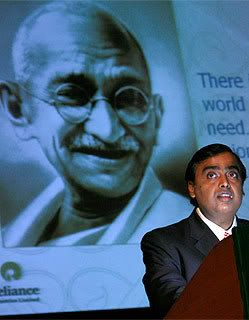
”Mukesh Ambani ist bald vielleicht der reichste Mann der Welt” (Photo dank der Presse)

DIE PRESSE: Die Zahl der indischen Milliardäre ist laut US-Magazin "Forbes" innerhalb eines Jahres um 18 auf 54 gestiegen. Der Industrielle Mukesh Ambani landete bei dem Ranking auf Platz 14.

Viele sehen in ihm aber bereits den reichsten Mann der Welt. "The Economic Times" reihte Ambani mit einem Vermögen von 63 Mrd. Dollar bereits vor Carlos Slim Helu und Bill Gates. >>>

Mark Alexander

November 28, 2007

Steve Jobs


Mark Alexander
The Easiest Way to Become a Billionaire

EZINE ARTICLES: Once God was very happy with the hard work of his office-bearers and angels and he held a function to honour and award them. He said: In the next five minutes imagine in your minds the things you want to get, the powers you want to have and the traits you want to develop. You will be showered with all of them with my blessings. Immediately all of them closed their eyes and floated in the world of imagination freely and passionately. Their ecstasy of recreating themselves according to their wishes knew no bounds. What they thought they became and they got.

You will be very happy to know that Power of your mind can do the same miracle to change your life. God has also fitted the mind of the man with magical powers. You just need to learn how to use it with determination, diligence and persistence.

POWER OF YOUR MIND

Every prominent psychologist of the world has said that you get in life what you think or focus on . William James, father of American psychology, said: ‘The greatest discovery of the 19th century was not in the realm of the physical sciences, but the power of the subconscious mind touched by faith. Any individual can tap into an eternal reservoir of power that will enable them to overcome any problem that may arise. All weaknesses can be overcome, bodily healing, financial independence, spiritual awakening, prosperity beyond your wildest dreams. This is the superstructure of happiness’.

What we attract in our life is in direct proportion to our thought pattern. What we think daily about our body, relations, work, business, money, materialistic things God showers on us. So many people pray to God to get certain things in life and wishes of many people are fulfilled. It is not a miracle but a scientific law. By praying to God daily we try to focus our energies towards an aim, and immediately law of attraction starts working. We can achieve any goal in our life, even become a billionaire.

Name any successful person in any field – Bill Gates, Dhirubhai Ambani (great Indian industrialist), John D. Rockefeller, Abraham Lincoln, George Bush, , Akio Morita (the man who built Sony), Mahatma Gandhi, Thomas Edison, Walt Disney, Ravindra Nath Tagore, Tolstoy, Lenin, Mao-tse-tung, Mohammed Ali (the greatest boxer), Sachin Tendulkar, Richard Branson (rags to riches business tycoon of UK), Azim Premji (richest man in India)– the list is endless – everybody intentionally or unintentionally used the same formula for success and achievement. >>> By Anandrahi JS

Mark Alexander
Kann ein Lotto-Millionär eigentlich glücklich sein?

WELTONLINE: 30 Millionen Euro beträgt der Lotto-Jackpot bei der Ziehung heute Abend. Mark Lutter erforscht am Max-Planck-Institut für Gesellschaftsforschung den Lotteriemarkt. Er hat herausgefunden, warum Millionen Menschen ihre Tippscheine ausfüllen, obwohl sie wissen, wie gering die Gewinnchance ist.

WELT ONLINE: Wie hoch stehen die Chancen, den Jackpot zu knacken?

Mark Lutter: Die Wahrscheinlichkeit, sechs Richtige plus Zusatzzahl zu tippen liegt bei 1: 140 Millionen. Man könnte also sagen, wenn Sie einmal pro Woche einen Tipp abgeben, müssten Sie 2,7 Millionen Jahre spielen, um den Jackpot zu erwischen. Da läge Ihr Einsatz dann aber deutlich höher als der Gewinn.

WELT ONLINE: Was macht eigentlich das Lottospiel für die Forschung interessant?

Lutter: Es ist ein gesellschaftliches Phänomen. 40 Prozent der erwachsenen Bevölkerung spielen mindestens einmal in Jahr Lotto, davon wiederum die Hälfte, also rund 20 Millionen Deutsche, sind regelmäßige Spieler und tippen mindestens einmal im Monat – und setzen dabei durchschnittlich immerhin 30 Euro im Monat ein. Der Durchschnittseinsatz aller Lottospieler liegt bei 17 Euro. >>>

Mark Alexander
The Depressed Superpower

SPIEGELONLINE INTERNATIONAL: As frustration takes hold in the land of optimism, Americans are beginning to resemble Germans. They are collectively depressed over the Iraq War, the weak dollar and the aging of the baby boomers. Presidential candidates are left to preach change to an electorate that is afraid of it.

All it takes to find out why America is in such a bad mood is a look at the local section of any American newspaper, at the photos of the smiling faces of soldiers killed in Iraq.

All it takes to discover why Americans are beginning to doubt their own greatness is to accept an invitation to a dinner hosted by Adrian Fenty, the mayor of Washington, DC. His vision, says Fenty, is for students in the District of Columbia to receive their books at the beginning of the school year, not in the middle. When asked whether he has other visions, the mayor nods enthusiastically. His goal, he says, is to improve security in the city's schools. Fenty wants to make sure students in the United States capital can once again leave the classroom without facing the threat of violence.

All it takes to understand why the United States, a once-proud economic power, seems so unsure about itself these days is a walk through a supermarket with author Sara Bongiorni. In her book "A Year without 'Made in China': One Family's True Life Adventure in the Global Economy," Bongiorni describes how even those who call themselves smart shoppers have mixed feelings when they purchase low-priced, foreign-made products. "When I see the label 'Made in China,' part of me says: good for China. But another part feels a rush of sentimentality because I've lost something without exactly knowing what it is."

Taking a trip down America's memory lane -- to Gary, Indiana, for instance -- is a good way to understand why Americans today are so anxious about the future. In the days when Gary was the home of the world's biggest steel company, the running joke was that US Steel was so hard up for workers that it would even hire dead people.

The company attracted workers from around the world, including the family of future pop star Michael Jackson. Gary's steelworkers pumped prosperity into America, and the country still retains a sizeable chunk of the past that once thrived in Gary and other places like it.

Optimism Is Becoming an Endangered Species

But Gary is an ailing city today. US Steel has moved its headquarters elsewhere and has severely cut back its Gary operations. Nowadays, the city isn't doing any better than its most famous son. Both have seen better days, but the difference is that Gary doesn't even have the money for a facelift. Once a city of 200,000, half of its population has since left for greener pastures. >>> By Gabor Steingart in Washington

Gabor Steingart, 45, has been a journalist for SPIEGEL since 1990. He is currently reporting from SPIEGEL's Washington, D.C. bureau. His best-selling book "The War for Wealth: Why Globalization is Bleeding the West of Its Prosperity" will be published in the United States in April 2008 by McGraw-Hill. His column, "West Wing -- The Battle for the White House," appears exclusively on SPIEGEL ONLINE on Tuesdays.

Mark Alexander

November 27, 2007

Bet Your Bottom Dollar Tensions Will Follow

THE TELEGRAPH: The weak dollar used to be an economic issue. But the greenback has now dropped so far, and has so much further to fall, that its decline is of profound political importance. The dollar isn't any old currency. And it isn't just the currency of the biggest economy on earth. The dollar is the world's "reserve currency" - which means central banks everywhere use it to stockpile wealth. No less than two-thirds of all sovereign foreign exchange holdings are denominated in dollars.

Last week, the dollar dropped to yet another record low - reaching the verge of $1.50 to the euro. On a trade-weighted basis, the currency has, in four years, lost a third of its value. That's done the US some favours, helping its exports stay competitive. But the dollar's long dive means countries worldwide, having used the currency to store their reserves, are sitting on massive losses. That's why the dollar's demise is of major diplomatic - and even military - significance. Before this summer, the dollar was falling for economic reasons. After years of over-consumption, the US had dug itself the world's biggest ever trade deficit - 6 per cent of GDP.

These huge liabilities, and America's need to issue a steady stream of government debt, had long put pressure on the greenback. US officialdom feigned concern but, in reality, America laughed up its sleeve. A falling dollar shoved the burden of US adjustment on to the rest of the world.

In recent months, though, the dollar has headed south with a vengeance - after Wall Street recklessly securitised $900bn of sub-prime loans. And, of course, as US property prices fall and default rates keep rising, this sub-prime crisis gets worse. >>

Mark Alexander

November 26, 2007

Shops 'May Have Weak Christmas'

BBC: UK retailers could be set to experience a very limited rise in Christmas sales compared with last year, the British Retail Consortium has warned.

The trade body estimates that like-for-like sales, which exclude new store openings, could increase less than 3% this festive season from 2006.

Its warning came after it said the sector had experienced a tough 2007.

A separate Lloyds TSB study said consumer confidence had been hit by higher prices and mortgage payments. >>

Mark Alexander
Islamic Banking and Finance - Riyazi Farook


Mark Alexander
CNBC World - Islamic Finance: Applying Religion to Economics


Mark Alexander
Go West: Dollarkurs macht 2008 zum „Nordamerika-Jahr"

WELTONLINE: Wenn der Dollar nur billig zu haben ist, schnellt die Zahl der deutschen USA-Touristen in die Höhe. Auf diesen Effekt setzen die Reiseveranstalter und US-Tourismusämter schon lange. Jetzt, da der Wechselkurs bei rund 1,50 US-Dollar zu 1 Euro steht, scheint sich die Hoffnung zu erfüllen.

Viele Veranstalter verweisen auf sehr gute Buchungszahlen für den Winter 2007/08 und auch bereits für die kommende Sommersaison. Der Trend scheint klar: Die Deutschen bekommen wieder mehr Lust auf Urlaub mit Cowboys und Canyons, Megastädten und Mississippi-Dampfern.

„2008 wird ein Nordamerika-Jahr“, ist die Überzeugung von Matthias Rotter, der bei der Rewe-Bausteintouristik in Frankfurt den Bereich Meier’s Weltreisen leitet. „Die Vorausbuchungen für den Sommer in den USA gehen durch die Decke, vor allem bei Mietwagen-Rundreisen und Wohnmobilen. Und der Winter ist von den Buchungen her der absolute Hammer“, sagt Tilo Krause-Dünow, Chef des Veranstalters Canusa in Hamburg und Vorstandsmitglied im Visit USA Committee in Frankfurt. >>

Mark Alexander
Le luxueux empire
des frères Chalhoub

LE FIGARO: Deux frères français, les Chalhoub, ont bâti un empire de 200 boutiques au Moyen-Orient.

Lunettes de soleil siglées Versace sur le front, sacs baguette Dior sous le bras et téléphones Prada à la main, des jeunes femmes furètent parmi les dessous affriolants de la marque Agent provocateur. Scène banale d’un shopping entre copines… sauf que rien ne dépasse de leurs abayas noires et qu’elles sont au BurJuman, le plus chic des malls de Dubaï, dédié aux élégantes du golfe Arabo-Persique avec ses fontaines vertes, ses escaliers en bois doré, ses restaurants libanais et son magasin Vuitton décoré de moucharabieh. Ces jeunes femmes auraient-elles seulement pu passer leurs journées dans un tel mall, il y a seulement dix ans ? Pas sûr.

Grâce aux Chalhoub, un vrai vent de révolution souffle sur la vie de l’élite orientale. Sans cette dynastie d’entrepreneurs visionnaires, le Golfe ne serait pas la nouvelle plaque tournante du luxe mondiale. Des maisons comme Vuitton, Dior, Baccarat, Bonpoint, Christofle, Fendi et Chanel n’y feraient pas autant d’affaires. Des millions de touristes n’afflueraient pas à Dubaï. Et les élégantes autochtones, oisives à 99 % et richissimes grâce aux cours élevés du pétrole, connaîtraient la même vie recluse que leurs mères. Au lieu de quoi, elles peuvent s’adonner à leur passe-temps favori : faire du shopping, sept jours sur sept, de 10 à 22 heures non plus au souk mais dans de gigantesques centres commerciaux lumineux et climatisés. >>

Mark Alexander
Sarkozy Wins China 20bn Euro Deal

Photo Sharing and Video Hosting at Photobucket
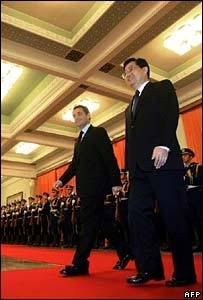
Photo of Mr Sarkozy with Mr Hu courtesy of the BBC

BBC: French industrialists visiting China with President Nicolas Sarkozy say they have finalised trade deals worth almost 20bn euros ($30bn; £14.5bn).

These include a delivery of 160 Airbus passenger planes to the value of about 10bn euros.
And state-owned French energy firm Areva said it had signed a contract to build two nuclear reactors in China.

The announcements came as Mr Sarkozy held a second meeting with his Chinese counterpart Hu Jintao.

"The total amount of these contracts has never been matched before," he told the Chinese president as they met in Beijing's Great Hall of the People. >>

LE FIGARO:
20 milliards de contrats déjà signés en Chine De Perrine Créquy

Mark Alexander
‘R’ word makes the leftovers harder to digest

TIMESONLINE: In the United States, the “R” word is back. As people in the world’s biggest economy pick at Thanksgiving leftovers, the ghost looming over the remains of the feast is the spectre of recession.

With Christmas not far off, Americans are feeling anything but festive. Consumer confidence is at its lowest for a decade and a half, apart from in the immediate wake of Hurricane Katrina in 2005. Polls show that two fifths of US households expect a recession in the next year – up from fewer than a third only a month ago. Glowering at their home computers, the anxious spend ever more time typing the “R” word into search engines.

Yet a slide into recession is far from the main expectation of Wall Street’s forecasters. Certainly, most expect a nasty economic setback in the closing months of this year, and several quarters of sub-par growth. But the consensus is for the US economy to expand by a relatively healthy 2.2 per cent next year.

Who, then, is right? Could the churning guts of angst-gripped Americans on Main Street end up more accurate than the insights that wizards on Wall Street glean from their data-laden statistical models? Alas, the answer is yes. Few analysts saw the last two recessions before they hit and, sadly, the sages look more and more likely to emerge as being too sanguine. A US recession looks more probable than not. >> By Gary Duncan

Mark Alexander

November 25, 2007

”I Got a ‘B’ in Economics 101"

Didn’t we all know it, George?


Mark Alexander

November 24, 2007

US-Ökonom warnt vor tiefer Weltwirtschaftskrise

SPIEGELONLINE: Zahlungssausfälle, Pleiten, Zwangsvollstreckungen: In der US-Kreditkrise steht Bank-Prognosen zufolge das Schlimmste noch bevor. Der US-Ökonom Burda fürchtet gar eine "tiefgreifende Rezession", wie sie die Welt seit Jahrzehnten nicht erlitten hat.

Hamburg/New York - Michael Burda sieht schwarz. Der amerikanische Ökonom ist sich sicher, dass die USA vor wirtschaftlich schweren Zeiten stehen. "Das Land steckt in einem schweren Dilemma. Ich erwarte eine tiefgreifende Rezession", sagt der Professor der Berliner Humboldt-Universität dem SPIEGEL.

Mehr noch: "Wenn die Krise noch bis weit ins kommende Jahr hineinreicht, kann sie Ausmaße annehmen wie bei der Weltwirtschaftskrise in den dreißiger Jahren", sagte Burda.

Auch in den USA selbst mehren sich die Stimmen, die vor einer Eskalation der Probleme warnen. Die Fälle von Zwangsvollstreckungen und Zahlungsausfällen würden nochmals deutlich zunehmen, glauben Bank-Experten. US-Ökonom warnt vor tiefer Weltwirtschaftskrise (mehr)

Mark Alexander
Sarkozy’s War with French Strikers

BBC: It would be an exaggeration to describe the French capital this week as a ghost town, but if you were a Parisian restaurant owner or a Parisian shop keeper you might be forgiven for doing so.

In my quarter, the popular pizza restaurant had to close because the chef and waiters could not get to work.

The boulangerie, usually stripped of its millefeuilles (custard pastry) and tartes aux fraises (strawberry tart) long before I get home from work, is still bulging with patisserie.

The baker tells me he is down 30-40% on sales because the usual customers did not dare risk being stranded in the city, and - instead - stayed home.

And in my local eight-till-late shop, the Moroccan shopkeeper grumbled it just was not worth stocking up on fresh produce - everyone was so tired after hours walking to and from work, they either did not bother to eat in the evenings or they just raided the freezer. It felt, he said, like there was a war on. Sarkozy's 'war' with French strikers (more) By Emma Jane Kirby

Mark Alexander
Der Dollar fällt auf den tiefsten Stand zu Franken und Euro

NZZ: Noch nie mussten für einen Dollar so wenig Franken oder Euro bezahlt werden wie am Freitag. Wegen der konjunkturellen Unsicherheiten in den USA könnte das Fed die Zinsen weiter senken und dadurch den Zinsvorteil der USA gegenüber Europa ausradieren.

cae. Die Dollar-Schwäche hält an. In der Nacht auf Freitag ist die US-Währung auf ein Rekordtief von Fr. 1.0896 gefallen – den tiefsten Stand, den der «Greenback» zum Franken je erreicht hat (vgl. Grafik). Im Laufe des Freitags erholte sich der Dollar zwar wieder auf über Fr. 1.10, doch die US-Währung blieb unter Druck. Ein Euro kostete am Freitag vorübergehend $ 1.4966, so viel wie noch nie. Der Dollar fällt auf den tiefsten Stand zu Franken und Euro: Zyklische Faktoren drücken die US-Währung unter Fr. 1.10

Mark Alexander
L'actualité économique et financière

LE FIGARO:
La dernière séance de la semaine Par Pierre Alexandre

LE FIGARO:
Wall Street grimpe

Mark Alexander
Sind die fetten Jahre vorbei?

DIE PRESSE: Die USA stecken tief in der Kreditkrise, Öl kostet bald 100 Dollar: Droht Europa eine Rezession? Nein, sagen die Ökonomen - warnen aber vor Sorglosigkeit.

Wien. Öl kostet fast 100 Dollar pro Barrel. Der Euro hat seit Jahresbeginn zum Dollar um mehr als zehn Prozent aufgewertet. Amerika steckt knietief in der Hypothekenkrise. Das nagt an den Nerven: Vier von zehn Amerikanern erwarten eine Rezession. Auch an der Wall Street herrscht Nervosität: Der Chefökonom der Investmentbank Goldman Sachs erklärte jüngst, die US-Kreditkrise könne eine „ernste Rezession“ zur Folge haben. Sind die fetten Jahre vorbei? (mehr)

DIE PRESSE:
Geschichte: 143 Jahre Ölpreis

DIE PRESSE:
The sound of Mieselsucht Von Michael Fleischhacker

DIE PRESSE:
Wir warten auf den Crash

Mark Alexander