February 26, 2008

Shari’ah Finance: Plenty of Interest in No Interest

THE TELEGRAPH: The Halal banking revolution is taking off, says Kara Gammell

The British Government is believed to be planning to raise funds by issuing Shariah-compliant bonds in the Middle East, which would be the first time a Western country did so, but many British banks already provide financial services in accordance with Islamic law.

Junaid Abbas Bhatti, an expert in Islamic Finance said: "The industry is growing at 15pc a year, so it's no surprise that the Western world's financial markets are starting to sit up and take notice of the Halal banking revolution.

"Islamic banking is far more complex than a simple prohibition on the giving and receiving of interest."

Emile Abu-Shakra of Lloyds TSB said there are now 2m Muslims in the UK. He added: "Our research tells us that three quarters want banking services that are in line with their faith.

''We have developed a range of products - from current accounts to mortgages - designed to meet the needs of needs of Britain's Muslim community.

"Not only has this made its possible for Muslims to bank according to their principles, but it has also helped to make Britain a real centre for Islamic finance."

The main difference between Islamic and conventional banking is that Islamic teaching says that money itself has no intrinsic value, and forbids people from profiting by lending it, without accepting a level of risk.

In other words, interest - known as "Riba" - cannot be charged. Sharia finance: plenty of interest in no interest >>>

Mark Alexander (Paperback)
Mark Alexander (Hardback)
Fears of Stagflation Re-Emerge

REUTERS: NEW YORK (Reuters) - U.S. consumer confidence slumped to its worst in five years this month as a tough job market helped produce the grimmest future outlook in 17 years, while soaring inflation among producers at the year's start stoked fears of stagflation.

Bad news also poured in from the beleaguered housing market, other data showed on Tuesday. The collapse in U.S. home prices accelerated to a record pace in the fourth quarter of 2007, with prices plunging 8.9 percent last year, according to the S&P/Case-Shiller U.S. National Home Price Index.

A government report showed U.S. producer prices jumped 1 percent in January on rising energy costs and posted the biggest 12-month gain in more than 26 years, which was the last time the U.S. was emerging from a stagflationary period of low growth and high inflation. Stagflation Fears >>>

Mark Alexander (Paperback)
Mark Alexander (Hardback)
’Non-Doms’ on the Run

THE TELEGRAPH: International lawyers are descending on London to persuade British non-domiciles to re-locate as pressure grows on the Chancellor to delay controversial plans to levy £30,000 a year on foreigners resident in the UK.

Seminars are being organised by foreign lawyers in London to act as shop windows to persuade tax experts to advise their clients to move away from the UK.

One of London's leading tax advisers to the UK's non-dom community said: "The UK Government really has no idea how much of a spectacular own-goal it has scored. It is totally depressing how many Irish, Swiss and Dutch lawyers are swarming all over our clients now in London, and the clients are listening to what was previously dismissed as jealous propaganda."

Dutch firm Loyens & Loeff is typical of international law firms setting up events to explain to advisers how their non-dom clients can benefit by leaving the UK. Foreign lawyers target City non-doms >>> By Sophie Brodie

Mark Alexander (Paperback)
Mark Alexander (Hardback)
February 25, 2008

Moscow World’s Costliest City

DAILY EXPRESS: WHEN a ride in one of London’s black cabs empties your purse, it isn’t hard to swallow the popular myth that the capital is the most expensive city in the world.

So thank your stars you’re not in Moscow, where the average visitor to the city – now officially the world’s most expensive – forks out nearly £250 a night for a room, compared with £154 in London.


In fact, the latest poll by industry observer Hogg Robinson Group put London in 10th place – down from eighth in 2006.


Second to the Russian capital was New York, where visitors pay £192 per night. In third place was Paris (£171), followed by Dubai (£164), Milan (£164), Stockholm (£160), Mumbai (£160), Bangalore (£159) and Hong Kong (£154).


For Moscow, it was a case of reclaiming the dubious title it also held in 2005 and 2006.


Room prices there have risen 93 per cent since 2004 and Margaret Bowler, global hotel relations director for Hogg Robinson Group, believes this has less to do with the draw of the country and more to do with economic factors.


She said: “The cost and availability of land in central Moscow, restricting the development of new hotels, is set to continue room inflation into 2008.”

It is just the latest confirmation of the city’s sky-high prices. Moscow World’s Cosliest City >>> By Heather Meyer

Mark Alexander (Paperback)
Mark Alexander (Hardback)

February 23, 2008

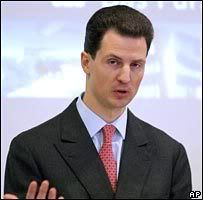
Liechtensteiners Fury at German Tax Snoop

Photobucket
Photo of Prince Alois of Liechtenstein courtesy of the BBC

BBC: Walking around Liechtenstein for the first time, there are two things that strike me most about this place: manure and money.

The smell of manure - that comes from the farmland that surrounds this rural principality.

The money… well, you can see that from all the shiny banks and investment firms that jostle for space in the capital, Vaduz.

These are the companies that have made Liechtenstein one of the richest states in Europe.

Secretive

Liechtenstein also has the reputation of being one of the most secretive tax havens in the world.

Just ask the Organisation for Economic Co-operation and Development.

This financial watchdog says Liechtenstein is one of only three states left on its blacklist of "uncooperative tax havens" (the others are not a million miles away - Monaco and Andorra).

Liechtenstein this week attacked the authorities in Berlin for buying information on German businessmen clients that have bank accounts in the tiny Alpine principality.

Germany has launched a tax evasion investigation using the data, which was supplied by an anonymous informant who was reportedly paid 5m euros (£3.75m; $7.3m). Liechtenstein fury at German tax snoop >>> By Steven Rosenberg

Mark Alexander (Paperback)
Mark Alexander (Hardback)

February 20, 2008

Germany: Worst Financial Crisis Since 1931? German State-Owned Banks on Verge of Collapse

SPIEGELONLINE INTERNATIONAL: The German government has had to bail out state-owned banks with taxpayers' money after their managements recklessly gambled away billions on subprime investments. But if a state-owned bank were to go under, the consequences could be disastrous for the whole economy.

Ingrid Matthäus-Maier, a member of the center-left Social Democratic Party (SPD) and the CEO of the state-owned KfW banking group, is undoubtedly in one of Germany's highest earnings brackets. Although her annual salary of €418,000 ($614,000) is substantially lower than that of her counterpart at Deutsche Bank, Josef Ackermann, who earns a tidy €13 million a year, she does earn more than twice the salary of German Chancellor Angela Merkel, who has to make do with a mere €200,000.

That's nice for Matthäus-Maier. A lawyer by profession who was a financial expert for the SPD for many years, she would not have been able to get on the board of a private bank in 1999, the year she joined the board of KfW -- she lacked the banking experience required by law. But KfW is not subject to the same regulations as other banks, which explains why Matthäus-Maier doesn't owe government auditors an explanation -- not even now, in the wake of recent public accusations that she botched the IKB crisis.

As the head of KfW, Matthäus-Maier is a major shareholder in IKB, the Düsseldorf-based bank that is on the brink of bankruptcy and is only being kept afloat by a series of government bailouts running into the billions (more...). Last week was marked by one crisis meeting after the next, but the headstrong government banker had more than the future of IKB on her mind. Indeed, she seemed more concerned about her employment contract and whether it would be extended. Her demands triggered an irritated reaction from the head of the KfW supervisory board, Economics Minister Michael Glos, as well as from others present at the meetings. Two days later, it was announced… >>> By Wolfgang Reuter

Mark Alexander (Paperback)
Mark Alexander (Hardback)

February 18, 2008

Shari’ah Now Official in Britain

ANGLO-AUSTRALIAN NATIONAL COMMUNITY COUNCIL: new sharia law controversy erupted last night over Government plans to issue special "Islamic bonds" to pay for Gordon Brown's public-spending programme by raising money from the Middle East.


Britain is to become the first Western nation to issue bonds approved by Muslim clerics in line with sharia law, which bans conventional loans involving interest payments as "sinful".


The scheme would mark one of the most significant economic advances of sharia law in the non-Muslim world.


It will lead to the ownership of Government buildings and other assets currently belonging to British taxpayers being switched wholesale to wealthy Middle-Eastern businessmen and banks.


The Government sees sharia-compliant bonds as a way of tapping Middle-East money and building bridges with the Muslim community.


But critics say the scheme would waste money and could undermine Britain's financial and legal systems.


Senior Conservative MP Edward Leigh, chairman of the Commons Public Accounts Committee, said: "I am concerned about the signal this would send – it could be the thin end of the wedge.


"British Common Law must be supreme and should apply to everyone."


A spokesman for the National Secular Society said: "There are lots of different ways to arrange financing.


"Constructing financial instruments to be sharia-compliant seems to me to involve a lot of unnecessary complication, which will serve only to make a lot of lawyers very rich."


The attempt to embrace Islamic financing would also appear to be at odds with Mr Brown's promise to promote Britishness and British values and institutions.


The Treasury has already faced heavy criticism for removing Britannia from 50p coins.


Other Western nations have been reluctant to issue Islamic bonds. Shari’a now official in Britain >>>

Mark Alexander (Paperback)
Mark Alexander (Hardback)

February 17, 2008

New Sharia Row Over Chancellor’s Plans for ‘Islamic Bonds’

THE MAIL ON SUNDAY: A new sharia law controversy erupted last night over Government plans to issue special "Islamic bonds" to pay for Gordon Brown's public-spending programme by raising money from the Middle East.

Britain is to become the first Western nation to issue bonds approved by Muslim clerics in line with sharia law, which bans conventional loans involving interest payments as "sinful".

The scheme would mark one of the most significant economic advances of sharia law in the non-Muslim world.

It will lead to the ownership of Government buildings and other assets currently belonging to British taxpayers being switched wholesale to wealthy Middle-Eastern businessmen and banks.

The Government sees sharia-compliant bonds as a way of tapping Middle-East money and building bridges with the Muslim community.

But critics say the scheme would waste money and could undermine Britain's financial and legal systems.

Senior Conservative MP Edward Leigh, chairman of the Commons Public Accounts Committee, said: "I am concerned about the signal this would send – it could be the thin end of the wedge.

"British Common Law must be supreme and should apply to everyone." New sharia row over Chancellor's plans for 'Islamic bonds' >>> By Simon Walters

Mark Alexander (Paperback)
Mark Alexander (Hardback)

February 16, 2008

An Iranian Viewpoint: The Fall of the Dollar Empire

PRESS TV: The following is an interview with Hamid Varzi an economist and banker based in Tehran about the US economic crisis:

Q. Please tell us more about the 2007 subprime mortgage financial crisis and why, how and when it began?

A. The crisis began in 2000 with Bush Jr.'s election that re-established the irresponsible “Supply Side” and “trickle-down” economic policies of the Reagan years. We are wrong to focus only on the subprime crisis, which has been conveniently blown out of all proportion in order to create the convenient and comforting impression that this is a manageable problem solvable through a simple reduction in interest rates and a 90-day government mandated delay on foreclosures (Hillary's recommendation). The subprime crisis presages far greater problems down the road. It is already spreading to other forms of commercial paper, and even if the damage can be contained the relief will be only temporary because a much larger danger is looming on the horizon: The US economy has grown largely on the back of speculative credit derivatives that have risen exponentially to $ 35 trillion, which is more than double the size of the entire US economy! This is an approaching iceberg, and all you've seen (in the sub-prime scandal) is the tip. To return to your question, the first chart below proves that speculative commercial lending received a major boost with Bush's election, and soared with his re-election. Credit derivative volumes continue to soar >>> An interview with Hamid Varzi by Monavar Khalaj, Press TV, Tehran

Mark Alexander (Paperback)
Mark Alexander (Hardback)
Ahmadinejad: Muslim Thinkers Can Introduce Independent Monetary, Banking System

IRNA: President Mahmoud Ahmadinejad said here Saturday that Muslim world thinkers are capable of introducing a monetary and banking system independent of the current system dominating the world.

President Ahmadinejad told head of the Islamic Development Bank Ahmad Mohammad Ali that any decision and activities for establishment of a banking and monetary system being based on Islamic injunctions would have an impact on colonial approach of some states towards Muslim states.

Stressing that the monetary and banking system regulates relations among countries and is the basis for economic activities, Ahmadinejad said Muslim states have been facing some restrictions in acting on the monetary and banking system governing the world.

He went on to say that the monetary and financial system underway in the world were devised after World War II as a means for domination on other countries.

He said among restrictions which such financial and monetary systems have created for Muslim states are outflow of Muslim nations' wealth and achievements and usage of the financial and monetary mechanisms against Muslim world. President: Muslim thinkers can introduce independent monetary, banking system >>>

Mark Alexander (Paperback)
Mark Alexander (Hardback)
Is This the First Piece of Common Sense Coming from This Government?

Photobucket
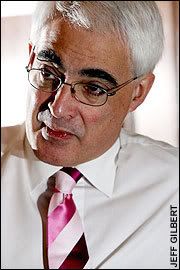
Photo of Alistair Darling courtesy of The Telegraph

THE TELEGRAPH: The Chancellor today criticises the culture of rewarding failure in the City by giving bonuses to executives who appear to have done little to deserve them.

In an interview with The Daily Telegraph, Alistair Darling says that as the country heads into an economic downturn, company boards must be able to justify large bonuses. They should apply the "next-door neighbour test" of whether the payouts would be regarded as reasonable and responsible in a climate when millions of households are struggling with rising living costs, he says.

"People get fed up if they see others getting great big bonuses and they can't actually see what they did. It can be extremely frustrating," Mr Darling says.

"Boards need to ask themselves, 'Are we behaving reasonably?'… If you're leaning over the fence talking to your next-door neighbour, can you justify what you've done?"

City bankers made an estimated £7 billion in bonuses last year. The bumper bonus round was one of the largest ever for investment bankers, despite the global economic turmoil and significant falls in the value of shares on stock markets around the world. Alastair Darling Attacks Bonuses for City Failure >>> By Rachel Sylvester

Mark Alexander (Paperback)
Mark Alexander (Hardback)

February 15, 2008

Secret Papers Reveal Threats from Prince Bandar If British Government Refused to Drop Inquiry into Corruption at BAE

Photobucket
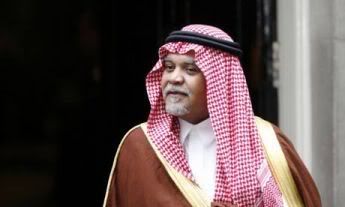
Photo of Prince Bandar, head of Saudi Arabia’s national security, courtesy of The Guardian

THE GUARDIAN: Saudi Arabia's rulers threatened to make it easier for terrorists to attack London unless corruption investigations into their arms deals were halted, according to court documents revealed yesterday.

Previously secret files describe how investigators were told they faced "another 7/7" and the loss of "British lives on British streets" if they pressed on with their inquiries and the Saudis carried out their threat to cut off intelligence.

Prince Bandar, the head of the Saudi national security council, and son of the crown prince, was alleged in court to be the man behind the threats to hold back information about suicide bombers and terrorists. He faces accusations that he himself took more than £1bn in secret payments from the arms company BAE.

He was accused in yesterday's high court hearings of flying to London in December 2006 and uttering threats which made the prime minister, Tony Blair, force an end to the Serious Fraud Office investigation into bribery allegations involving Bandar and his family.

The threats halted the fraud inquiry, but triggered an international outcry, with allegations that Britain had broken international anti-bribery treaties.

Lord Justice Moses, hearing the civil case with Mr Justice Sullivan, said the government appeared to have "rolled over" after the threats. He said one possible view was that it was "just as if a gun had been held to the head" of the government.

The SFO investigation began in 2004, when Robert Wardle, its director, studied evidence unearthed by the Guardian. This revealed that massive secret payments were going from BAE to Saudi Arabian princes, to promote arms deals.

Yesterday, anti-corruption campaigners began a legal action to overturn the decision to halt the case. They want the original investigation restarted, arguing the government had caved into blackmail. BAE: secret papers reveal threats from Saudi prince - Spectre of 'another 7/7' led Tony Blair to block bribes inquiry, high court told >>> By David Leigh and Rob Evans

LISTEN TO GUARDIAN AUDIO:
'It was remarkable the way the government had just rolled over': Two pressure groups are appealing against the decision to drop an investigation into BAE's dealings with Saudi Arabia

THE GUARDIAN:
A cover-up laid bare: court hears how SFO inquiry was halted: Papers show how arms giant tried to avoid revealing secrets; Saudi threats meant 'no other choice' but to stop investigation

THE GUARDIAN:
Full Coverage: The BAE Files

DAILY MAIL:
Blair accused of forcing BAE fraud probe to fold by applying 'irresistible pressure

THE INDEPENDENT:
Blair used 'irresistible pressure' to halt investigation into BAE-Saudi arms deal By Robert Verkaik, Law Editor

Mark Alexander (Paperback)
Mark Alexander (Hardback)

February 13, 2008

Bank Warns of Sharp Slowdown in UK Economy

DAILY EXPRESS: THE Bank of England issued a dire warning about the state of the UK economy today, claiming that interest cuts may need to be cut further as growth slows and inflation soars.

Bank Governor Mervyn King warned that UK growth is expected to be less than two per cent by the end of the year, a sharp fall from the current rate of three per cent.


He also said interest rates may have to be cut further to prevent the economy falling into recession. Bank Warns of Sharp Slowdown in UK Economy >>> By Nicola McCafferty

Mark Alexander (Paperback)
Mark Alexander (Hardback)

February 12, 2008

US Pushes EU to Shut Down Iranian Banks

FINANCIAL TIMES: The US is pushing the European Union to increase the pressure on Tehran over its nuclear programme by stopping two Iranian banks from operating on European soil.

The plan to take steps against Banks Saderat and Melli – a move also backed by Paris and London – would build on a United Nations Security Council resolution that the US and the EU hope to push through this month.

So far, Germany, Italy and other European states have resisted taking EU action to ban Saderat and Melli – which Washington alleges are involved in terrorist financing and proliferation activities – because neither bank has yet been the subject of UN action.

The lack of an EU ban has left the UK, the US’s closest ally, unable to prevent a branch of Saderat from operating in the City of London – a fact which blunts the effectiveness of the US’s drive for international action against the banks. US pushes EU to shut down Iranian banks >>> By Daniel Dombey in Washington, Roula Khalaf and James Blitz in London

Mark Alexander (Paperback)
Mark Alexander (Hardback)

February 07, 2008

Warren Buffet Blames Banks for Meltdown

Photobucket
Photo of Warren Buffett courtesy of Google Images

BUSINESS TELEGRAPH: Billionaire Warren Buffett has accused major investment banks of creating their own downfalls through the collapse in the US sub-prime mortgage market.

Mr Buffett, known as the "Sage of Omaha" for his investment record, suggested that the banking fraternity has only itself to blame for its recent problems which have seen banks write off more than $130bn (£66.3bn) so far.

"It's sort of a little poetic justice, in that the people that brewed this toxic Kool-Aid found themselves drinking a lot of it in the end," Mr Buffett said, making reference to the American soft drink.

The septuagenarian investor, speaking in Toronto, said that in spite of the meltdown in the sub-prime mortgage market and the impact on the banking system, funds remain available.

"I wouldn't quite call it a credit crunch," he said. "Money is available, and it's really quite cheap because of the lowering of rates that has taken place."

However, he said what had taken place was "a re-pricing of risk," leading to an "unavailability of what I might call 'dumb money', of which there was plenty around a year ago."

Mr Buffett also reiterated his negative views on the subject of the US dollar, saying that over the next five-10 years, the dollar could seriously devalue if the US trade deficit persists. As a result, Mr Buffett - who famously bet $21.8bn against the dollar in 2005, a position he has since unwound - stressed he will continue to look beyond the US for investments in part to hedge against the dollar's weakness. Warren Buffett blames banks for meltdown >>> By James Quinn Wall Street Correspondent

Mark Alexander (Paperback)
Mark Alexander (Hardback)

February 06, 2008

George & Gordon and Free Trade

THE TELEGRAPH: Gordon Brown and George W. Bush have one thing in common. No, not their brand of toothpaste, nor a fondness for jeans and casual jackets. Nor a willingness to see the Iraq war through to victory. Nor a belief that tax cuts can stimulate economic growth.

What they have in common is a belief that their nations and the world are served by the preservation of the free trading regime that has contributed so much to economic welfare in the post-World War Two period.

Both have a relaxed attitude towards the free movement of people, and are therefore reluctant to prevent immigrants from joining their nations' workforces.

Both resist efforts to raise barriers to the free flow of goods into their countries, with an occasional politically necessitated lapse on Bush's part. And both favour the free flow of capital and welcome the investment of sovereign wealth funds in their nations' financial and other institutions.

The British Prime Minister and the American President might be the last two men standing in the fight against protectionism. Unless you count Tony Blair and John McCain, which you probably shouldn't, since Blair is otherwise engaged, and McCain has a long way to go before he sits in the Oval Office where he can affect trade policy.

All three pillars of free trade - free movement of people, goods, and capital - are under assault, or soon will be. Gordon Brown and George Bush's free trade >>> By Irwin Stelzer

Mark Alexander (Paperback)
Mark Alexander (Hardback)
Islamic Banking: Is It Really Kosher?

NO SHARIA.BLOGSPOT.COM: Muslim scholars say the Qur’an prohibits collecting interest on loans. But many banks, both global and local, have found clever ways to meet religious strictures. It’s a system that may be hypocritical, but also profitable.

The coverage can be a little bit breathless: “La finance Islamique en plein boom,” Le Figaro reported in September. Yes, Islamic banking, structured along the lines that religion decrees, is in full boom. But is it really banking? And is it really kosher?


Islam prohibits the payment of interest on loans, so observant Muslims require specialized alternative arrangements from their banks. Many of the largest global financial companies, including Deutsche Bank and JPMorgan Chase, have established thriving subsidiaries that strive to meet these requirements. As a result, optimists speculate that the common pursuit of lucre—divinely sanctioned, filthy, or otherwise—will bring bickering civilizations together. They may be right.


The Islamic aversion to interest collection comes from the Qur’an. Not that the term “interest” is ever used: the Arabic injunction forbids something called riba. The Qur’an offers no exact definition of what riba meant in seventh-century Arabia, the time and place of the Prophet Mohammed—let alone what the term should mean today. In particular, the passages are ambiguous on the question of whether riba refers to all kinds of interest collection, or only usurious interest—that is, lending practices that are, according to some ill-defined standard, unfair and exploitative. What is clear in the divine financial critique is that, whatever riba may be, Jews are doing it. At one point God warns that they will face a “painful day of doom” if they keep it up.


This ambiguity was a practical problem for the early Muslim jurists, who formalized religious rules in a code called sharia. They were divided on the subject, but as time went on, the weight of consensus came to rest on the side of prohibiting all interest collection. Islamic Banking: Is It Really Kosher? >>> By Aaron MacClean, The American

Mark Alexander (Paperback)
Mark Alexander (Hardback)

February 04, 2008

Le retour des deux “nations” britanniques: la riche et la pauvre

LE MONDE: Dans son roman Sybil, Benjamin Disraeli, premier ministre de la reine Victoria, avait condamné la coupure du royaume en "deux nations entre lesquelles il n'y a ni relation ni sympathie... les riches et les pauvres". Ce thème, récurrent sous le gouvernement Thatcher (1979-1990), est redevenu d'actualité.

"En trente-cinq années de métier dans la distribution, je n'ai jamais vu de disparités aussi grandes : à Londres et dans le Sud, les nantis s'enrichissent, dans le reste du pays, les gens s'appauvrissent. Je ne reconnais plus le Royaume-Uni" : directeur général des grands magasins Marks & Spencer, Stuart Rose a repris à son compte la remarque de Disraeli. Malgré la baisse du nombre de touristes américains et japonais ou le ralentissement économique, lors des fêtes de fin d'année, les ventes de M & S ont explosé à Londres et dans les comtés voisins. En revanche, le chiffre d'affaires de l'enseigne dans le nord de l'Angleterre et en Ecosse a fortement diminué.

Lacunes du système éducatif

Dans la foulée, un rapport de l'institut des études fiscales, Institute for Fiscal Studies, confirme le fossé grandissant entre les riches et le reste de la population depuis l'arrivée au pouvoir du Labour, en 1997. Les 47 000 contribuables gagnant plus de 350 000 livres brut par an vivent dans leur quasi-totalité à Londres.

A l'évidence, cet écart régional est fécondé par le formidable essor des services, en particulier financiers, dans la capitale britannique. A l'exception des multinationales, pharmacie, défense, aéronautique etc., l'industrie britannique installée dans le vieux Pays noir, a souffert des délocalisations et de la concurrence étrangère, sans parler de la fermeté jusqu'il y a peu de la livre sterling.

Le Nord est pénalisé par une infrastructure de transports inférieure et les lacunes du système éducatif d'Etat. Tandis que les rémunérations s'envolent dans le tertiaire, les ouvriers et employés voient leurs revenus amputés par la hausse de la fiscalité indirecte et l'inflation. Cette situation contrastée est aussi patente dans les régions rurales du Sud-Ouest. Le retour des deux "nations" britanniques : la riche et la pauvre >>>

Mark Alexander (Paperback)
Mark Alexander (Hardback)
Russian Economy Succumbs to the Oil Curse

THE TELEGRAPH: Moscow is the most expensive city in the world, like Tokyo before the Nikkei bubble burst. A taxi from Domodedovo airport to the Kremlin costs $170 (£86). Property in Ostozhenka trumps Chelsea. Space fetches $30,000 a square metre.

Nice Tsarist flats fetch $3m to $4m. Even Bolshevik boxes are booming. Moscow boasts 150,000 home millionaires in dollars, says Sergei Polonsky, the Mirax Group tycoon. In a good year, prices double.

This is the curse of commodity wealth, the "Dutch Disease" that eats at the competitive foundations of an economy and incubates a parasite culture. No doubt Russia's scientists, engineers, and cyber talent, will enrich the country, but first it must overcome the toxic effects of oil at $90 a barrel.

"We can no longer afford to buy Russian equipment," said Yevgeny Ivanov, head of Polyus Gold.

"The prices here are one and a half times higher than abroad so we're having to break our rigid rule and turn to foreign-made machinery. It is bad news for Russian firms. The commodity super-cycle is catching up with us through higher prices. It is a disheartening picture," he said.

"There's no infrastructure, no power, no roads. Electricity costs twice what they pay in Alaska and Canada. We face a Soviet bureaucracy passing decrees that make you weep," he said.

The government has declared an infrastructure emergency. Russia has hit the limits of durable growth on today's rickety foundations.China has built 25,000 miles of highways since 1988, Russia a few hundred. Russian economy succumbs to the oil curse >>> By Ambrose Evans-Pritchard International Business Editor

Mark Alexander (Paperback)
Mark Alexander (Hardback)

February 01, 2008

Microsoft will Yahoo kaufen

NZZ Online: Der amerikanische Softwarekonzern Microsoft will das Online-Unternehmen Yahoo für 44,6 Milliarden Dollar übernehmen. Microsoft will damit seine Position im hart umkämpften Markt von Onlinediensten ausbauen. Die Ankündigung hat den Börsen Schwung verliehen.

(ap/sda/Reuters) Der weltgrösste Softwarekonzern Microsoft will das schwächelnde Online-Unternehmen Yahoo für 44,6 Milliarden Dollar übernehmen. Microsoft will damit seine Position im hart umkämpften Markt der Internet-Werbung ausbauen. Microsoft bietet nach eigenen Angaben von Freitag 31 Dollar pro Yahoo-Aktie, was einen Aufschlag von 62% auf den Schlusskurs vom Donnerstag bedeutet.

Yahoo gilt seit geraumer Zeit als Übernahmekandidat. Das Onlineunternehmen war zwar bald nach der Gründung durch Jerry Yang und seinen Kommilitonen David Filo im Jahr 1995 die Nummer eins im Internet. Inzwischen aber ist Yahoo bei den Werbeeinnahmen längst von Google überholt. Google nimmt in zwei Monaten so viel Geld ein wie Yahoo in einem ganzen Jahr. Microsoft will Yahoo kaufen: Softwarekonzern offeriert knapp 45 Milliarden Dollar >>>

Mark Alexander (Paperback)
Mark Alexander (Hardback)